Hack a webcam and a film camera into a USB microscope

posted Dec 8th 2011 11:18am by
filed under: classic hacks, digital cameras hacks

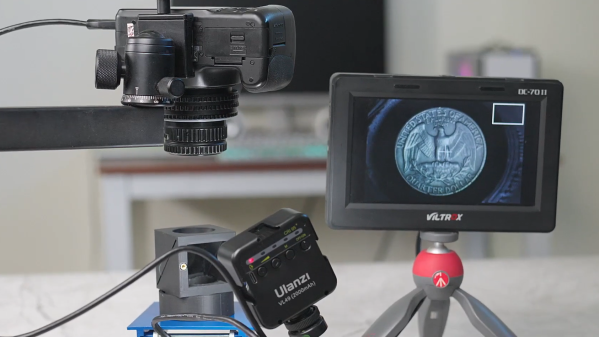
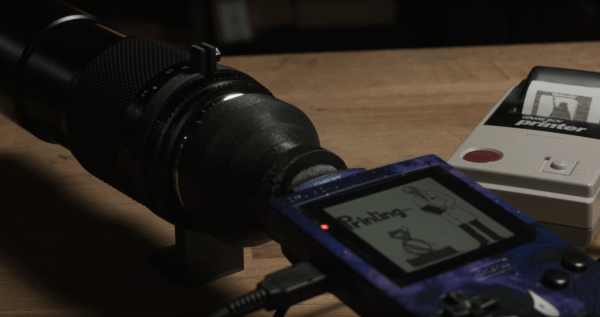
Most of you probably have a webcam sitting around somewhere, and after all the high voltage projects you’ve done using disposable cameras, we bet you have some camera lenses too. You could always do what [Butch] did and combine the lens from the camera with the webcam to do some up close inspection.

This seems like something we’ve seen several times, but we can’t find it in our archive. Such a simple and quick hack looks surprisingly effective in his shots. If you want to see the details, like where he tied into the webcam’s board to power an external LED, you’ll have to download the PDF.

Hackaday Links: December 7, 2011

posted Dec 7th 2011 8:01am by
filed under: Hackaday links

LED Neurons

[Alexandra Olivier] put up an art installation at Wellesley College that looks like a bunch of neurons built out of LEDs. The neurons are connected to a couple PIR sensors and ‘fire’ whenever movement is detected. The result is a lot like being inside a brain. Fitting, then, that the installation is called Social Synapses.

Last year’s big toy was always evil, though

Last year, [Andrew] had to fight the throngs of shoppers to get the must have toy of the season, a Zhu Zhu pet. Since these robotic hamster things have spent the last 11 months in the back of a closet, it seems reasonable to make them evil. They’re still not as evil as a demonic Furby….

So we call it a bifocal, right?

There’s an old photography trick for a really hacky macro setup – just turn the lens around. Well, what if you wanted automatic metering and flash control? Simple, just electrically reverse the lens. Bonus points for being able to use the lens regularly as well.

Control all the bands

Well here’s something cool: an all-in-one USB 315mhz, 433mhz, and 868mhz transceiver. What can you do with it? Well, [codeninja] can control the outdoor lights for two of his neighbors, open gates and doors, crash his weather station, and just about anything else in those bands. It’s pretty much like war driving for important stuff nobody cares about.

So this is our favorite holiday now

There’s a Dutch tradition to play Sinterklaas and make someone a present. [Jenor] decided to build an antique-looking DC voltmeter with a pair of vacuum tubes. The tubes don’t work anymore, but the heaters still provide a nice warm glow. It’s a bit large to be regularly used as a piece of test equipment, but it really does look awesome. Very steampunkey, and it’s the though that counts anyway.


Macro lens and image stacking

posted Apr 2nd 2011 2:24pm by
filed under: digital cameras hacks

[Samuel Sargent] built his own lens for making stacked macro images.This project, which was completed as part of his senior thesis, utilizes a Zeiss enlarger lens. The aperture ring was broken, making it difficult to tell how much light was being let into the camera. Instead of scrapping the whole thing he turned it around, making it a macro lens when combined with a few other parts. He’s used a Nikon PB-5 belows, a PK-13 extension tube, and a body cap to provide a way to mount the lens to his camera. A hole was added to the body cap using his Dremel, and a liberal dose of epoxy putty seals all of the gaps.

After the break you can see a couple of photos that [Samuel] made of bismuth. He estimates the sharpest focal length by taking a few test shots. Next he captures a series of images, moving the bellows slightly between each shot. Finally, this set is combined using Helicon Focus image stacking software. Maybe for his graduate thesis he can build a mechanized platform to move the subject automatically.

Read the rest of this entry »

Stackable macro photography rig

posted Feb 19th 2011 6:35am by
filed under: digital cameras hacks

When taking macro photographs you lose a lot of clarity due to a reduced depth of field. One way to get sharp pictures is to take multiple shots at slightly different distances from the subject and then stack them into one image. There’s software to do this for you, but you still need a set pictures to start with. [Dsvilko] built this setup to easily capture a set of macro images.

He’s using the internals from an optical drive as a sled to carry the subject. A PICAXE drives the stepper motor that moves the carriage, which takes input from an IR remote control. This turns out to be a fantastic method as the sled can move in 0.2mm increments. After he’s got his set of images he uses Zerene to stack them together.

Bonus points to [Dsvilko] who used Linux command line tools to edit together the demonstration video embedded after the break.

Read the rest of this entry »

Macro photos using an under-light rig

posted Dec 21st 2010 9:00am by
filed under: digital cameras hacks

[Aki Korhonen] wanted to tighten up his macro photography setup. He already had the camera for the job, but wanted a fully adjustable target platform that he could easily light. What he came up with is a jig to hold the camera and fine tune the subject of each photo. It uses a frame with a piece of glass whose distance from the lens is adjusted by turning a knob. Below the glass a reflective surface redirects light from an LED flashlight up through the platform, lighting the snowflakes he’s shooting. A fixed LED source is in the plans for the next rendition.

Take a look at the overview of his setup in the quick clip after the break.

Read the rest of this entry »


Retro adapter for Canon SLR

posted Nov 20th 2010 9:00am by
filed under: classic hacks, digital cameras hacks

[calculon] was able to modify a “dumb” adapter to allow his Canon SLR to use the aperture and focus on a retro lens.  With his new flip mounted wide angle lens he was able to achieve some pretty neat macro shots.  By cutting away some of the cheaper ring he was able to feed the wire through and glue it onto the the cameras contact points.  The wire was then attached to the inputs on the “new” lens. With a new adapter running about $375 not only was this a neat little hack but it was also a money saver. You can see some more of his photos on his flicker

Macro lens for a Nexus One

posted Sep 11th 2010 12:07pm by
filed under: cellphones hacks

[Thomas] tipped us off about a macro lens attachment for his Nexus One. As you’d expect, adding the lens helps the phone’s camera bring tiny details into focus. He re-purposed a lens from a pair of mini binoculars, using epoxy putty to make a mounting bracket. Now the last time we saw this putty used with a phone it was for a snap-in bracket that cradled the phone and included a lens adapter. Rather than go that route [Thomas] made use of the headphone jack just above the camera lens. An old headphone plug has been epoxied to the macro lens ring, holding it in place securely while remaining easily removable.

Using quality optics with a webcam

posted Sep 1st 2010 11:05am by
filed under: digital cameras hacks

[Devon Croy] built a case to join a webcam sensor with a camera lens. The box is a PVC conduit box you’d find at a home center. He used JB Weld to attach four bolts to the back of the box. These are used to fine-tune the mounting plate for the webcam sensor to ensure it’s at the focal point of the lens. The lens connects through a couple of extension tubes to an adapter mounted in the center of the box’s cover plate. The setup above shows a macro lens that takes pretty good pictures.

If you need images of really tiny things you should look into a microscope adapter for your camera.


Hack a Day serves up fresh hacks each day, every day from around the web as well as hacking related news.

Send us your hacks


Hacks

Resources