Arduino notebook cover makes it easy to tinker anywhere

posted Dec 21st 2011 4:59pm by
filed under: arduino hacks

arduino-notebook-cover

[Erv] was putting his holiday shopping list together and decided that instead of buying his friends something from the store, he would give them something a bit more useful. A former Electrical Engineer by trade, [Erv] typically prefers PIC microcontrollers, but he says that Arduinos are just so convenient to use for prototyping that he likes to always have one on hand.

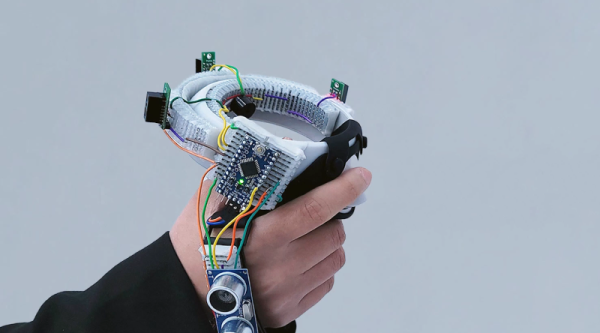
He figured that his friends might enjoy having easy access to an Arduino as well, so he made them some slick ZapBook covers which enable them to have a prototyping platform on hand at all times. The cover is made from a PCB and includes a socket for an Arduino Pro Mini, along with a handful of built-in LEDs. He has extended a few other I/O pins from the Arduino as well, but he says that the small solder bridges connecting the LEDs can be removed in a pinch, freeing up 8 additional pins with ease. We are pretty keen on the idea of an easily portable prototyping setup, though it doesn’t hurt that [Erv] incorporated a Hack a Day skull with light up eyes into his design either!

We’re not sure if he’s planning on releasing the schematics for the board, but the notebooks would be pretty useful for any hackerspaces hosting beginner Arduino programming classes.

DIY breadboard modules for easy prototyping

posted Sep 27th 2011 9:01am by
filed under: tool hacks

[Rajendra] got tired of building the same basic circuits time and again on the breadboard. He decided to build some simple, modular circuits on protoboard and make them easy to interface with the breadboard. As you can see, he ended up with seven modules that make prototyping faster and easier.

At first glance some might not seem all that beneficial. For instance, making a board for an 18-pin PIC microcontroller into a single-in-line form factor would seem like you’re actually wasting breadboard space when compared to the DIL package of the chip. But consider that the oscillator and its capacitors, reset button, and programming header are also on the breakout board and will not have to be built in place. There are also several I/O boards, one with five buttons, another with an LED bar graph, and a set of LEDs with a SIL resistor package on-board. These modules can be plugged into a breadboard and wired up with jumper wires, or connected directly to the same rows as the microcontroller module.


Propeller proto board has you flying in no time

posted Mar 29th 2011 9:57am by
filed under: tool hacks

propeller_proto_board

[Parker] was in need of a Propeller development board to make working on his projects easier. More often than not, when he needed to prototype something, he would pull the only one he had on hand from his home made pinball machine, and replace it when finished. This was time consuming and cumbersome, so he decided he needed a better way of doing things.

He looked into purchasing a Gadget Gangster proto board which allows you to use a Propeller much like an Arduino, complete with support for shields and the like. Unfortunately, they were sold out and he was in a hurry to finish up a project. Rather than wait, he decided to build his own proto board, which would be more flexible than the COTS version – allowing him to add things like an Analog to Digital converter without having to use a shield.

He looked around online and found some schematics to follow, and had his proto board constructed in no time. It gets the job done and looks quite clean, considering it was put together using perf board.

Keep reading to see a video walkthrough of the Propeller development board construction.

Read the rest of this entry »

USB man-in-the-middle adapter

posted Mar 16th 2011 9:01am by
filed under: tool hacks

The module works as a pass through, providing access to data and power lines for a USB device. [BadWolf] built it in order to sniff out communications between peripherals and the Universal Serial Bus. For now it just provides access to the different signals, but we think there’s quite a bit of usefulness in that. First off, the power rail is mapped out to a jumper, making it dead simple to monitor the voltage stability or patch in a multimeter to get feedback on current consumption. But you can also see in the foreground that a pin socket makes it easy to tap into the board using jumper wires. We think it would be a great breadboard adapter for USB work that would continue being useful after you’ve populated your first PCB for the prototype.

[BadWolf] has other plans in store for it though. He wants to intercept and decipher the communications happening on the data lines. In the video after the break he mentions the possibility of using a Bus Pirate for this (we have our doubts about that) but plans to start his testing with an STM32 discovery kit. We can’t wait to see what he comes up with.

Extremely organized prototyping

posted Jul 25th 2010 8:35am by
filed under: tool hacks

We’ve got a couple of very high-tech shoe boxes in which we store our prototyping accessories. You’ll find a collection of LCD modules, chips on breakout boards, switches soldered to homemade boards for easy breadboarding, and much more. That is assuming you can find anything in that mess of components.

[Shahriar] took a different approach. He’s mounted all of his prototyping gear inside of a briefcase. This large collection of high-end boards include PIC prototyping, various LCD screens, and a large portion of SparkFun’s stocked boards. It’s much more advanced than the Arduino to-go platform, and you can see a full walk through of the system after the break.

Read the rest of this entry »


Review: mbed NXP LPC1768 microcontroller

posted Nov 21st 2009 8:19am by
filed under: reviews

mbed is a next-generation 32-bit microcontroller platform. It’s a prototyping and teaching tool somewhat along the lines of Arduino. On steroids. With claws and fangs. Other contenders in this class include the MAKE Controller, STM32 Primer and Primer 2, Freescale Tower, and Microchip’s PIC32 Starter Kit. The mbed hardware has a number of advantages (and a few disadvantages) compared to these other platforms, but what really sets it apart is the development environment: the entire system — editor, compiler, libraries and reference materials — are completely web-based. There is no software to install or maintain on the host system.
Read the rest of this entry »

Arduino shield with offset headers

posted Jul 16th 2009 3:52pm by
filed under: arduino hacks, news, tool hacks

arduinoshield

Here’s another adafruit product launched today: a prototyping shield that compensates for the Arduino’s stupid oddly spaced headers.

Related: The Seeeduino has an alternate row of headers with protoboard friendly spacing.

Hack a Day serves up fresh hacks each day, every day from around the web as well as hacking related news.

Send us your hacks


Hacks

Resources