Aquarium Automation Keeps The Fish Fed And The Lights On

fish-tank-automator

Anyone who owns a fish tank knows that a good amount of care is required to keep fish happy, healthy, and most of all – alive. [Vicente Jiménez] usually has no problem keeping up on the day to day maintenance such as feeding and switching the tank light, but he wanted to automate these processes for times when he can’t be home to take care of the fish (Translation).

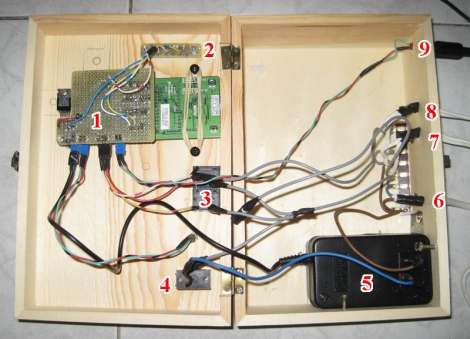
His aquarium automation project is meant to cover three separate parts of the operation: light control, feeding, and pump regulation during feeding times. [Vincente] picked up an STM8L Discovery board to control his system, which enabled him to easily control the automation of all three.

He constructed the feeding mechanism using an old cassette player motor, which turns his food drum (an old film canister), twice a day at specified feeding times. Before the drum is turned to dispense food, the STM8L turns off the aquarium’s pump via a relay to ensure it doesn’t get clogged in the process. During the day he keeps the tank illuminated, but once night falls, the microcontroller shuts the lights off so the fish can get their rest.

There’s no video of the system in action, but [Vincente] has detailed its construction pretty thoroughly in his blog, so be sure to check it out if you are in need of something similar.
IR Helicopter Controller Hacked Into A Linux Game Pad

syma-linux-joystick

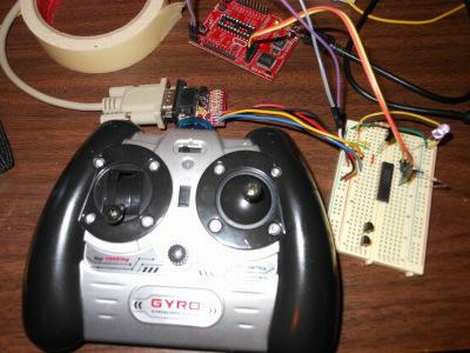
[Mike Kohn’s] Syma S107 helicopter wasn’t flying as well as it used to due to a broken gear, he figured he might as well find some use for the toy’s controller, since it was currently sitting around collecting dust. Having done a bunch of work with Syma IR protocols earlier this year, he decided it would be pretty easy to get the remote working as a game pad for his Linux desktop.

He patched an IR receiver into an MSP430 board, which decodes the incoming IR signals, sending them to his computer over a serial connection. [Mike] dug around in the Linux source for some good joystick driver code to borrow and found something that was close enough to work. After a bit of tweaking he loaded up his driver module and fired up Mame to give [Ms. Pacman] a try.

He says that the controller worked without much trouble, though as he discovered in previous projects, there are some quirks in the controller that make it somewhat less than convenient to use full time. Check out his site if you’re interested in taking a look at the code that he used to get things running.

An ITunes Rating Box For Everyone

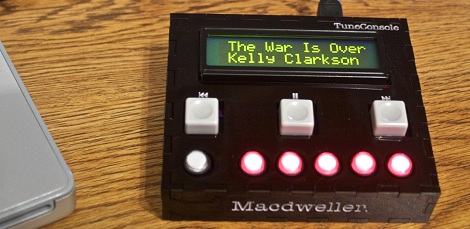
If you’ve ever scoffed at the idea of opening up iTunes every four minutes to rate a song, [Steve] is the guy to talk to. He built a small hardware box with five illuminated buttons to rate the current song playing on iTunes.

This build comes after [Steve]’s earlier Arduino-based rating box that was functional, but didn’t have the level of polish he desired. To get to the current iteration, [Steve] designed a custom board around a PIC18F microcontroller programmed as a USB HID device. After a great deal of frustration soldering teeny SMD components, [Steve] had a functioning USB five-star iTunes rating box. With a custom acrylic case the build was finally completed.

We’re very impressed with the finished version of [Steve]’s TuneConsole, as he calls it. We can certainly imagine other people wanting a similar device. Whether that comes from releasing the schematics and boards or selling PCBs on Seeed Studio is something we’re eager to find out.

Racing With Dyson’s Spare Parts

When it comes time to unwind at the Dyson design facility these engineers know how to do it right. Recently, the company challenged their engineers to a grown-up version of the Pinewood Derby in which they raced their own cars powered by a Dyson motor.

The video after the breaks shows a large collection of these time trials on a track made from upturned wooden pallets. Most of the vehicles are made from parts which we don’t recognize. But some of them are very familiar like our favorite hand dryer ever (seen above) and the iconic goldenrod manifold from the Dyson ball vacuum cleaner.

The course ends abruptly, as you can see in the last run of the video. There is one entry that included a human rider and he seems to be going nearly as fast as the riderless carriages are. The video cuts away before he hits the wall, but we can’t image he had the time to include brakes in that design.

Continue reading “Racing With Dyson’s Spare Parts”

Those USB TV Tuners Used For SDR Can Also Grab GPS Data

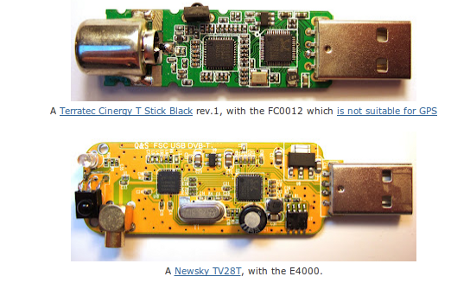
Talk about versatile hardware. These inexpensive TV tuner dongles can also grab GPS data. You may remember seeing this same hardware used as a $20 option for software defined radio. But [Michele Bavaro] decided to see what other tricks they could pull off.

Would it surprise you that he can get location data accurate to about 20 centimeters? That figure doesn’t tell the whole story, as readings were taken while the dongle was stationary for three hours, then averaged to achieve that type of accuracy. But depending on what you need the data for this might not be a problem. And [Michele] does plan to implement real-time GPS data in his next iteration of the project. He plans to use an SDR acquisition algorithm to measure doppler shift in accounting for the slow clock speed of the dongles compared to standard GPS receivers. We can understand how that would work, but we’re glad he has the skills to actually make it happen because we’re at a loss on how the concept could be implemented.

[via Reddit]

Stair Accent Lights Made From Cheap LED Strips

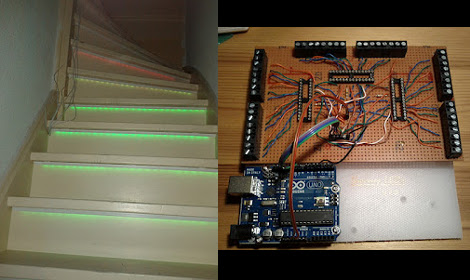
We really like [Geert’s] take on accent lighting for his stairs. He built his own LED channels which mount under the bullnose of each step. The LED strips that he used are actually quite inexpensive. They are RGB versions, but the pixels are not individually addressable. This means that instead of having drivers integrated into the strip (usually those use SPI for color data) this strip just has a power rail and three ground rails for the colors. Ten meters of the strip cost him under forty dollars.

He did want to be able to address each step separately, as well as mix and match colors, so he designed the driver board seen above to use a set of TLC5940 LED drivers. These are controlled by the Arduino which handles color changing and animations. It will eventually include sensors to affect the LEDs as you walk up the stairs. Each strip is mounted in a piece of angle bracket, and they’re connected back to the driver board using telephone extension wire.

Free Formed Circuit Protected By A Brick Of Crystal Clear Resin

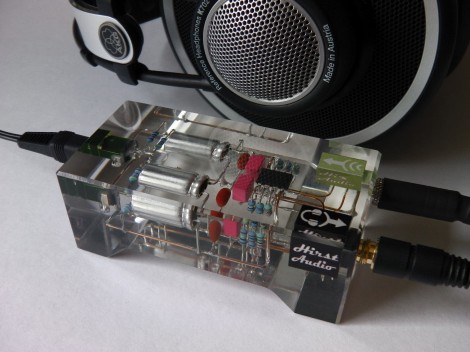
The look of this crystal clear resin brick is pretty amazing. [Rupert Hirst] decided to encase his amplifier circuit in a block of polyester resin. We just hope he got everything in his circuit right because there’s no way to replace any of those parts now!

He deserves a lot of credit for working out a visually pleasing way to mount each component. There wasn’t any type of substrate used, but a few lower gauge wires were picked as the rails and they add some mounting stability. Before casting, he took the case of each of the three jacks apart and sealed the seams with some of the casting resin to prevent the final pour from filling them up.

Eagle CAD was used to design the mold. He printed it out on some card stock, then used a hobby knife to cut the pieces out and super glue to assemble them. A second layer of super glue was run on each seam to ensure they’re water tight. After the casting was made [Rupert] spent plenty of time sanding, routing, and polishing the brick to achieve this look.

This makes us wonder about heat dissipation. Do you think it will be a problem? Tells us what your opinion by leaving a comment.