Circuit Design? Spread The Joy

Accountants and MBAs use spreadsheets to play “what if” scenarios with business and financial data. Can you do the same thing with electronic circuits? The answer–perhaps not surprisingly–is yes.

Consider this simple common emitter amplifier (I modeled it in PartSim, if you’d like to open it):
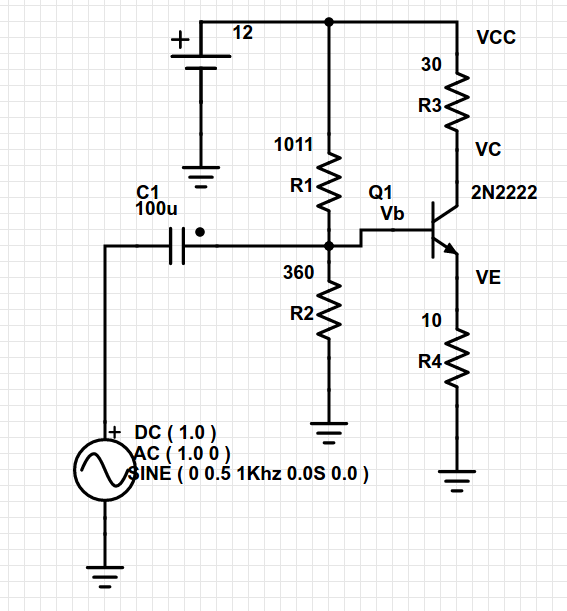
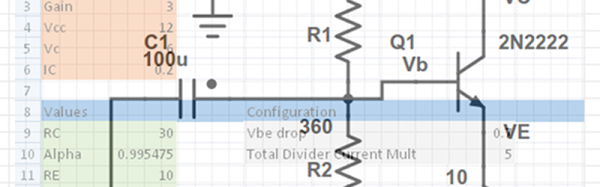
In this particular case, there are several key design parameters. The beta of the transistor (current gain) is 220. The amplifier has an overall voltage gain of about 3 (30/10). I say about, because unless the transistor is ideal, it won’t be quite that. The supply voltage (Vcc) is 12 volts and I wanted the collector voltage (VC) to idle at 6V to allow the maximum possible positive and negative swing. I wanted the collector current (IC) to be 200mA.

Continue reading “Circuit Design? Spread The Joy”

Big Brother And Others Are Watching Your Car

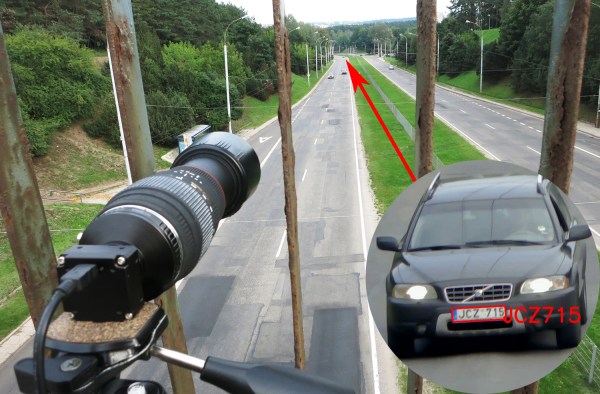
We are all (hopefully) aware that we can be watched while we’re online. Our clicks are all trackable to some extent, whether it’s our country’s government or an advertiser. What isn’t as obvious, though, is that it’s just as easy to track our movements in real life. [Saulius] was able to prove this concept by using optical character recognition to track the license plate numbers of passing cars half a kilometer away.

To achieve such long distances (and still have clear and reliable data to work with) [Saulius] paired a 70-300 mm telephoto lens with a compact USB camera. All of the gear was set up on an overpass and the camera was aimed at cars coming around a corner of a highway. As soon as the cars enter the frame, the USB camera feeds the information to a laptop running openALPR which is able to process and record license plate data.

The build is pretty impressive, but [Saulius] notes that it isn’t the ideal setup for processing a large amount of information at once because of the demands made on the laptop. With this equipment, monitoring a parking lot would be a more feasible situation. Still, with even this level of capability available to anyone with the cash, imagine what someone could do with the resources of a national government. They might even have long distance laser night vision!

Working For Elon Musk

One of my favorite types of science fiction character is found in the books of Ben Bova; a business mogul who through brilliance, hard work, and the force of personality drives mankind to a whole new level in areas such as commercializing space, colonizing the stars, battling governments, and thwarting competitors.

It is possible to name a few such characters in real life — influencing the electricity industry was George Westinghouse, automobiles was Henry Ford, and more recently Steve Jobs and Elon Musk. With Elon’s drive we may all finally be driving electric cars within 20 years and spreading out into space with his cheap rockets. Due to the latter he may be the closest yet to one of Bova’s characters.

So what’s it like to work for Elon Musk at Tesla or SpaceX? Most of us have read articles about him, and much that he’s written himself, as well as watched some of his many interviews and talks. But to get some idea of what it’s like to work for him I greatly enjoyed the insight from Ashlee Vance’s biography Elon Musk – Tesla, SpaceX, and the Quest for a Fantastic Future. To write it Vance had many interviews with Musk as well as those who work with him or have in the past. Through this we get a fascinating look at a contemporary mogul of engineering.

Continue reading “Working For Elon Musk”

Build A Tiny (Unstable) Bugging Device

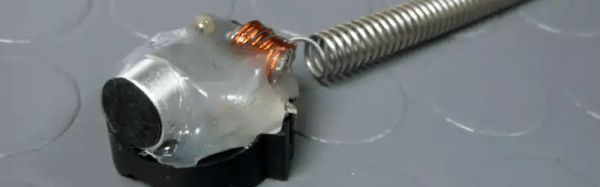
We don’t know who the [amgworkshop] wanted to listen in on, but they apparently went searching for a small FM wireless transmitter. There’s plenty of circuits around, but they wanted something smaller. The original circuit had a variable capacitor to tune the output frequency. The new design uses a fixed capacitor and a spring for an antenna. You can see the build steps in the video below, but don’t expect a lot of frequency stability or fidelity out of a single transistor transmitter.

The parts list is minimal. In addition to a coin cell holder (which serves as the construction base), you need a transistor, two resistors, three capacitors, a homemade inductor (very easy to make with some wire and a drill bit), and an electret microphone. Of course, you need a battery, too. The whole thing is potted with hot glue.

Continue reading “Build A Tiny (Unstable) Bugging Device”

Amazon Dash Button Finds Your Phone

This scene replays quite often in our house: my wife has misplaced her cell phone so she asks me to call her. But where did I leave my cell phone? And the race is on! Who will find their phone first to call the other?

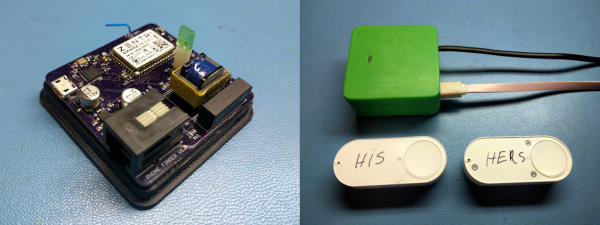
[Zapta] solves this problem with his Phone Finder. The system comes in two parts: a base station with WiFi that’s also connected to the house’s phone line, and an arbitrary number of Amazon Dash buttons that trigger dialing commands.

[Zapta] presses a Dash button, which connects over WiFi to the base station. The base station recognizes the MAC address of the button, looks up and dials the corresponding missing cell phone. This solves the need-a-phone-to-find-a-phone problem very neatly, and since Dash buttons are dirt cheap they can be scattered liberally around the house. They’re clearly marked “his” and “hers” suggesting a similar domestic dynamic.

If we were implementing the base station from scratch, we’d probably try to figure out how a single ESP8266 could do all of the heavy lifting, but browsing through [Zapta]’s GitHub and the included circuit diagram (PDF) demystifies the phone-line interface.

In the early days of cordless phones, we used to joke that a solution to losing them would be to attach a string and tie them to the wall. (Luddites!) We’re glad to see [Zapta] take this project in the opposite direction — using technological overkill to solve the unintended problems that arise from technological progress.

Hackaday Prize Entry: Coffee Machine Grows In Complexity With No Sign Of Stopping

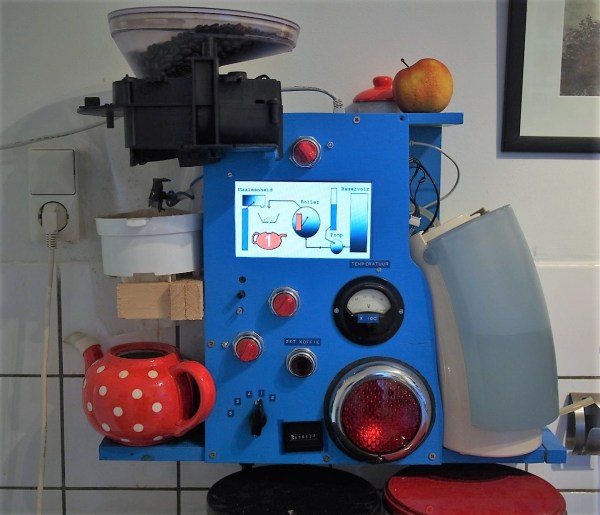
In Star Trek, there is a race of cyborgs with a drive to slowly assimilate all sentient life. Their aesthetic is not far off from the one [Ronald]’s ever expanding coffee machine is taking on. One has to wonder, what dark purpose would bring the Borg into existence? Where did they start? If [Ronald] doesn’t get a satisfying cup of coffee soon, we may find out.

We covered the first iteration of his brewing machine in 2013. We like to imagine that he’s spent many sleepless, heavily caffeinated days and nights since then to arrive at version 2. This version is a mechanical improvement over his original Rube Goldberg contraption. On top of that, it has improved electronics and code, with a color screen reminiscent of industrial control panels.

He’s also working on something called, “AutoBaristaScript(TM),” which attempts to hold the entire universe of pour-over coffee within its clutches. We don’t know when he’ll stop, but when he does finally create that perfect cup, what’s left of the world will breathe easier. They’ll also drink good coffee.


Editor’s Note: The Borg do not necessarily want to assimilate all sentient life as an end unto itself. The Kazon were deemed unworthy of assimilation (VOY: Mortal Coil). The Borg are driven towards perfection, accomplished by adding technological and biological distinctiveness to their own.

Pan And Tilt With Dual Controllers

It wasn’t long ago that faced with a controller project, you might shop for something with just the right features and try to minimize the cost. These days, if you are just doing a one-off, it might be just as easy to throw commodity hardware at it. After all, a Raspberry Pi costs less than a nice meal and it is more powerful than a full PC would have been not long ago.

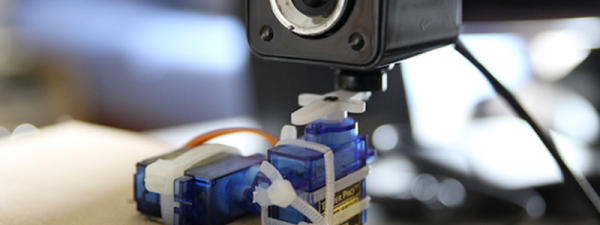
When [Joe Coburn] wanted to make a pan and tilt webcam he didn’t try to find a minimal configuration. He just threw a Raspberry Pi in for interfacing to the Internet and an Arduino in to control two RC servo motors. A zip tie holds the servos together and potentially the web cam, too.

You can see the result in the video below. It is a simple matter to set up the camera with the Pi, send some commands to the Arduino and hook up to the Internet.

Continue reading “Pan And Tilt With Dual Controllers”