OpenSurgery Explores The Possibility Of DIY Surgery Robots

As the many many warnings at the base of the Open Surgery website clearly state, doing your own surgery is a very bad idea. However, trying to build a surgery robot like Da Vinci to see if it can be done cheaply, is a great one.

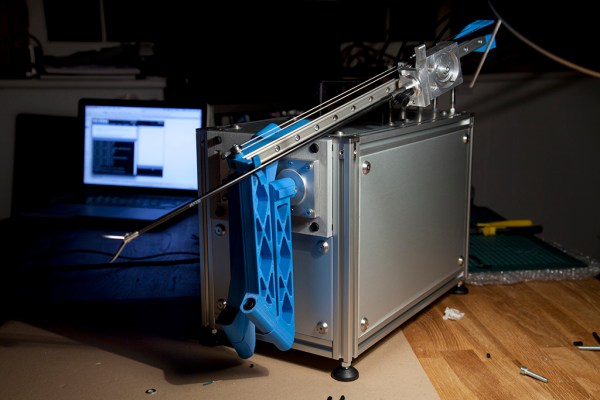
For purely academic reasons, [Frank Kolkman] decided to see if one could build a surgery robot for less than an Arab prince spends on their daily commuter vehicle. The answer is, more-or-less, yes. Now, would anyone want to trust their precious insides to a 3D printed robot with dubious precision?  Definitely not.

The end effectors were easily purchased from a chinese seller. Forty bucks will get you a sterile robotic surgery gripper, scissor, or scalpel in neat sterile packaging. The brain of the robot is basically a 3D printer. An Arduino and a RAMPS board are the most economical way to drive a couple steppers.

The initial version of the robot proves that for around five grand it’s entirely possible to build a surgery robot. Whether or not it’s legal, safe, usable, etc. Those are all questions for another research project.


Ion Trap Makes Programmable Quantum Computer

The Joint Quantum Institute published a recent paper detailing a quantum computer constructed with five qubits formed from trapped ions. The novel architecture allows the computer to accept programs for multiple algorithms.

Quantum computers make use of qubits and trapped ions–ions confined with an electromagnetic field–are one way to create them. In particular, a linear radio frequency trap and laser cooling traps five ytterbium ions with a separation of about 5 microns. To entangle the qubits, the device uses 50 to 100 laser pulses on individual or pairs of ions. The pulse shape determines the actual function performed, which is how the device is programmable. The operations depend on the sequence of laser pulses that activate it. Continue reading “Ion Trap Makes Programmable Quantum Computer”

Alternator Becomes Motor For This Electric Go-kart

Growing up in the 70s and 80s, a go-kart was a quick ticket to coolness, second maybe to a mini-bike. In both cases, a welded steel tube frame and a cast-off lawnmower engine were all that stood between you and neighborhood glory. Looks like a couple of engineering students caught the retro juvenile delinquent bug and built this electric go-kart for their final project.

While the frame for [Adrian Georgescu] and [Masoud Johnson]’s build was a second-hand find, the powertrain is all custom. They targeted a power output of 3 kW but found no affordable motors in that range. So, in true hacker fashion, they rolled their own motor from a used Subaru alternator. The three-phase motor controller came from an electric scooter, three LiPo packs provide the juice, and a pair of Arduinos takes care of throttle control, speed sensing, and sending data to the virtual dashboard on an Android phone. Some lights and a snappy red and black paint job finished off the build. While the video below shows that the acceleration isn’t exactly neck-snapping in the Tesla style, the e-kart can build up to a good speed – 53 km/h. Not too shabby, and no deafening engine right behind your head.

If you’ve got the e-kart bug, best check out some of our previous posts, like this kart built from off-the-shelf components, or this four-wheel-drive mini-kart. Any way you build it, you’ll rule the cul-de-sac.

Continue reading “Alternator Becomes Motor For This Electric Go-kart”

Easy Toy Hack Makes Floating Death Star

It always seems odd to us that magnetic levitation seems to only find use in big projects (like trains) and in toys. Surely there’s a practical application that fits on our desktop. This isn’t it, but it is a cool way to turn a cheesy-looking levitating globe into a pretty cool Star Wars desk toy.

As projects go, this isn’t especially technically challenging, but it is a great example of taking something off the shelf and hacking it into something else. The globe covering came off, revealing two hemispheres. A circular hole cut out and inverted provides the main weapon. Some internal lighting and small holes provide light. Some fiber optic sanded and tinted green make the weapon fire. The rest is all in the painting.

There’s even a tiny imperial ship orbiting the killer man-made (or is that Sith-made) moon. If you want a bigger challenge, you might try bamboo. Or you can go minimalist and let your eyes and brain do most of the work.

Continue reading “Easy Toy Hack Makes Floating Death Star”

3.3V Is Not Enough For This Raspberry Pi Zero

A Raspberry Pi Zero is down to a price and size where it’s just begging to be integrated into your projects. Unless, that is, if your project involves a lot of 5 V equipment. Then it’s just begging to be fried.

[David Brown] solved this problem by breaking out pins with level converters. He used flat-flex cable and some pin-headers. While he was at it, he added a full-sized USB port and power headers. (Extra hack points are awarded for connecting the USB to the board through pogo pins.)

Continue reading “3.3V Is Not Enough For This Raspberry Pi Zero”

Hackaday Prize Entry: An Oven Of Raspberry Pis

When the Raspberry Pi was introduced, the world was given a very cheap, usable Linux computer. Cheap is good, and it enables one kind of project that was previously fairly expensive. This, of course, is cluster computing, and now we can imagine an Aronofsky-esque Beowulf cluster in our apartment.

This Hackaday Prize entry is for a 100-board cluster of Raspberry Pis running Hadoop. Has something like this been done before? Most certainly. The trick is getting it right, being able to physically scale the cluster, and putting the right software on it.

The Raspberry Pi doesn’t have connectors in all the right places. The Ethernet and USB is on one side, power input is on another, and god help you if you need a direct serial connection to a Pi in the middle of a stack. This is the physical problem of putting a cluster of Pis together. If you’re exceptionally clever and are using Pi Zeros, you’ll come up with something like this, but for normal Pis, you’ll need an enclosure, a beefy, efficient power supply, and a mess of network switches.

For the software, the team behind this box of Raspberries is turning to Hadoop. Yahoo recently built a Hadoop cluster with 32,000 nodes used for deep learning and other very computationally intensive tasks. This much smaller cluster won’t be used for very demanding work. Instead, this cluster will be used for education, training, and training those ever important STEAM students. It’s big data in a small package, and a great project for the Hackaday Prize.

Retrofitted Retro Radio

In a world full of products that are only used for a brief time and then discarded, it gives a lot of us solace to know that there was a time when furniture was made out of solid wood and not particle board, or when coffee makers were made out of metal and not plastic. It’s hard to say exactly what precipitated the change to our one-time-use culture, but in the meantime there are projects that serve to re-purpose those old, durable products from another time so that they can stay relevant in today’s ever-changing world. [Jose]’s new old radio is a great example of this style of hack.

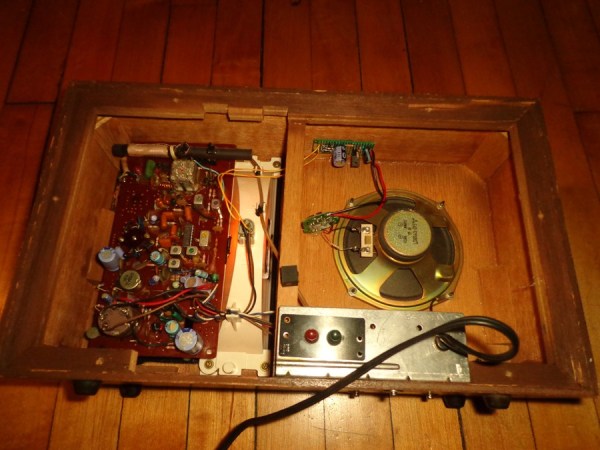
[Jose] had a 1970s-era single-speaker radio that he found in a thrift store. The first thought that he had to get the aesthetically pleasing radio working again was to install a Bluetooth receiver into the radio’s amplifier. This proved to be too time-consuming of a task, and [Jose] decided to drive the Bluetooth module off of the power circuit for the light bulb. He built a 6V AC to 4.2V DC circuit, swapped over the speaker cable, and started listening to his tunes. The modifications he made aren’t destructive, either. If he wants, he will be able to reconnect the original (and still functional) circuitry back to the speaker and pretend he’s back in 1970.

While this isn’t the most intricate hack we’ve ever featured, it’s always refreshing to see someone get use out of an old piece of technology rather than send it off to the landfill with all of our Pentium IIs or last year’s IKEA shelves that have already fallen apart. And even if the 70s aren’t your era of choice, perhaps something newer will inspire you to bust a move.