This Motorless Pull-Behind Mower Is Made From Junk

Cutting a field of grass is a straightforward and satisfying process, given a suitably powered mover. A tractor with a rotary topper to hang on its three-point linkage and power-take-off will make short work of the task.

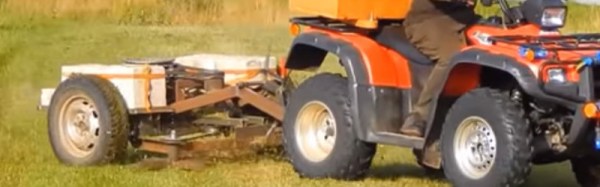
[Donn DIY] had an agricultural quad-bike, but when it came to mowing its lack of a power-take-off meant it wasn’t much use. When he saw a home-made mower for a quad-bike online he had to give it a go himself, and came up with his own take on a mower made from junk.

He started with the rear axle and differential from a Russian built Lada, which he reconditioned, before mounting in a wooden jig with its input shaft pointing upwards. He then made a frame for three mower shafts, onto which he mounted his custom-made rotors and their machined bearing housings. Some pulley machining, and he could then link the rotor shafts to the differential with a series of V-belts and a further shaft to step up the rotor speed.

He wasn’t finished there, after the rotors came a lever mechanism for lifting the cutters off the ground, and a pair of weight baskets to ensure traction was maintained. The result is a mover that takes its drive from its wheels, and cuts grass very effectively when towed behind the quad-bike. The unguarded blades would probably give a farm insurance assessor an apoplexy, but for the purposes of the video below the break at least we can see everything.

Continue reading “This Motorless Pull-Behind Mower Is Made From Junk”
Hackaday Prize Entry: A Simple CNC

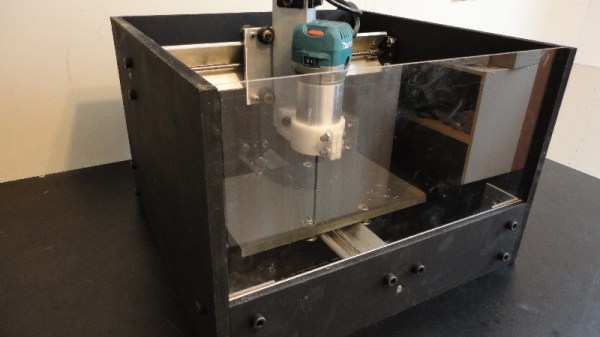
3D printers are all the rage, but there’s still space for more traditional CNC machines. For their Hackaday Prize entry, [Andy], [Tim], and [Chris] are building the Sienci Mill – a simple desktop CNC mill that’s able to cut drill and carve everything from wood to circuit boards.

As far as desktop CNC machines go, it doesn’t get much more simple than this. They’re using steel plates for the rails, NEMA 17s for the motors, and a simple stepper motor driver Arduino shield for the controller. The more complex parts are 3D printed, and the BOM doesn’t add up to much.

Right now, the guys are testing their mill on wood, plastic, and aluminum. With 3D printed parts, they’re also able to test a bunch of different spindles from the ubiquitous router to the smaller Dremel. It’s a great project and should be fantastically cheap when the guys finalize the plans, making this a great entry for the Hackaday Prize.

The HackadayPrize2016 is Sponsored by:

Ham Antenna Rises To The Occasion

There was a time when you could do what you wanted in your yard and hams could build giant antenna farms. These days, there are usually laws or deed restrictions that stop that from happening. Even if you can build an antenna, you might want to quickly put up something temporary in an emergency.

[Eric’s] solution? Suspend a wire from a weather balloon filled with helium from the local WalMart. The 8 foot balloon took two containers (18 cubic feet) of gas before it would rise sufficiently. Once you have a floating balloon, the rest of the concept is simple: connect a wire (100 feet of 26 gauge), use a tuner to match the load to the transmitter, and you have instant antenna.

Continue reading “Ham Antenna Rises To The Occasion”

Hacker-Friendly SBCs: Which Ones?

We have run out of fruits to name all the single-board computers on the market, but that doesn’t mean you can’t buy a rotten one. Bad documentation, incomplete specifications and deprecated firmwares are just some of the caveats of buying only by price and hardware features. To help you out in case you just need to find a great and open-enough SBC with community support, [Eric] has put together a decent list with 81 individually reviewed boards over at hackerboards.com.

Continue reading “Hacker-Friendly SBCs: Which Ones?”

LEGO Monowheel Corners Like It’s On Rails

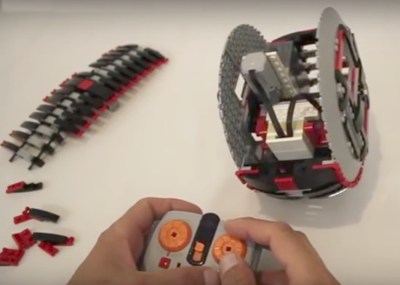
[Jason]’s at it again. This time the LEGO maestro is working on a LEGO BB-8 droid. As a first step he’s made a motorized monowheel that not only races along hallways and through living rooms at the peril of any passing people, but turns as well.

To drive it forward there’s an axle that runs across the center of the wheel and a motor that rotates that axle. He’s also included some weight bricks. Without the mass of those bricks for the rotation to work against, the motor and axle would just spin in place while the friction of the floor keeps the wheel from rotating. If you’ve seen the DIYer’s guide to making BB-8 drive systems, you’ll know that this is classified as an axle drive system.

LEGO monowheel interior shown while leaning to turn

For steering the monowheel left or right he has another mass located just above the axle. Shifting the mass to the left causes the monowheel to lean and move in that direction. Shifting the mass to the right makes the wheel move to the right in the same fashion. Being ever efficient, [Jason] has the motor that shifts the mass doubling as the mass itself.

As with any proof-of-concept, there are still some issues to work out. When turning the wheel left or right it can tip onto its side. Ridges on both sides of the wheel’s circumference reduce the chances of that happening but don’t eliminate it altogether. Also, the steering mass/motor doesn’t yet have a self-centering mechanism; after a turn it’s up to the person holding the remote control to find center. If the mass isn’t correctly centered after a turn, there tends to be some wobble.

As always, we’re looking forward to seeing how [Jason] solves those issues but first he’ll have to put it back together since, as you can see from the video below, it didn’t quite pass the stair test.

Continue reading “LEGO Monowheel Corners Like It’s On Rails”

Government Drones To Toss M&Ms To Prarie Dogs

We hear a lot about drone surveillance, drone package delivery, drone this, and drone that. Honestly, though, the best use of drones has been taking cool aerial videos and posting them online. Until now.

The US Fish and Wildlife Service plans to cover acres upon acres of prairie-dog habitat with vaccine-laced, peanut-butter coated M&Ms. The snacks also include a dye that will show up in the whiskers of prairie dogs that take the bait, allowing scientists to assess the efficacy of the program. And this is all in the name of saving endangered black-footed ferrets which share burrows with the prairie dogs. It seems they were getting the plague from the prairie dogs.

The quads are outfitted with a “glorified gumball machine” that spreads the vaccine tidbits around. Why a quad? They can cover more space with less disruption to the animals’ habitat. That’s a great application in our book.

But if you think this is a case of the USF&WS showing outrageous innovation, consider the way rabies was all but eliminated in Europe: throwing hundreds of thousands of vaccine-doped chicken heads out of helicopters across France, Switzerland, and Germany. You couldn’t make this up.

(Via [Popular Science], where the title is even more clickbaity than ours. Get it? “Clickbait”?)

Headline image: US Fish and Wildlife Service Mountain-Prairie

How To Measure The Extremely Small: Atomic Mass

How does one go about measuring the mass of an object? Mass is defined as the amount of matter an object contains. This is very different from weight, of course, as the mass of our object would remain the same despite the presence or size of a gravitational field. It is safe to say, however,  that most laboratory measurement systems are here on Earth, and we can use the Earth’s gravity to aid in our mass measurement. One way is to use a balance and a known amount of mass. Simply place our object on one side of the balance, and keep adding known amounts of mass to the other side until the balance is balanced.

But what if our object is very small…too small to see and too light to measure with gravity? How does one measure the mass of single atom? Furthermore, how does one determine how much of an object consists of a particular type of atom? There are two commonly used tools just for this purpose. Chances are you’ve heard of one of these but not the other. These tools used to measure substances on the atomic level is the focus of today’s article.

Continue reading “How To Measure The Extremely Small: Atomic Mass”