SimpleSumo Bots Teach More Than Fighting

[MechEngineerMike] wrote in to share the enthusiasm over SimpleSumo, a series of open source, customizable robots he designed for mini-sumo battling and much more. For the unfamiliar, mini-sumo is a sport where two robots try to push each other out of a ring. [Mike]’s bots are simplified versions designed for education.

[Mike] was inspired by a video of some kids building mini-sumo bots who were doing anything and everything to personalize them. He vowed to make his own affordable, easy-to-build bots with education firmly in mind. His other major requirement? They had to be as easily customizable as that one potato-based toy that eventually came with a bucket of parts. As of this writing, there are 34 interchangeable accessories.

[Mike]’s first idea was to build the bots out of custom 3D-printed building blocks. He soon found it was too much work to print consistent blocks and switched to a modular cube-like design instead. SimpleSumo bots can do much more than just fight each other. [Mike] has written programs to make them flee from objects, follow lines, find objects and push them out of the ring, and beep with increasing frequency when an object is detected.

The bots are completely open source, but [Mike] sells kits for people who can’t print the parts themselves. He’s made a wealth of information available on his website including links to outside resources about mini-sumo, Arduino, programming, and 3D design. How about a complete series of assembly videos? First one is after the break.  Don’t know how to build a battle ring? He’s got that covered, too.

For a sumo bot that’s more brains than brawn, check out Zumo Red, the smart sumo.

Continue reading “SimpleSumo Bots Teach More Than Fighting”

Neural Network Really Ties The Room Together

If there’s one thing that Hollywood knows about hackers, it’s that they absolutely love data visualizations. Sometimes it’s projected on a big wall (Hackers, WarGames), other times it’s gibberish until the plot says otherwise (Sneakers, The Matrix). But no matter what, it has to look cool. No hacker worth his or her salt can possibly work unless they’ve got an evolving Venn diagram or spectral waterfall running somewhere in the background.

Inspired by Hollywood portrayals, specifically one featured in Avengers: Age of Ultron, [Zack Akil] decided it was time to secure his place in the pantheon of hacker wall visualizations. But not content to just show meaningless nonsense on his wall, he set out to create something that was at least showing actual data.

[Zack] created a neural network to work through multi-label classification data in Python using the scikit-learn machine learning suite. The code takes the values from the neutral network training algorithm and converts them to RGB colors by way of an Arduino. Each “node” in the neutral network is 3D printed in translucent filament, and fitted with an RGB LED module. These modules are then connected to each other via side-glow fiber optic tubes, so that the colors within the tubes are mixed depending on the colors of the nodes they are attached to. This allows for a very organic “growing” effect, as colors move through the network node-by-node.

In the end this particular visualization doesn’t really mean anything; the data it’s working on only exists for the purposes of the visualization itself. But [Zack] succeeded in creating a practical visualization of machine learning, and if you’re the kind of person who needs to keep tabs on learning algorithms, some variation of this design may be just what you’re looking for.

If AI isn’t your thing but you still want a wall of RGB LEDs, maybe you can use this phased array antenna visualizer instead. If you’re really hip, maybe you’ll go the analog route and put a big gauge on the wall.

Continue reading “Neural Network Really Ties The Room Together”

Wireless Oscilloscope Review

[Martin Rowe] over at EDN recently put a $200 wireless oscilloscope to the test. The Aeroscope 100A is a single channel scope in a probe body that communicates back to an Apple smartphone or tablet via Bluetooth LE. You can see the video from the post, below.

The original prototype of the device had a high bandwidth, but the production model only manages to have a 20 MHz bandwidth at 100 megasamples per second: nothing earth-shattering.

Continue reading “Wireless Oscilloscope Review”

Crystal radios from Jeri Ellsworth's museum tour

Jeri Ellsworth Tours A Radio And Tech Museum

[Jeri Ellsworth] has done some YouTubing again (yes, that’s a word, just like YouTuber) after a four-year hiatus. She’s recently uploaded a very enjoyable four-part series touring the Museum of Radio and Technology in Huntington, West Virginia.

Part one contains radios spanning the ages, starting with a spark gap transmitter, some wonderful crystal sets, pocket radios from the 1940s, commercially available amateur radio transmitters and receivers from the 1930s to the 1950s, and more. There’s even a lovely hack of a transmitter built into an old refrigerator. Part two contains educational toys, three covers television sets and cameras, and four is about all types of record players and hi-fi. Each contains equipment as old as the spark gap transmitters in part one.

You may know of [Jeri] as co-founder of castAR, an augmented reality startup that recently shut its doors, but before that she was famous among hackers for her numerous projects ranging from a flexible electroluminescent display,  a centimeter wave scanner using hacked feed horns, to yours truly’s personal favorite, a Commodore 64 bass keytar.

So nuke some popcorn, sit back, and enjoy the tour following the break.

Continue reading “Jeri Ellsworth Tours A Radio And Tech Museum”

You’d Print A Part, But Would You Print A Foot?

Born with just one foot, [Nerraw99] had to work around prosthetics all his life. Finally getting fed up with the various shortcomings of his leather and foam foot, he designed, tweaked, printed and tested his own replacement!

After using Structure Sensor to scan both his feet, [Nerraw99] began tooling around with the model in Blender and 3D printing them at his local fablab/makerspace: MakerLabs. It ended up taking nearly a dozen printed iterations — multiple printing issues notwithstanding — to get the size right and the fit comfortable. Not all of the attempts were useless; one version turned out to be a suitable water shoe for days at the beach!

Continue reading “You’d Print A Part, But Would You Print A Foot?”

Hackaday Prize Entry: Global Positioning Clock

How do you get the attention of thousands of Hackaday readers? Build a clock! There are just so many choices to agonize over. Do you go with a crystal as a clock source, a fancy oven controlled crystal oscillator, or just mains voltage? Should you even think about putting a GPS module in a clock? All these are very interesting questions that encourage discussion or learning, and that’s what Hackaday is all about. Clocks are cool, and the engineering behind them is even cooler.

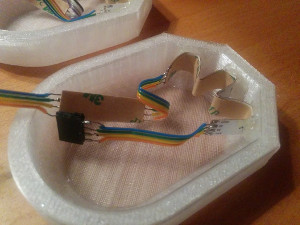
For one of [Nick]’s Hackaday Prize entries, he’s building a minimalist GPS clock. First up, the centerpiece of every clock, the display. There are eight seven-segment displays, two each for the hours, minutes, and seconds, and a smaller digit for tenths of a second. These displays are controlled by an ATXmega32E5, an upgrade on an earlier version of this project that only used an ATtiny and a MAX6951 LED driver.

The GPS wizardry is where this project gets really cool. [Nick] is using a SkyTraq Venus838LPx-T (that’s also available on a breakout board on Tindie). This GPS chip has a handy edge mount SMA connector to receive the signals from a GPS satellite, and has a bidirectional UART to dump the NMEA time codes and a PPS output. By combining the timecode, PPS output, and playing around with the timers on the microcontroller, [Nick] has a fantastically accurate clock that also looks great.

Catching 30 Kilowatts With Thor’s Hammer

Can you really catch lightning with Mjolnir, the mythical hammer of Thor? If you’re [James Hobson] you can get pretty darn close. He’s a long time writer at Hackaday who’s been building an epic following on his YouTube channel by making the digital effects of blockbuster movies into practical effects. Today he released a video showing how he channeled a jolt of lightning with hammer held high.

The lightning source for this hack is a huge Tesla coil held overhead by a telescoping lift. Humans and high voltage mix poorly, which is why you can’t actually tell this is [James]. He’s wearing a full body suit of grounded chainmail which serves as a Faraday cage, safely directing the current around him to avoid a literally heart-stopping moment. Check out the antics in the video after the break.

Longtime readers will remember [Caleb Kraft’s] take on Mjolnir, a build that placed the Tesla coil in the hammer itself. [James]’ version is undeniably more impressive, with the tradeoff that it’s wholly unportable. While we’re on the topic of mythical hammers, our other most favorite build is the delightful prank build which makes the hammer unliftable except by the recognized owner.

Continue reading “Catching 30 Kilowatts With Thor’s Hammer”