Make That Special Cup Of Coffee By Completely Tweaking The Coffee Machine

An interesting part of working on the Building Management and Control (BMaC) project – as previously covered on this site – was the reverse-engineering and ultimately the gaining of full control over the coffee machines at the office. Not the boring filter coffee machines, mind you, but the fully automatic espresso machine type that grinds beans, makes coffee, adds milk, and much more. Depending on one’s budget, naturally.

These little marvels of engineering contain meters of tubing, dozens of sensors, valves, ceramic grinders, and heating elements. The complexity of this machinery made us think that maybe there was more that we could do with these machines beyond what their existing programming and predefined products would allow. Naturally, there was.

Continue reading “Make That Special Cup Of Coffee By Completely Tweaking The Coffee Machine”

3D Printer Becomes Soldering Robot

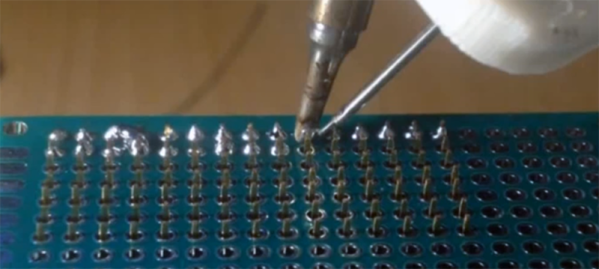
What do you do if you have to solder thousands of through-hole parts? The expensive, professional way of doing this is running the boards through a wave soldering machine, or a machine with a fancy CNC solder fountain. The amateur way of soldering thousands of through-hole joints is putting some boards on the workbench and sitting down with a soldering iron. There is nothing in between; you’re either going to go with full automation for a large soldering job, or you’re doing it completely manually. That’s the problem this soldering robot solves. It’s a small, cheap, but still relatively capable soldering robot built out of a 3D printer.

This project is a solution to the development hell of the OpenScan project. This project is built around a small, simple printed circuit board that uses several 0.1″ female headers to connect an Arduino and motor drivers. Soldering them by hand is simply boring, and 3D printers are cheap, so the great mind behind this project decided to use a printer to pump out solder.

The modifications to the printer include a mount for a TS100 soldering iron and a modified filament extruder that pushes a spool of solder through a PTFE tube. The GCode for this soldering job was created manually, but you could also use a slicer instead. After 20 hours of development, the ‘success rate’ – however that is defined – is between 60-80%. That needs to get up to four or five nines before this DIY soldering robot is practical but this is a decidedly not-bad result for a few hours of tinkering.

This printer mod works great for the use case of stuffing a few 0.1″ headers into a board and letting a robot automatically solder the joints, but this printer will run into a problem with the general case of soldering a lot of randomly-shaped through hole parts. You need to actually hold the parts up against the board while soldering. There’s an easy solution to this problem: just flip the 3D printer upside down. This hack of a cheap 3D printer is so, so close to being a great solution to soldering thousands of through-hole parts quickly and easily, and we’re looking forward to seeing where the community takes this idea. You can check out the video demo below.

Continue reading “3D Printer Becomes Soldering Robot”

Reviving A Casio Scientific Calculator, With A CNC Router

Before Wolfram Alpha, before the Internet, before even PCs, calculations more complex than what could be accomplished with a “four banger” required some kind of programmable calculator. There were many to choose from, if you had the means, and as time passed they became more and more sophisticated. Some even added offline storage so your painstakingly written and tediously entered programs didn’t evaporate when the calculator was turned off.

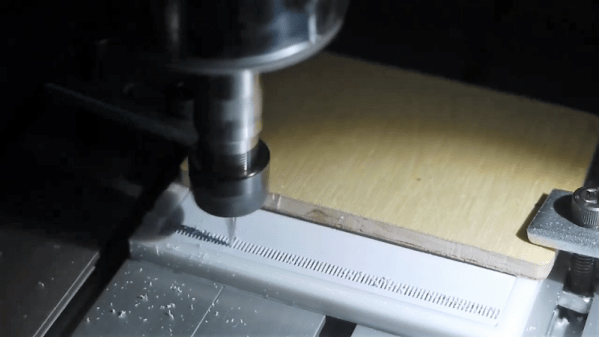
One such programmable calculator, a Casio PRO fx-1 with magnetic card storage, came across [amen]’s bench recently. Sadly, it didn’t come with any cards, so [amen] reverse engineered the card reader and brought the machine back to its 1970s glory. The oddball mag cards for it are no longer available, so [amen] had to make do with. He found some blank cards of approximately the right size for cheap, but somehow had to replicate the band of vertical stripes adjacent to the magnetic strip on the card. Reasoning that they provide an optical synchronization signal, he decided to use a CNC router to cut a series of fine-pitched slots in the plastic card. It took a little effort to get working, including tapping the optical sensor and reading the signal on an oscilloscope, but as the video below shows, the hacked cards work fine with the vintage calculator.

Kudos to [amen] for reviving this retro-cool calculator. Now that it’s back in action, it might be fun to visualize domains on the magnetic strip. A flatbed scanner can be used for that job.

Continue reading “Reviving A Casio Scientific Calculator, With A CNC Router”

Raspberry Pi Becomes The Encrypted Password Keeper You Need

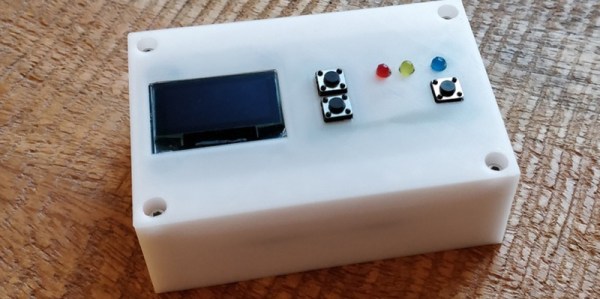
Unless you’re one of the cool people who uses the same password everywhere, you might be in need of a hardware device that keeps your usernames and passwords handy. The Passkeeper is a hardware password storage system built on a Raspberry Pi. It encrypts your passwords, and only through the magic of a special key fob will you ever get your passwords out of this device.

The hardware for this device is built around the Raspberry Pi Zero. You might be questioning the use of a Pi Zero, but given that it’s an entire Linux system for just a few bucks, it only makes sense. The rest of the hardware is a tiny OLED SPI display, an RFID card reader, a few LEDs, some wire, and some solder. A 3D printed case keeps everything together.

Of course, this build is all about the software, and for that, the Passkeeper device is built in Go, with a system that builds a web interface, builds the firmware, and writes everything to an SD card. Usage is simply plugging the Passkeeper into the USB port of your computer where it presents itself as a network interface. Everything is available by pinging an IP address, and after that the web UI will log your usernames and passwords. All this data is encrypted, and can only be unlocked if an RFID key fob is present. It’s an interesting idea and certinaly inexpensive. It’s not quite as polished as something like the Mooltipass, but if you have a Pi around and don’t have a password keeper, this is something to build this weekend.

Scientists Create Speech From Brain Signals

One of the things that makes us human is our ability to communicate. However, a stroke or other medical impairment can take that ability away without warning. Although Stephen Hawking managed to do great things with a computer-aided voice, it took a lot of patience and technology to get there. Composing an e-mail or an utterance for a speech synthesizer using a tongue stick or by blinking can be quite frustrating since most people can only manage about ten words a minute. Conventional speech averages about 150 words per minute. However, scientists recently reported in the journal Nature that they have successfully decoded brain signals into speech directly, which could open up an entirely new world for people who need assistance communicating.

The tech is still only lab-ready, but they claim to be able to produce mostly intelligible sentences using the technique. Previous efforts have only managed to produce single syllables, not entire sentences.

Continue reading “Scientists Create Speech From Brain Signals”

Charge All Your Batteries With USB PD

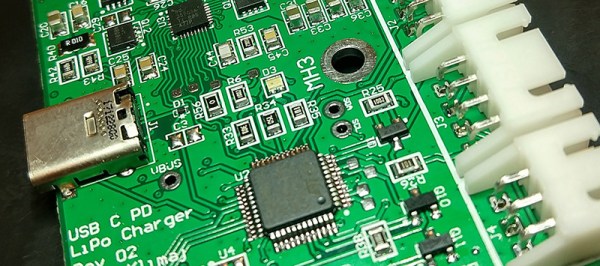
USB-C has been around for a while, and now that it can charge phones and Macbooks and Thinkpads, the hackers are starting to take note of power adapters that can supply lots of current. [Alex] was turned on to USB-C after he charged a laptop, Nintendo Switch, and phone with one power adapter. This led him to create a USB-C battery charger for all your LiPos.

The high-level design of this project is simply a board with a USB C port on one end, an XT60 plug on the other, and some support for balance leads. Plug this board into a USB C adapter, plug a battery in, and the battery will charge automagically. The only UI is an RGB LED. It’s difficult to imagine a battery charger that’s easier to use.

For the electronics, [Alex] is using an STM32G0 for the smarts of the device, which includes handling the USB PD spec. This gives the charger 20 Volts to play with, and this is then regulated and sent into the battery. Right now, this board will charge 2-4c batteries. That’s a good enough proof of concept to charge some quadcopter batteries, or just as a really simple way to charge some LiPo cells.

RFID Payment Ring Made From Dissolved Credit Card

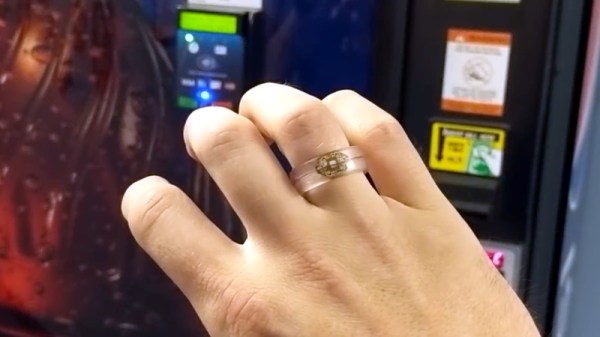
RFID payment systems are one of those things that the community seems to be divided on. Some only see the technology as a potential security liability, and will go a far as to disable the RFID chip in their card so that it can’t be read by a would-be attacker. Others think the ease and convenience of paying for goods by tapping their card or smartphone on the register more than makes up for the relatively remote risk of RFID sniffers. Given the time and effort [David Sikes] put into creating this contactless payment ring, we think it’s pretty clear which camp he’s in.

Alright, so the whole ring making part sounds easy enough, but how does one get an RFID chip that’s linked to their account? Easy. Just call the bank and ask them for one. Of course, they won’t just send you out a little RFID chip and antenna to mount in your hacked up project. (If only things were so simple!) But they will send you a new card if you tell them your old one is getting worn out and needs a replacement. All you have to do when it gets there is liberate the electronics without damaging them.

[David] found that an hour or so in an acetone bath was enough to dissolve the plastic and expose the epoxy-encased RFID chip, assuming you scrape the outer layers of the card off first. He notes that you can speed this part of the process up considerably if you know the exact placement and size of the RFID chip; that way you can cut out just the area you’re interested in rather than having to liquefy the whole card.

Once you have your chip, you just need to mount it into a ring. [David] has designed a 3D printable frame (if you’ve got a high-resolution SLA machine, that is) which accepts the chip and a new antenna made from a coil of 38 AWG magnet wire. With the components settled into the printed frame, its off to a silicone mold and the liberal application of epoxy resin to encapsulate the whole thing in a durable shell.

If a ring is not personal enough for you, then the next step is getting the RFID chip implanted directly into your hand. There are even folks at hacker cons who will do that sort of thing for you, if you’re squeamish.

Continue reading “RFID Payment Ring Made From Dissolved Credit Card”