Diode Steering And Counting With A 555

While you’re not likely to see this technique used very much today, there’s a lot you can do with a 555, some logic chips, and a handful of diodes. [Fran] is here with a great example of using these simple parts to build a circuit that counts to zero, using parts you can probably find under your workbench.

[Fran] was inspired to build this diode counter from one of [Dave]’s Mailbags and [Colin Mitchell]’s 555 circuit book. The 555 is the standard component found in every parts drawer, but since we have tiny microcontrollers that cost the same as a 555, we’re not seeing the artistry of a simple timer chip and a few logic chips much these days.

This circuit began with a 555 attached to a 4017B decade counter. Simply by tying a few LEDs to the output of the 4017, [Fran] made a bunch of LEDs light up in sequence. Cool, but nothing unexpected. The real trick uses a few diodes and six LEDs to build a scanner – a line of LEDs that will blink from left to right, then right to left. Impressive, and with a little more circuitry it’s a Larson Scanner, as seen in Battlestar Galactica and Knight Rider.

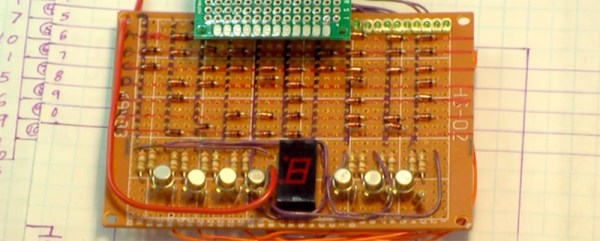
The real trick for this technique comes when [Fran] pulls out a piece of protoboard, several dozen diodes, and seven old transistors to have a seven-segment display count from zero to nine. The 4017 simply counts out on ten pins, and each of these pins is wired to a bunch of diodes for each segment in the display. Add in a few resistors and a transistor, and [Fran] replicated what’s inside a seven-segment driver with discrete parts.

If counting to zero isn’t enough proof that you can do a whole lot with some diodes and logic chips, how about programming an Atari 2600 with one?

Video below.

Continue reading “Diode Steering And Counting With A 555”

Piana – Musical Synthesis For The Raspberry Pi

For the last 15 years or so, software synths have slowly yet surely replaced those beatboxes, drum machines, and true synthesizers. It’s a loss for old hardware aficionados, but at least everyone with a MacBook is now a musician, amiright?

The Raspberry Pi and Pi2 already have more processing power than a desktop from ’99, so it’s no surprise that all of those classic synths, from a Moog. Yamaha DX, Casio CZ, Linn drum machine, Fairlight, and a mellotron, can all be stuffed into a Pi thanks to the work of [Phil Atkin] and his Raspberry Pi synthesizer.

[Phil]’s efforts to bring audio synthesis to the Pi fall under three techniques: subtractive synthesis, phase distortion synthesis, and sample-based synthesis, something that’s found in everything from Akai MPCs, MacBooks, and that one episode of The Cosby Show. [Phil] is combining all of these techniques into a piece of software that’s capable of running seamlessly on the Pi, giving anyone with a $35 computer a tool that would have been worth several thousand dollars in 1985.

The project is pretty far along, but the recent release of the Raspberry Pi 2 has thrown [Phil] for a loop. On one hand, the Pi 2 is much more capable than the original Pi in terms of hardware, and this lends itself to more sounds and a better GUI. On the other hand, there are millions of original Pi 1s out there that still make for exceptional synthesizers. Either way, [Phil]’s work is a great example of how far you can push the Pi with audio work.

Thanks [Wybren] for the tip. Videos below.

Continue reading “Piana – Musical Synthesis For The Raspberry Pi”

Fail Of The Week: WinCE Is A Noun And A Verb

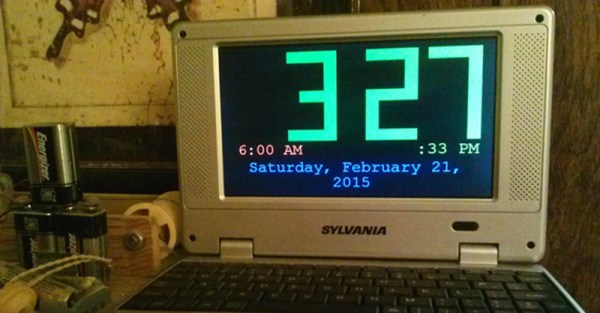
A few years ago, [localroger] found some incredible hardware on sale: a very tiny laptop with a seven-inch screen, full keyboard, trackpad, Ethernet, WiFi, USB (with support for a lot of HID devices), and a battery that would last hours. They were on sale for $30 USD, and [localroger] bought four of them. A great deal, you say? These machines ran Windows CE. No, owning a WinCE device is not the Fail of the Week.

Figuring he should do something with these machines, [roger] thought, ‘a clock will do’, and began to figure out how to program or write an app for these things. These tiny netbooks did come with a programming language, JavaScript, in the form of the built-in IE6 web browser. This was actually a really, really good solution – WinCE apps formatted for portrait displays just didn’t work with the ‘widescreen’ laptop, and a hand-coded HTML table is probably the best solution anyone could have hoped for.

These machines – [roger] used three of them over the years as alarm clocks – did their job well, even if NTP had been left out of the OS image. The real fail here comes from buying a $30 WinCE netbook, and using it for something as mission critical as an alarm clock. The displays burned in, the batteries began puffing up, one unit somehow wouldn’t allow IE to run (probably a bad Flash chip), and the trackpad in another one sent the cursor on a random walk. You get what you pay for.

These WinCE netbooks have finally been put out to pasture, hopefully the same one laser printers go to. It’s all for the best, though; [roger] made a much better alarm clock with Nixies.


2013-09-05-Hackaday-Fail-tips-tileFail of the Week is a Hackaday column which runs every now and again. Help keep the fun rolling by writing about your past failures and sending us a link to the story — or sending in links to fail write ups you find in your Internet travels.

TwinTeeth: The Delta Bot PCB Factory

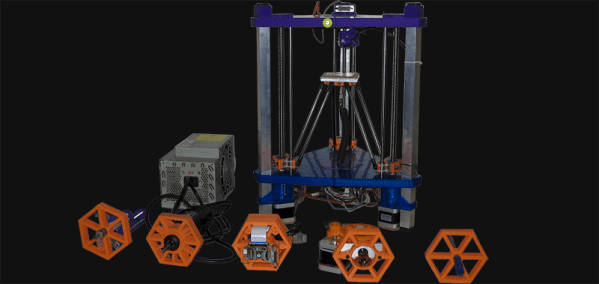
There are a few all-in-one CNC/milling/plotting/3D printing/engraving bots out there that claim to be mini factories for hobbyists, prototypers, and other homebrew creators. The latest is Diyouware’s TwinTeeth, a bot obviously inspired by a few 3D printers, but something that has a few interesting features we hope will propagate through the open hardware ecosystem.

The design of the TwinTeeth is an inverse delta bot, kinematically similar to a large number of 3D printers out there. Instead of suspending the tool from a trio of arms, the TwinTeeth puts the work surface on the arms and suspends the tool from the top of the machine. There are a few neat bonuses for this setup – all the tools, from a BluRay laser diode, a Dremel, solder paste dispenser, and a plastic extruder for 3D printing can be mounted in easy to mount adapters. The TwinTooth design uses three locking pins to keep each toolhead in place, and after a little bit of software setup this machine can quickly switch between its various functions.

One very interesting feature of this bot is the ability to mask off PCBs for chemical etching with a BluRay laser diode. This actually works pretty well, as evidenced by the teams earlier work with a purpose-built PCB masker machine. The only problem with this technique is that presensitized boards must be used. If that’s an issue, no problem, just use the Dremel attachment with a v-bit cutter.

In Chicago? Bring A Hack!

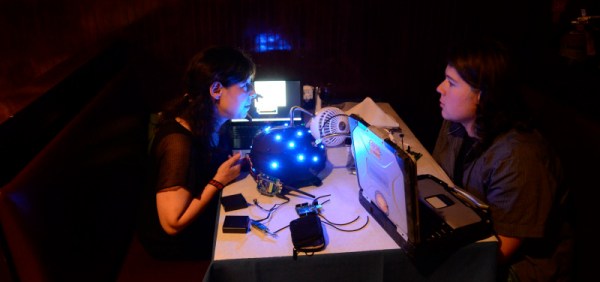
It’s been far too long since we’ve had a Hackaday presence at a hackerspace. This, of course, is a terrible oversight and something must be done to correct it. If you’re in Chicago, you’re in luck. We’re going to be at Pumping Station: One this Wednesday for a Bring-A-Hack meetup.

If you have a cool build to show off, a bunch of blinky things, wearables, or just some cool tech, the mythical Hackaday Prize guru [Sophi Kravitz] will be at PS:1 Wednesday evening. I’m pretty sure there will be stickers, but sadly no t-shirt cannon just yet.

The event is free, open to everyone, and there’s pizza. RSVPing would be a good idea, and you can do that over on the meetup.com page for the event.

Hackaday Links Column Banner

Hackaday Links: February 22, 2015

We met up with Freescale guy [Witek] at our party in Munich last year, and he wrote in to tell us about the Freescale booth at Embedded World this week in Nuremberg. They’re going to have a bunch of Freedom boards to play around with and an extremely powerful RIoTboard with a 1GHz iMX6 Solo processor, 1GB of RAM, and 4GB of EMMC Flash. It’s not a Raspi or BeagleBone killer, but if you need a small Linux board with a lot of horsepower, there ‘ya go.

SmarterEveryDay is finally getting around to doing a series of videos about space. This guy knows his stuff, and with the access he can get, it should make for interesting viewing.

Here’s something for your Sunday listening: [Vint Cerf] at Carnegie Mellon talking about the Olive Project and the Interplanetary Internet. The Olive project is an archive for executables, and solves the problem of having to preserve hardware along with software. Cool stuff.

10 GHz pulse magnetron destroys electronics. That’s the only information you’re going to get with this one. There’s a fine line between ‘don’t try this at home’ and ‘this project needs replication’.

Most of the northern half of the United States is covered in a billion tons of snow. [Jamie]’s electric snowmobile/Power Wheels is the perfect vehicle for this occasion. It’s 36V with two 500W motors. Figure out how to replace the wheels with small treads, and there’s really something interesting here.

A Smaller, Homebrew Amstrad

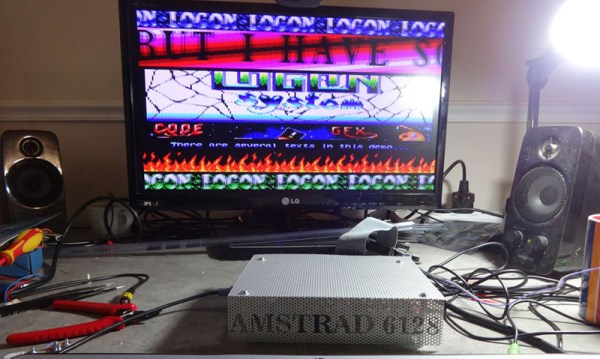
Although they weren’t very popular in America, the Amstrad CPC 464 and CPC 6128 were extremely well-received in Europe. [Zaxon] loved his ‘464, and for a bit of a learning experience – and the fact that an Amstrad takes up an exceptional amount of desk space – decided to make a clone of his favorite computer (.pl, Google translatrix).

The clone began as a simple schematic of the original Amstrad CPC 464, but the parts used in the original required some modern equivalents. Still, most of the old chips remained in the clone; the original Hitachi HD46505 CRT controller remains, as do the original DRAM chips and the vintage Z80 CPU.

A few modern amenities were added, including an interface for a PS/2 keyboard and a disk that’s much improved over the original cassette drive or weird 3.5″ disks: a Disk On Module, or basically a CompactFlash card in a strange form factor that plugs straight into a motherboard’s IDE socket. They’re mostly seen when tearing apart old thin clients, but using them in retrocomputing project is a great idea.

Thanks [rasz_pl] for the tip. Video below.

Continue reading “A Smaller, Homebrew Amstrad”