MacGyver, Jedi Knights, Ammo Stockpiles, And Candy Crush

Everyone’s favorite machinist, tinkerer, YouTube celebrity, deadpan comedian, and Canadian is back with a tale of popping a few benzos, stumbling around Mexico, and wondering why everyone else on the planet is so stupid.

The hero of our story considered the feasibility of one hundred and eighty-sixth trimester abortions as he stood outside a Mexican airport watching a stockbroker complain about the battery in his cellphone. Meanwhile, cars drove by.

Here’s how you charge a phone with a car battery and an ‘ol Dixon Ticonderoga.

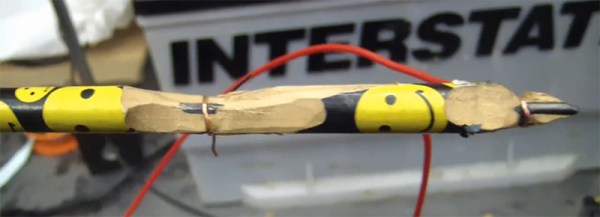
To charge a battery, all you really need to do is connect the terminals to a power source with the right voltage. A cell phone battery needs about three volts, and a car battery has twelve. You need a voltage divider. You can get that with a pencil. Take out a knife, get to the carbon and clay wrapped in wood, and wire the battery up. Make a cut a quarter of the way down this rather long resistor, and there you will find something around three volts.

Does it work? Yeah. It works even better if you have some tape to hold wires onto the cell phone battery when charging. Is it smart? It is if there is no other conceivable way of charging your cell phone. Should you do it? Nah. Video below. Thanks [Morris] for the link.

Continue reading “MacGyver, Jedi Knights, Ammo Stockpiles, And Candy Crush”
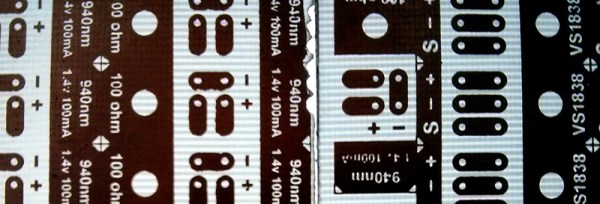
Toner Transfer And Packing Tape

The toner transfer process of producing PCBs has evolved tremendously over the last few years. It started out by printing PCB layouts onto magazines with a laser printer, then some clever people figured out that glossy inkjet photo paper would work just as well. Now there’s a new substrate for you – packing tape – and it seems to work pretty well.

[David] was designing a cheap board for a robot kit for a workshop and needed 100 tiny PCBs. They were simple boards, and perfectly suited for home PCB manufacturing. He started off by printing directly onto glossy magazine paper, but this wasn’t an ideal solution. During one run, some of the toner landed on the packaging tape he was using to secure the boards. A bit of serendipity came into play and [David] discovered packaging tape is usable in the toner transfer process.

The technique is simple enough: put some packaging tape on a piece of paper, print a board layout (reversed!) on a laser printer, and go through the usual clothes iron/laminator/etching process. [David] is actually using a hair straightener for transferring the toner over to the copper clad board – interesting, and in a pinch you can use the same tool for reflowing SMD components.

Towards A Reverse Engineering Of Samsung’s S-Pen

A few years ago, Wacom, the company behind all those cool graphics tablets, teamed up with Samsung to create the S Pen, a rebirth of that weird pen computing thing that happened in the 90s and a very interesting peripheral if only someone would write some software for it. [Kerry D. Wong] was wondering how the S Pen worked and wired up some hardware to take a look at how the pen communicates with the phone.

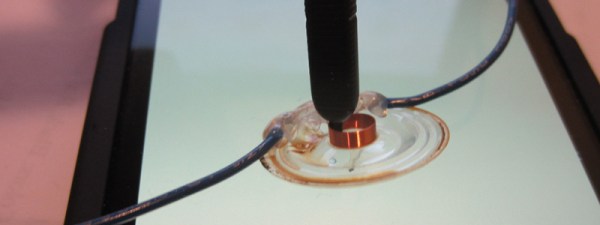
It was already known that the S Pen was powered by an RF field, and works somewhat like RFID. Listening in on the communication would require a coil of some type, so [Kerry] disassembled a small speaker and connected it to a scope.

A look at the captured waveforms from the S Pen reveled the carrier frequency appears to be in the range of 550 to 560kHz, outside the range of standard RFID. He doesn’t have the equipment to decode the complete protocol, but a few things can be deduced – the screen senses the location of the pen by detecting a dip in the RF field strength. The only information that is transferred between the pen and phone is the 11-bit pressure sensitivity and a 1-bit value that signals the button is on or off.

[Kerry] put the waveform data up on his site should anyone want to make an attempt at decoding the protocol.

Pre-Web Hardware Connects To The Web

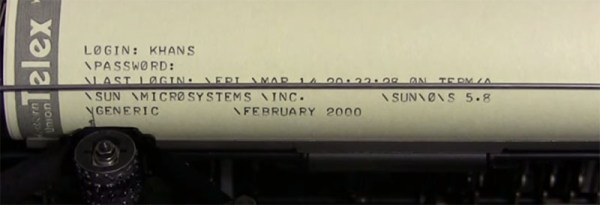
We’re not quite to the 25th anniversary of the world wide web, but that doesn’t mean the greatest innovation in information distribution since [Gutenberg]’s press can’t be celebrated a bit early, does it? [Suhayl] is throwing some of his hardware into the ring, and loading up the first web page with a modem from the mid 1960s and a teletype from the mid 70s. No, no sane person would have ever done this 25 years ago, but it’s neat to watch in any event.

The hardware [Suhayl] is using includes a Livermore Data Systems modem. It’s a finely crafted wooden box with an acoustic coupler on top, and a DB-25 connector on a side that connects to a terminal or computer via RS-232. If that Livermore Data Systems acoustic coupler modem looks familiar, you might be right. This modem was demoed back in 2009 by [phreakmonkey]. It’s an impressive little box that can connect to a remote system at up to 300 baud.

The I/O is handled by an ASR-33 teletype. This was the standard way to connect to computers and mainframes before we were all blessed with video terminals and TV typewriters. The whole setup connects to a Unix system with a much more familiar Hayes modem, runs a text-only browser, and retrieves the first web page as it was served up at CERN some 25 years ago.

Hacklet 35 – BeagleBone Projects

The Raspberry Pi 2 is just barely a month old, and now that vintage console emulation on this new hardware has been nailed down, it’s just about time for everyone to do real work. You know, recompiling stuff to take advantage of the new CPU, figuring out how to get Android working on the Pi, and all that good stuff that makes the Pi useful.

It will come as no surprise to our regular readers that there’s another board out there that’s just as good in most cases, and in some ways better than the Pi 2. It’s the BeagleBone Black, and for this edition of the Hacklet, we’re focusing on all the cool BeagleBone projects on Hackaday.io.

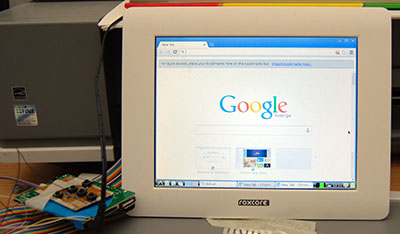
lcdSo you have a credit card sized Linux computer and a small, old LCD panel. If it doesn’t have HDMI, VGA or composite input, there’s probably no way of getting this display working, right? Nope. Not when you can make an LCD cape for $10.
[Dennis] had an old digital picture frame from a while back, and decided his BeagleBone needed a display. A few bits of wire and some FPC connectors, and [Dennis] has a custom display for his ‘Bone. It’s better than waiting for that DSI display…

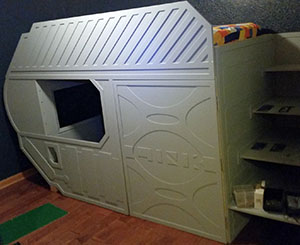
bed[THX1082] is making a bed for his son. This isn’t your usual race car bed, or even a very cool locomotive bed. No, this is a spaceship bed. Is your bed a space ship? No, I didn’t think so.

Most of the work with plywood, MDF, paint, and glue is done, which means the best feature of this bed – a BeagleBone Black with an LCD, buttons, a TV, and some 3D printed parts – is what [THX] is working on right now. He’s even forking a multiplayer networked starship simulator to run in the bed. Is your bed a starship simulator?

beer

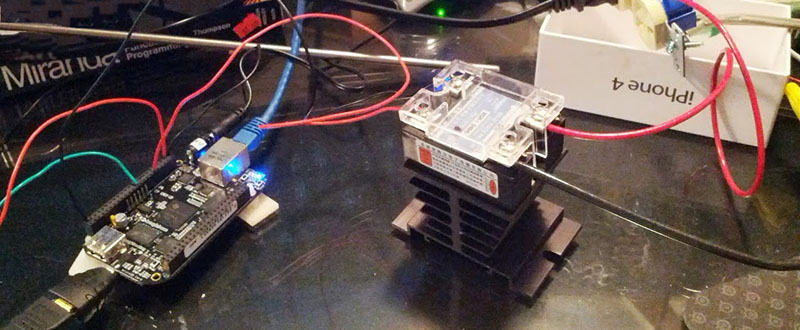
Beer. [Deric] has been working on a multi-step fermentation controller using the BeagleBone Black. For good beer you need to control temperatures and time, lest you end up with some terrible swill that I’d probably still drink.

This project controls every aspect of fermentation, from encouraging yeast growth, metabolization of sugars, and flocculation. The plan is to use two circuits – one for heating and one for cooling – and a pair of temperature sensors to ensure the beer is fermenting correctly.


If you’re looking for more BeagleBone Projects, there’s an entire list of them over on Hackaday.io with GLaDOs Glasses, Flight Computers, and Computer Vision.

Fixing Sega Cartridges With Old BIOS Chips

For one reason or another, [Dragao] has an old Sonic The Hedgehog cartridge that throws an illegal instruction somewhere in the Marble Zone stage. While the cause of this illegal instruction is probably cosmic rays, how to repair this cartridge isn’t quite as clear. It can be done, though, using BIOS chips from an old computer.

[Dragao] got the idea of repairing this cartridge from Game Boy flash carts. These cartridges use chips that are a simple parallel interface to the address and data lines of the Game Boy’s CPU, and Sega Genesis / Mega Drive flash cart would work the same way. The problem was finding old DIP flash chips that would work. He eventually found some 8-bit wide chips on the motherboard of an old computer, and by stacking the chips, he had a 16-bit wide Flash chip.

To program the chips, [Dragao] wired everything up to an Arduino Mega, put a ROM on the chip, and wired it up to the old Sega cartridge. Surprisingly or unsurprisingly, everything worked, and now [Dragao] has a fully functioning copy of Sonic The Hedgehog.

A Wearable Space Station Notifier

If you don’t live in northern Europe, Alaska, or the extreme southern part of South America, there’s a 400-ton, $150 Billion space station flying over your head several times a day. It’s the International Space Station, and it’s the most complex and expensive construction project of all time. Look up at the right time, and you can see a point of light rising in the sky, brighter than any star, darting across to the opposite horizon.

ISS-Above is a simple tool that will tell you when you’ll be able to see the ISS passing overhead next, and the creator of the project, [Liam Kennedy] has a new crowdfunding project to turn this space station notifier into a wearable. It’s called the Pulsar, and with the help of an RFduino and a real time clock, it will alert you to an upcoming station pass with a bit of wearable electronics.

ISS
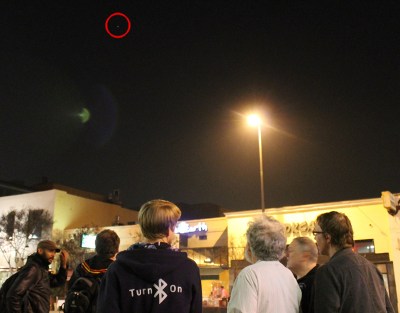
Viewing the ISS at the most recent Hackaday Pasadena Meetup.

The ISS-Above is a great device to keep tabs on the six astronauts currently orbiting our globe, but if you want to see the space station rise over the horizon… well, lugging a Raspi and an HDMI monitor outside isn’t the best solution. The Pulsar is a tiny wearable board with a ring of LEDs programmed with 50 future passes of the space station. When the station is overhead, the LEDs light up, and a bright object appears over the western horizon.

[Liam] brought his Pulsar to the most recent Hackaday Pasadena meetup, and as his wearable LEDs lit up, the ISS appeared right on cue. The evening was only tainted by a crazy lady who decided to argue the existence of the International Space Station.

Video below.

Continue reading “A Wearable Space Station Notifier”