Inputs Of Interest: Tongues For Technology

Welcome to the first installment of Inputs of Interest. In this column, we’re going to take a look at various input devices and methods, discuss their merits, give their downsides a rundown, and pontificate about the possibilities they present for hackers. I’ll leave it open to the possibility of spotlighting one particular device (because I already have one in mind), but most often the column will focus on input concepts.

A mouth mouse can help you get your input issues licked. Via @merchusey on Unsplash

Some inputs are built for having fun. Some are ultra-specific shortcuts designed to do work. Others are assistive devices for people with low mobility. And many inputs blur the lines between these three ideas. This time on Inputs of Interest, we’re going to chew on the idea of oral inputs — those driven by the user’s tongue, teeth, or both.

Unless you’ve recently bitten it, burned it, or had it pierced, you probably don’t think much about your tongue. But the tongue is a strong, multi-muscled organ that rarely gets tired. It’s connected to the brain by a cranial nerve, and usually remains undamaged in people who are paralyzed from the neck down. This makes it a viable input-driving option for almost everyone, regardless of ability. And yet, tongues and mouths in general seem to be under-utilized as input appendages.

Ideally, any input device should be affordable and/or open source, regardless of the driving appendage. Whether the user is otherwise able-bodied or isn’t, there’s no reason the device shouldn’t be as useful and beautiful as possible.

Continue reading “Inputs Of Interest: Tongues For Technology”

Destroy My Vegetable Garden? Oh Hail No!

Building and maintaining a garden takes a lot of work. And unless you have a greenhouse, you’re forced to leave your hard work outside to fend for itself against the double-edged sword of the elements. Rain and sun are necessary, but hard, pelting hail is never welcome. Just ask [Nick Rogness]. He didn’t go through all the trouble of building a 12’x12′ garden and planting tasty vegetables just to have Mother Nature spew her impurity-filled ice balls on it every other night during the summertime.

[Nick] did what any of us would do: fight back with technology. His solution was to build a retractable roof that covers the garden with a heavy duty tarp. A Raspberry Pi Zero W controls pair of linear actuators via motor controllers, and [Nick] put a limit switch in each of the four corners to report on the roof status. He can run the roof manually, or control it with his phone using MQTT. The whole thing runs on a 12V marine battery that gets charged up by a solar panel, so part of the interface is dedicated to reporting the battery stats.

[Nick] ran out of time to implement all the features he wanted before the season started, but there’s always next year. He has big plans that include soil moisture sensors, rain detection sensors, and an automatic watering system that collects and uses rain water. We planted the bite-size demo video for you after the break — just wash the dirt off and you’re good to go.

Maybe someday [Nick] will create a system that can automate the entire garden, like the FarmBot. Hey, we’re just trying to plant seeds of ideas.

Continue reading “Destroy My Vegetable Garden? Oh Hail No!”

Random Numbers From Outer Space

Need a random number? Sure, you could just roll a die, but if you do, you might invite laughter from nearby quantum enthusiasts. If it’s truly, unpredictably random numbers you need, look no farther than the background radiation constantly bombarding us from the safety of its celestial hideout.

In a rare but much appreciated break from the Nixie tube norm of clock making, [Alpha-Phoenix] has designed a muon-powered random number generator around that warm, vintage glow. Muons are subatomic particles that are like electrons, but much heavier, and are created when pions enter the atmosphere and undergo radioactive decay. The Geiger-Müller tube, mainstay of Geiger counters the world over, detects these incoming muons and uses them to generate the number.

Inside the box, a 555 in astable mode drives a decade counter, which outputs the numbers 0-9 sequentially on the Nixie via beefy transistors. While the G-M tube waits for muons, the numbers just cycle through repeatedly, looking pretty. When a muon hits the tube, a second 555 tells the decade counter to stop immediately. Bingo, you have your random number! The only trouble we can see with this method is that if you need a number right away, you might have to go get a banana and wave it near the G-M tube.

Whether this all makes sense or not, you should check out [Alpha-Phoenix]’s project video, which is as entertaining as it is informative. He’s planning a follow-up video focused on the randomness of the G-M tube, so look out for that.

Looking for a cheaper way to catch your random numbers? You can do it with a fish tank, some air pumps, and a sprinkle of OpenCV.

Continue reading “Random Numbers From Outer Space”

See If Today’s Air Quality Will Conch You Out

Air quality is one of those problems that is rather invisible and hard to grasp until it gets bad enough to be undeniable. By then, it may be too late to do much about it. But if more people were interested in the problem enough to monitor the air around them, there would be more innovators bringing more ideas to the table. And more attention to a problem usually means more accountability and eventual action.

This solar-powered particulate analyzer made by [rabbitcreek] is a friendly way to take the problem out of the stratosphere of ‘someday’ and bring it down to the average person’s backyard. Its modular nature makes it fairly simple to build, and the conch shell enclosure gives it a natural look. That shell also cleverly hides the electronics, while at the same time allowing air and particulates to reach the sensor. If you don’t like the shell enclosure, we think the right type of bird feeder could protect the electronics while allowing airflow.

[rabbitcreek] attached a sizeable solar panel to the shell on a GoPro mount so it can be adjusted to face the sun. The panel charges a Li-Po battery that gets boosted to 5V. Every two hours, a low-power breakout circuit wakes up the Feather ESP32 and takes a reading from the particulate sensor. [rabbitcreek] can easily see the data on his phone thanks to the Blynk app he created.

Why limit this to your yard? Bare ESP32s are cheap enough that it’s feasible to build a whole network of air quality sensors.

Binary Advent Calendar Does More With Fewer Doors

[John] sent this one in to us a little bit after Christmas, but we’ll give him a pass because it’s so beautiful. Think of it this way: now you have almost a full year to make a binary advent calendar of your own before December 1st rolls around again.

Normal advent calendars are pretty cool, especially when there is chocolate behind all 24 doors. But is it really a representational ramp-up if you never get more than one chocolate each day? [John] doesn’t think so. The economics of his binary advent calendar are a bit magical, much like the holiday season itself. Most days you’ll get two pieces of chocolate instead of one, and many days you’ll get three. That is, as long as you opened the right doors.

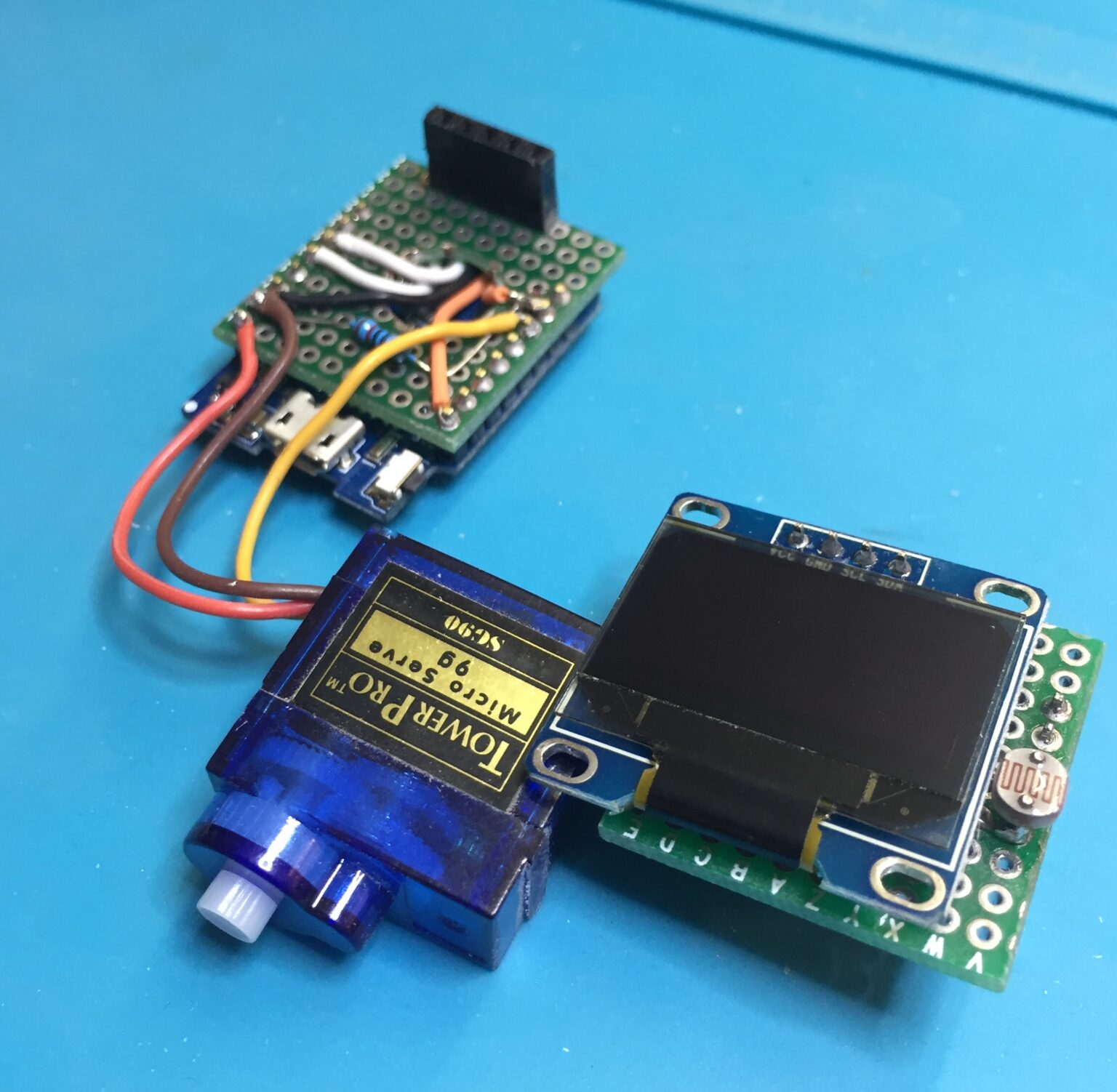
A momentary switch hidden behind the hinge of each door tells the Arduino clone when it’s been opened. The Arduino checks your binary counting abilities, and if you’re right, a servo moves a gate forward and dispenses one chocolate ball per opened door. We love the simplicity of the dispensing mechanism — the doors are designed with a ceiling that keeps non-qualifying chocolates in their channels until their flag comes up.

[John] is working out the kinks before he releases this into the wild. For now, you can get a taste in the demo video featuring a bite-sized explanation. If you don’t like chocolate, maybe this blinky advent calendar will light you up inside.

Continue reading “Binary Advent Calendar Does More With Fewer Doors”

Oceanography As Open As The Seas

With Earth in the throes of climate change and no suitable Planet B lined up just yet, oceanography is as important now as it has ever been. And yet, the instruments relied upon for decades to test ocean conditions are holding steady within the range of expensive to prohibitively expensive. Like any other area of science, lowering the barrier of entry has almost no disadvantages — more players means more data, and that means more insight into the inner workings of the briny deep.

[Oceanography for Everyone] aims to change all that by showing the world just how easy it is to build an oceanographic testing suite that measures conductivity (aka salinity), temperature, and depth using common components. OpenCTD is designed primarily for use on the continental shelf, and has been successfully tested to a depth of 100 meters.

An Adalogger M0 and RTC Featherwing run the show from their waterproof booth in the center of the PVC tube. There’s a 14-bar pressure sensor for depth, a trio of DS18B20s for temperature averaging, and a commercial conductivity probe that gathers salinity data. These sensors are fed through a 3D-printed base plate and ultimately potted in stainless steel epoxy. The other end of the tube is sealed with a mechanical plug that seats and unseats with the whirl of a wingnut.

We particularly like the scratch-built magnetic slide switch that turns OpenCTD on and off without the need to open the cylinder. If you’d like to build one of these for yourself, take a deep dive into [Oceanography for Everyone]’s comprehensive guide — it covers the components, construction, and calibration in remarkable detail. The switch is explained starting on page 50. You can find out more about the work Oceanography for Everyone is doing at their site.

As far as cheap waterproof enclosures go, PVC is a great choice. It works well for underwater photography, too.

The Flexible Permanence Of Copper Tape Circuits

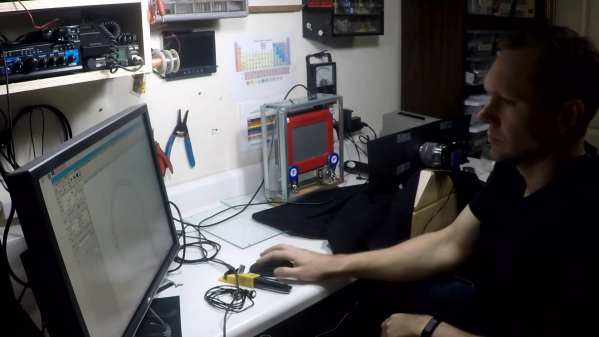
Somewhere between shoving components into a breadboard temporarily and committing them to a piece of protoboard or a PCB lies the copper tape method. This flexible Manhattan-style method of circuitry formed the basis for [Bunnie Huang]’s Chibitronics startup, and has since inspired many to stop etching boards and start fetching hoards of copper tape.

[Hales] hit the ground running when he learned about this method, and has made many a copper tape circuit in the last year or so. He offers several nice tips on his site that speak from experience with this method, and he’ll even show you how to easily work an SMD breakout board into the mix.

Generally speaking, [Hales] prefers plywood as the substrate to paper or cardboard for durability. He starts by drawing out the circuit and planning where all the tape traces will go and how wide they need to be. Then he lays out copper traces and pads, rubs the tape against the substrate to make it adhere strongly, and reinforces joints and laps with solder before adding the components. As you can see, copper tape circuits can get pretty complicated if you use Kapton tape as insulation between stacked layers of traces.

Copper and Kapton (polyimide) tape are just two of the many useful tapes you may not be aware of. Stick with us a moment and check out [Nava Whiteford]’s exploration of various adhesive marvels.