An RPi-Powered Multi-DX7/TX816 Style Synth

[Kevin] over at Simple DIY ElectroMusic Projects has released a complete DIY modular design for simulating the classic 80s Yamaha TX816 DX/FM modular digital synthesizer. This beast of a synth was used by the cool bands of the 80s as well as TV studios, and ownership of the original machine is an expensive investment. But with the power of modern hackable electronics, and the MiniDexed firmware running bare-metal on a Raspberry Pi getting access to a compatible synth doesn’t have to break the bank.

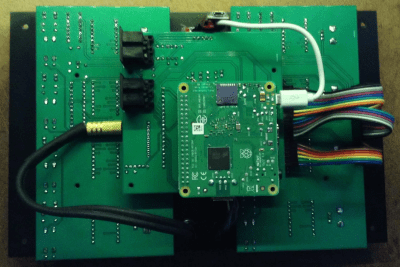
[Kevin] wanted to emulate the look and feel of the original TX816 aesthetic, developing a custom PCB handling the user interface for four of the eight channels, and a second acting as an interface to the Raspberry Pi using a Pico. Also sitting on this PCB is the GY-PCM5102 I2S DAC, and the MIDI connectors needed to connect to the system controller. Both PCBs, including a PCB-based front panel, were developed with KiCAD. The firmware for the Pico part of the system can be found on the firmware GitHub. The video demo (embedded below) shows off the system running a very 80s-sounding rendition of Holst’s famous ‘Jupiter’ from the planet series, and we all agree it sounds pretty sweet. For a complete rundown of the build, here are the links for the blog series for ease of access: Intro, PCBs, Panel, Build Guide, Mechanical, Pico/TX816 IO code, and finally usage. Phew!
If MiniDexed sounds familiar, that is because we featured another of [Kevin’s] earlier MiniDexed projects a little while ago.

Continue reading “An RPi-Powered Multi-DX7/TX816 Style Synth”

A History Of NASA Supercomputers, Among Others

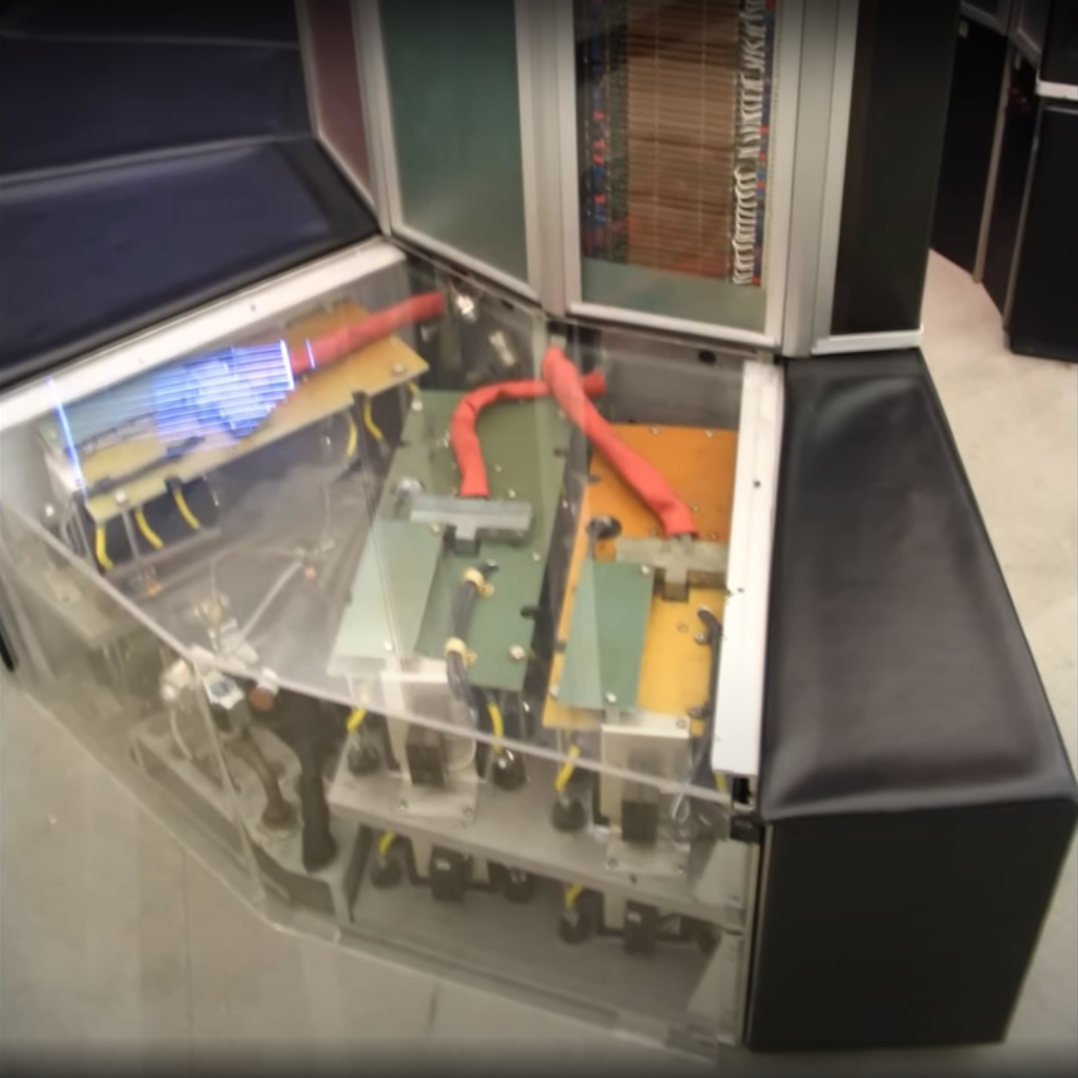
The History Guy on YouTube has posted an interesting video on the history of the supercomputer, with a specific focus on their use by NASA for the implementation of computational fluid dynamics (CFD) models of aeronautical assemblies.

The aero designers of the day were quickly finding out the limitations of the wind tunnel testing approach, especially for so-called transonic flow conditions. This occurs when an object moving through a fluid (like air can be modeled) produces regions of supersonic flow mixed in with subsonic flow and makes for additional drag scenarios. This severely impacts aircraft performance. Not accounting for these effects is not an option, hence the great industry interest in CFD modeling. But the equations for which (usually based around the Navier-Stokes system) are non-linear, and extremely computationally intensive.

Obviously, a certain Mr. Cray is a prominent player in this story, who, as the story goes, exhausted the financial tolerance of his employer, CDC, and subsequently formed Cray Research Inc, and the rest is (an interesting) history. Many Cray machines were instrumental in the development of the space program, and now adorn computing museums the world over. You simply haven’t lived until you’ve sipped your weak lemon drink whilst sitting on the ‘bench’ around an early Cray machine.

You see, supercomputers are a different beast from those machines mere mortals have access to, or at least the earlier ones were. The focus is on pure performance, ideally for floating-point computation, with cost far less of a concern, than getting to the next computational milestone. The Cray-1 for example, is a 64-bit machine capable of 80 MIPS scalar performance (whilst eating over 100 kW of juice), and some very limited parallel processing ability.

While this was immensely faster than anything else available at the time, the modern approach to supercomputing is less about fancy processor design and more about the massive use of parallelism of existing chips with lots of local fast storage mixed in. Every hacker out there should experience these old machines if they can, because the tricks they used and the lengths the designers went to get squeeze out every ounce of processing grunt, can be a real eye-opener.

Want to see what happens when you really push out the boat and use the whole wafer for parallel computation? Checkout the Cerberus. If your needs are somewhat less, but dabbling in parallel computing gets you all pumped, you could build a small array out of Pine64s. Finally, the story wouldn’t be complete without talking about the life and sad early demise of Seymour Cray.
Continue reading “A History Of NASA Supercomputers, Among Others”

Bust Out That Old Analog Scope For Some Velociraster Fun!

[Oli Wright] is back again with another installation of CRT shenanigans. This time, the target is the humble analog oscilloscope, specifically a Farnell DTV12-14 12 MHz dual-channel unit, which features a handy X-Y mode. The result is the Velociraster, a simple (in hardware terms) Raspberry Pi Pico based display driver.

Using a Pico to drive a pair of AD767 12-bit DACs, the outputs of which drive the two ‘scope input channels directly, this breadboard and pile-of-wires hack can produce some seriously impressive results. On the software side of things, the design is a now a familiar show, with core0 running the application’s high-level processing, and core1 acting in parallel as the rendering engine, determining static DAC codes to be pushed out to the DACs using the DMA and the PIO.

Continue reading “Bust Out That Old Analog Scope For Some Velociraster Fun!”

Holograms: The Future Of Speedy Nanoscale 3D Printing?

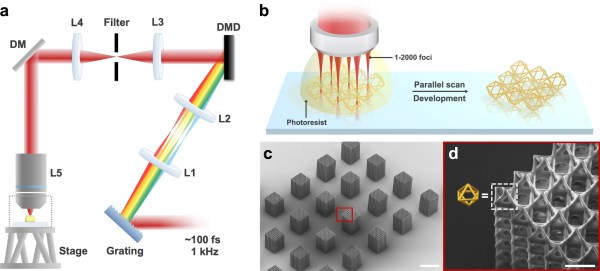
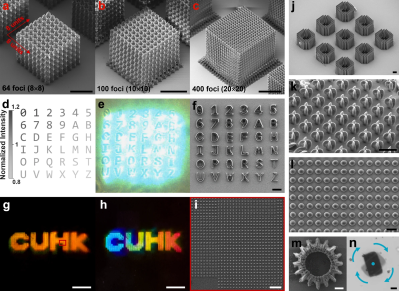
3D printing by painting with light beams on a vat of liquid plastic was once the stuff of science fiction, but now is very much science-fact. More than that, it’s consumer-level technology that we’re almost at the point of being blasé about. Scientists and engineers the world over have been quietly beavering away in their labs on the new hotness, nanoscale 3D printing with varying success. Recently IEESpectrum reports some promising work using holographic imaging to generate nanoscale structures at record speed.

Current stereolithography printers make use of UV laser scanned over the bottom of a vat of UV-sensitive liquid photopolymer resin, which is chemically tweaked to make it sensitive to the UV frequency photons. This is all fine, but as we know, this method is slow and can be of limited resolution, and has been largely superseded by LCD technology. Recent research has focussed on two-photon lithography, which uses a resin that is largely transparent to the wavelength of light concerned, but critically, can be polymerized with enough energy density (i.e. the method requires multiple photons to be simultaneously absorbed.) This is achieved by using pulsed-mode lasers to focus to a very tight point, giving the required huge energy density. This tight focus, plus the ability to pass the beam through the vat of liquid allows much tighter image resolution. But it is slow, painfully slow.
Continue reading “Holograms: The Future Of Speedy Nanoscale 3D Printing?”

CNC Intaglio-Esque Engraving

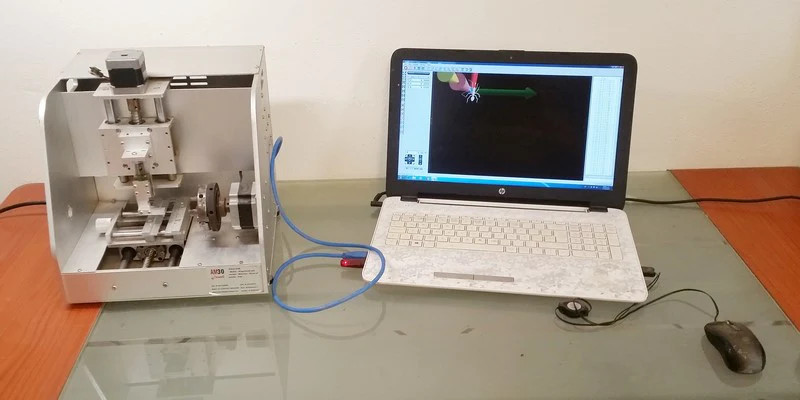
Intaglio is an ancient carving technique for adding details to a workpiece, by manually removing material from a surface with only basic hand tools. If enough material depth is removed, the resulting piece can be used as a stamp, as was the case with rings, used to stamp the wax seals of verified letters. [Nicolas Tranchant] works in the jewelry industry, and wondered if he could press a CNC engraving machine into service to engrave gemstones in a more time-efficient manner than the manual carving methods of old.

Engraving and machining generally work only if the tool you are using is mechanically harder than the material the workpiece is made from. In this case, this property is measured on the Mohs scale, which is a qualitative measurement of the ability of one (harder) material to scratch another. Diamond is the hardest known material on the Mohs scale and has a Mohs hardness of 10, so it can produce a scratch on the surface of say, Corundum — Mohs value 9 — but not the other way around.

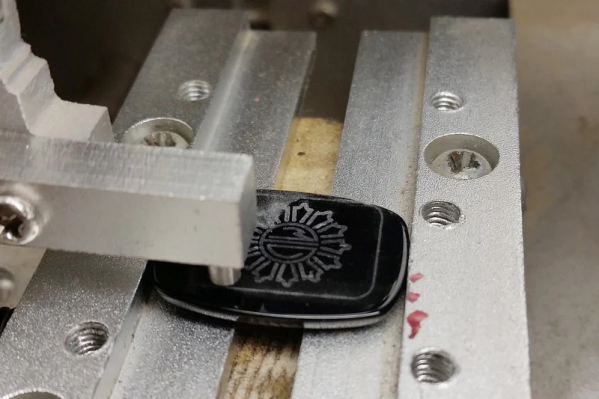
[Nicolas] shows the results of using a diamond tip equipped CNC engraver on various gemstones typical of Intaglio work, such as Black Onyx, Malachite, and Amethyst with some details of the number of engraving passes needed and visual comparison to the same material treated to traditional carving.

Let’s be clear here, the traditional intaglio process produces deep grooves on the surface of the workpiece and the results are different from this simple multi-pass engraving method — but limiting the CNC machine to purely metal engraving duties seemed a tad wasteful. Now if they can only get a suitable machine for deeper engraving, then custom digitally engraved intaglio style seal rings could be seeing a comeback!

Intaglio isn’t just about jewelry of course, the technique has been used in the typesetting industry for centuries. But to bring this back into ours, here’s a little something about making a simple printing press.

Ondol: Korean Underfloor Heating

One of the many aspects of the modern world we often take for granted is the very technology that keeps our accommodation at a habitable temperature. Examples of this include centralized heating systems using hot-water circulation, or blown air ducted to multiple rooms from a central furnace. Certainly in Europe, once the Romans shipped out, and before the industrial revolution, we were pretty cold unless someone lit a fire in the room. Every room. But not in Korea. The Ondol heating principles have been used constantly from about 5000 BC to only a few decades ago, keeping your average Korean countryman nice and toasty.

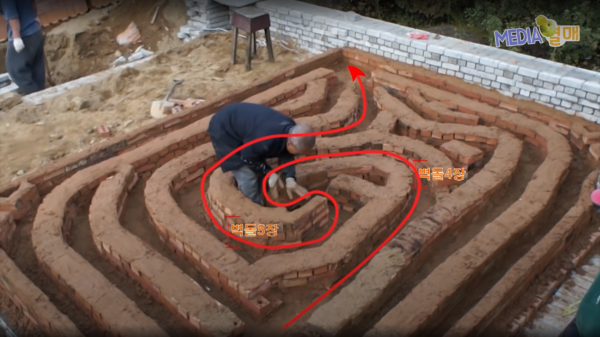
Having said that, the sophistication has improved a bit. Initially, the idea was to simply heat up a bunch of rocks in the fire, and bring them indoors, but Ondol quickly became part of the building itself. As will be seen from the video embedded below, the house sits on top of an elaborate double stack of serpentine channels, that circulate the hot combustion products from the furnace as thoroughly as possible, slowing down the gases and allowing their heat to transfer into the structure of the floor, and then radiate into the space above. It does bear more than a passing resemblance to the Roman hypocaust system, ruined examples of which can be found all over the UK and Europe. The skill demonstrated in the video is considerable, but must surely be an expensive build reserved for the most culturally aware Koreans who wish to live in simpler (and less hectic) locations in their country.

Maybe for the vast majority of us, this kind of thing is not viable, and we’re more likely to benefit from a more centralized approach, perhaps using waste heat from data centers or geothermal activity. (See: Iceland)

Continue reading “Ondol: Korean Underfloor Heating”

Who Needs Gasoline When You’ve Got Sodium?

YouTuber and serial debunker [Thunderf00t] was thinking about the use of sodium to counteract global warming. The theory is that sodium can be used as a fuel when combusted with air, producing a cloud of sodium hydroxide which apparently can have a cooling effect if enough of it is kicking around the upper atmosphere. The idea is to either use sodium directly as a fuel, or as a fuel additive, to increase the aerosol content of vehicle emissions and maybe reduce their impact a little.

One slight complication to using sodium as a fuel is that it’s solid at room temperature, so it would need to be either delivered as pellets or in liquid form. That’s not a major hurdle as the melting point is a smidge below 100 degrees Celsius and well within the operating region of an internal combustion engine, but you can imagine the impact of metal solidifying in your fuel system. Luckily, just like with solder eutectic mixes, sodium-potassium alloy happens to remain in liquid form at handleable temperatures and only has a slight tendency to spontaneously ignite. So that’s good.

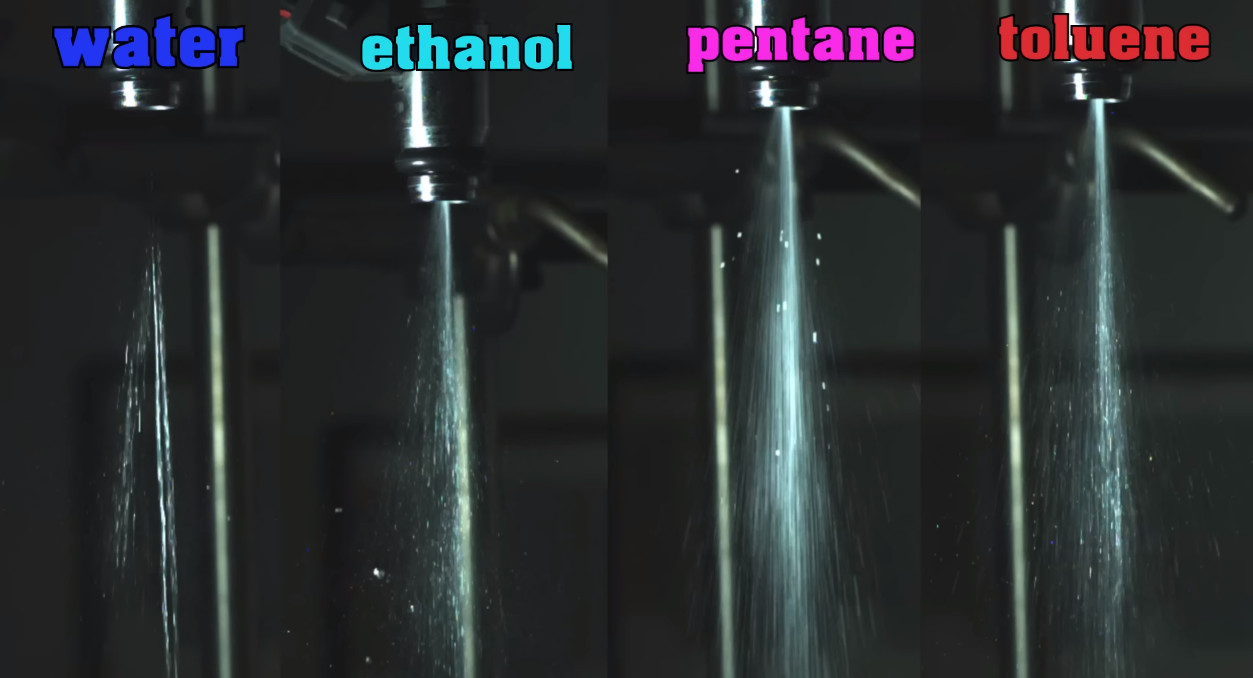
Initial experiments using ultrasonic evaporators proved somewhat unsuccessful due to the alloy’s electrical conductivity and tendency to set everything on fire. The next attempt was using a standard automotive fuel injector from the petrol version of the Ford Fiesta. Using a suitable container, a three-way valve to allow the introduction of fuels, and an inert argon feed (preventing spontaneous combustion in the air), delivering the liquid metal fuel into the fuel injector seems straightforward enough.

[Thunderf00t] started with ethanol, then worked up to pentane before finally attempting to use the feisty sodium-potassium, once the bugs had been shaken out of the high-speed video setup. [Thunderf00t] does stress the importance of materials selection when handling this potential liquid metal fuel, since it apparently just bursts into flames in a violent manner on contact with incompatible materials. Heck, this stuff even reacts with PTFE, which is generally considered a very resistant material. We’re totally convinced we’d not like to see this stuff being pumped from a roadside gas station, at all, but it sure is a fun concept to think about.

Sodium-Potassium alloy doesn’t feature on these pages too often, but here’s a little fountain of the stuff, just because why not?

Continue reading “Who Needs Gasoline When You’ve Got Sodium?”