Mini Library For Kids Gets Blinky Lights And Solar Upgrade

Reading is big in Québec, and [pepelepoisson]’s young children have access to a free mini library nook that had seen better days and was in dire need of maintenance and refurbishing. In the process of repairing and repainting the little outdoor book nook, he took the opportunity to install a few experimental upgrades (link in French, English translation here.)

The mini library pods are called Croque-Livres, part of a program of free little book nooks for children across Québec (the name is a bit tricky to translate into English, but think of it as “snack shack, but for books” because books are things to be happily devoured.)

After sanding and repairs and a few coats of new paint, the Croque-Livres was enhanced with a strip of WS2812B LEDs, rechargeable battery with solar panel, magnet and reed switch as door sensor, and a 3.3 V Arduino to drive it all. [pepelepoisson]’s GitHub repository for the project contains the code and CAD files for the 3D printed pieces.

The WS2812B LED strip technically requires 5 V, but as [pepelepoisson] found in his earlier project Stecchino, the LED strip works fine when driven directly from a 3.7 V lithium-polymer cell. It’s not until around 3 V that it starts to get unreliable, so a single 3.7 V cell powers everything nicely.

When the door is opened, the LED strip lights up with a brief animation, then displays the battery voltage as a bar graph. After that, the number of times the door as been opened is shown on the LED strip in binary. It’s highly visual, interactive, and there’s even a small cheat sheet explaining how binary works for anyone interested in translating the light pattern into a number. How well does it all hold up? So far so good, but it’s an experiment that doesn’t interfere at all with the operation of the little box, so it’s all good fun.
How To Retrofit A Pick And Place Machine For OpenPnP, In Detail

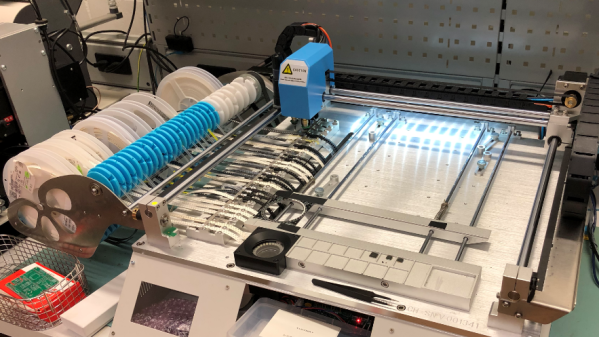
[Erich Styger] owns a Charmhigh CHM-T36VA pick and place machine, which he describes as well-built and a great value of hardware for the money. However, the software end is less impressive, with a proprietary controller that is functional but not great. The good news is that it is possible to retrofit the machine to use the OpenPnP framework, which is open-source and offers more features. Even better, [Erich] has already done and documented all the hard parts!

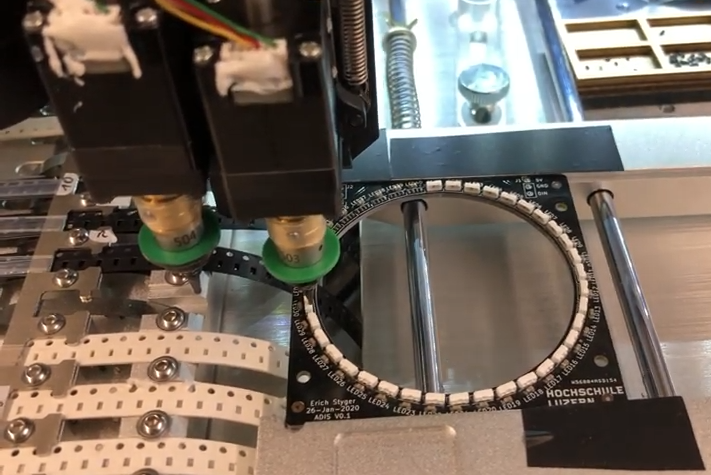
The CHM-T36VA has two heads, vision system, and uses drag feeders.

The conversion requires upgrading a few hardware parts such as the cameras, replacing the controller’s firmware, then installing and configuring OpenPnP (which runs on an attached PC.)

[Erich] does not recommend this conversion for anyone who is not very familiar with electronics, or has any worries about voiding warranties. Barring that, he suspects the conversion could be done in about a day or two’s worth of focused work. It took him two weeks, including time spent fine-tuning the first production job. He says the bulk of the time was spent on configuration, but he has shared his configuration on GitHub in the hopes that it will save a lot of time for anyone using the same hardware.

After populating some 300 boards and placing over 7000 parts, he’s very happy with the results. The machine places between 600 and 700 parts per hour, so speed might not be amazing but it’s perfectly serviceable. [Erich] finds that while the machine runs a little slower than it did with the original controller, it also runs much smoother and quieter overall. In return he gets what he truly wanted: a pick and place machine whose operation and configuration is entirely open and accessible. You can see it in action in the video, embedded below.

Continue reading “How To Retrofit A Pick And Place Machine For OpenPnP, In Detail”

Great Badge Concept: A “Geiger Counter” For WiFi Deauthentication Frames

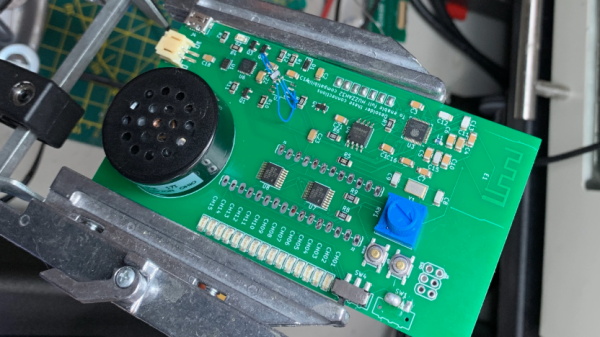
[Nick Price] had a wonderful concept for a DEFCON badge: a device that worked a lot like a directional Geiger counter, but chirped at detecting WiFi deauthentication packets instead of radiation. That’s a wild idea and it somehow slipped past us last year. Why detect such a thing? Well, the WiFi deauth attack is a kind of invisible toxicity, effectively jamming wireless communications by forcing users to be constantly tied up with authentication, and this device would detect it.

A few things were harder than expected, however. To make the device directional, [Nick] designed and built a PCB Yagi antenna but it wasn’t practical. Not only was it far too big, it would also have required going to four layers on a PCB that was already expensive. The solution he settled on — inspired by a friend’s joke about just dropping the badge into a Pringles can — was to surround the PCB omni antenna with a copper pipe end cap from the plumbing section of any hardware store. [Nick] figured that soldering that to the ground plane should result in a simple, cheap, and attractive directional antenna mod. Did it work? We’ll all have to wait and see.

Sadly, [Nick] wasn’t able to finish in time for last year’s DEFCON. Hardware revisions mounted, and fabrication times for his specialized PCB were longer than usual. Worse news is that this year’s is cancelled, or rather is going virtual, which means he’s going to have to deauth himself. The good news is that now he’s got another 12-month extension. Watch the brief video of the functional prototype, embedded below.

Continue reading “Great Badge Concept: A “Geiger Counter” For WiFi Deauthentication Frames”

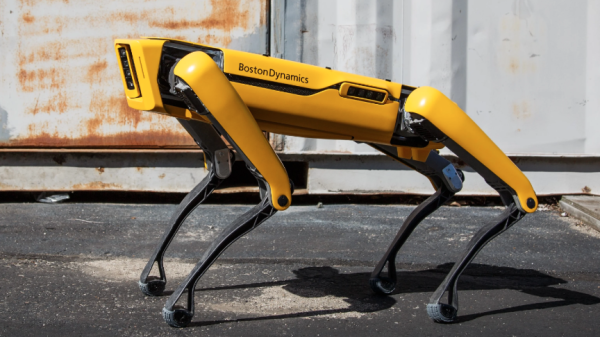
Boston Dynamics’ Spot Robot Gets A Price Tag: $75 Grand

One of Spot’s features is the ability to navigate real-world environments. This has not historically been a strong point for robots.

Not long ago, Boston Dynamics’ Spot finally went on sale, meaning the dog-like robot can now be purchased online. Previously it was available only to be leased by early adopters willing to pay to see what the robot had to offer. Pricing was tucked behind an NDA, and Spot could be only leased and not actually purchased — until now.

From a hobbyist’s perspective, Spot’s price is of course eye-watering; the cost of the accessories even more so. It would be perfectly understandable to ask what good is a robotic dog and what makes it worth such a cost?

From an industrial equipment point of view, the cost is perhaps less shocking. Maybe it’s a reminder that from an industrial and commercial perspective, the price of a thing matters mainly in relation to what kind of benefits it can bring, and what kind of price or savings can be hung on that.

Hackers being hackers and free from having to worry about such things, some choose to make their own four-legged robot pals with no winning lotto tickets, juicy grants, or enormous R&D budgets needed.

Hands On With A Batteryless E-Paper Display

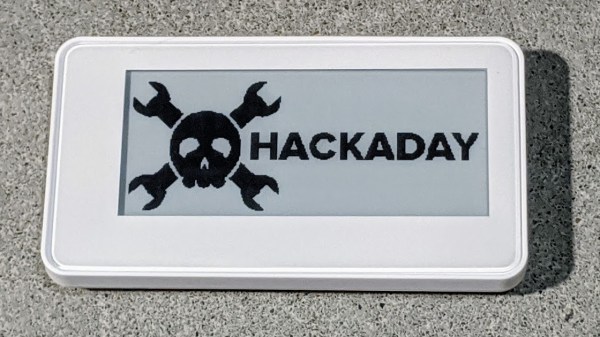
E-paper displays are unusual in that power is only needed during a screen update. Once the display’s contents have been set, no power whatsoever is required to maintain the image. That’s pretty nifty. By making the display driver board communicate wirelessly over near-field communication (NFC) — which also provides a small amount of power — it is possible for this device to be both wireless and without any power source of its own. In a way, the technology required to do this has existed for some time, but the company Waveshare Electronics has recently made easy to use options available for sale. I ordered one of their 2.9 inch battery-less NFC displays to see how it acts.

Continue reading “Hands On With A Batteryless E-Paper Display”

ESP32 Becomes Music Player In Under 40 Lines Of Code

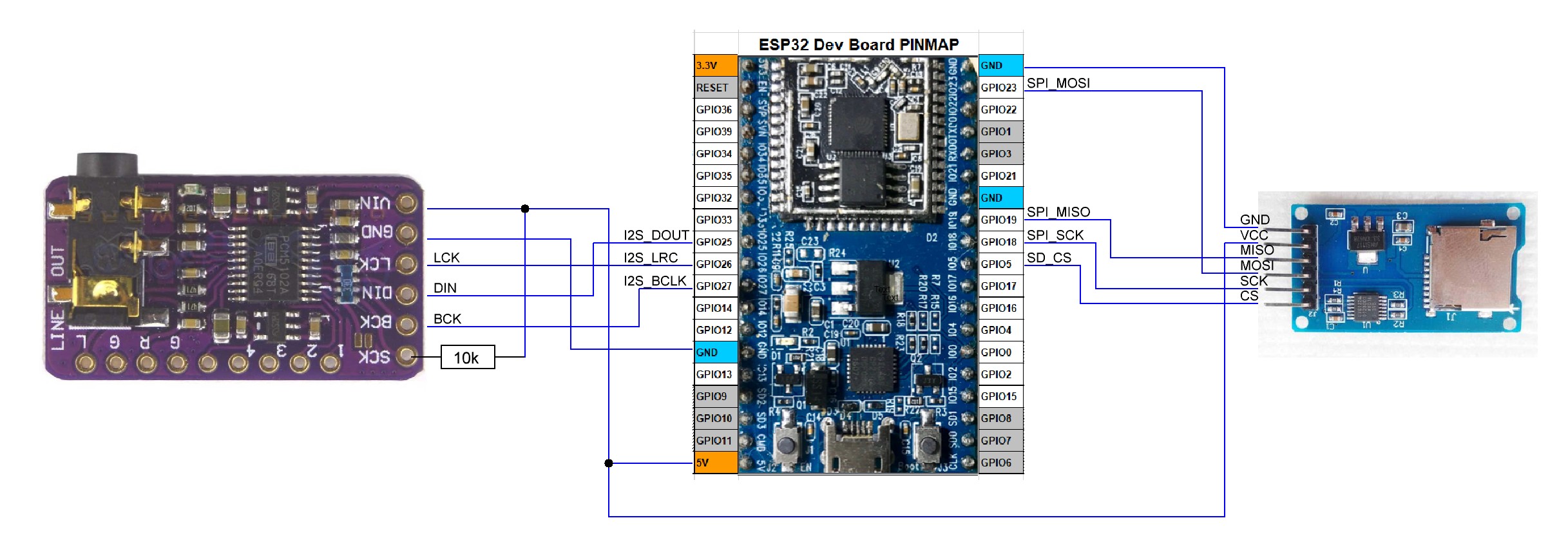
The demo code for [XTronical]’s ESP32-based SD card music player is not even 40 lines long, though it will also require a few economical parts before it all works. Nevertheless, making a microcontroller play MP3s (and other formats) from an SD card is considerably simpler today than it was years ago.

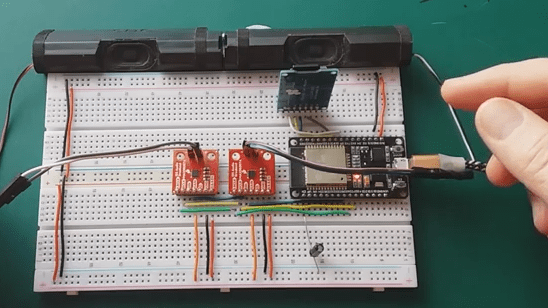
Part of what makes this all work is I2S (Inter-IC Sound), a format for communicating PCM audio data between devices. Besides the ESP32, at the heart of it all is an SD card reader breakout board and the MAX98357A, which can be thought of as a combination I2S decoder and Class D amplifier. The ESP32 reads audio files from the SD card and uses an I2S audio library to send the I2S data stream to the MAX98357A (or two of them for stereo.) From there it is decoded automatically and audio gets pumped though attached speakers.

A few economical components, and only a handful of connections between them.

It’s amazing how much easier audio is to work with when one can take advantage of shuffling audio data around digitally, and the decoder handles multiple formats with an amplifier built in. You can see [XTronical]’s ESP32 player in action in the video embedded below.

Continue reading “ESP32 Becomes Music Player In Under 40 Lines Of Code”

Dremel Workstation’s New Job: Applying Threaded Inserts With Cheap Soldering Iron

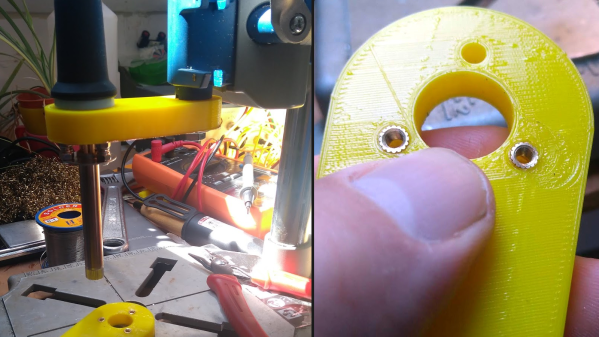
Dremel has been helping people fit square pegs into round holes for years, and [concretedog] saw that the Dremel 220 Workstation — a piece of hardware similar to a drill press — could be convinced to hold a cheap soldering iron just as easily as it holds a rotary tool. A soldering iron makes an effective thermal insert tool, and the job of heating and pressing the threaded metal rings into plastic is made much easier when it can be done similar to operating a drill press. With a few modifications and a 3D-printed adapter, the thermal insert rig was born.

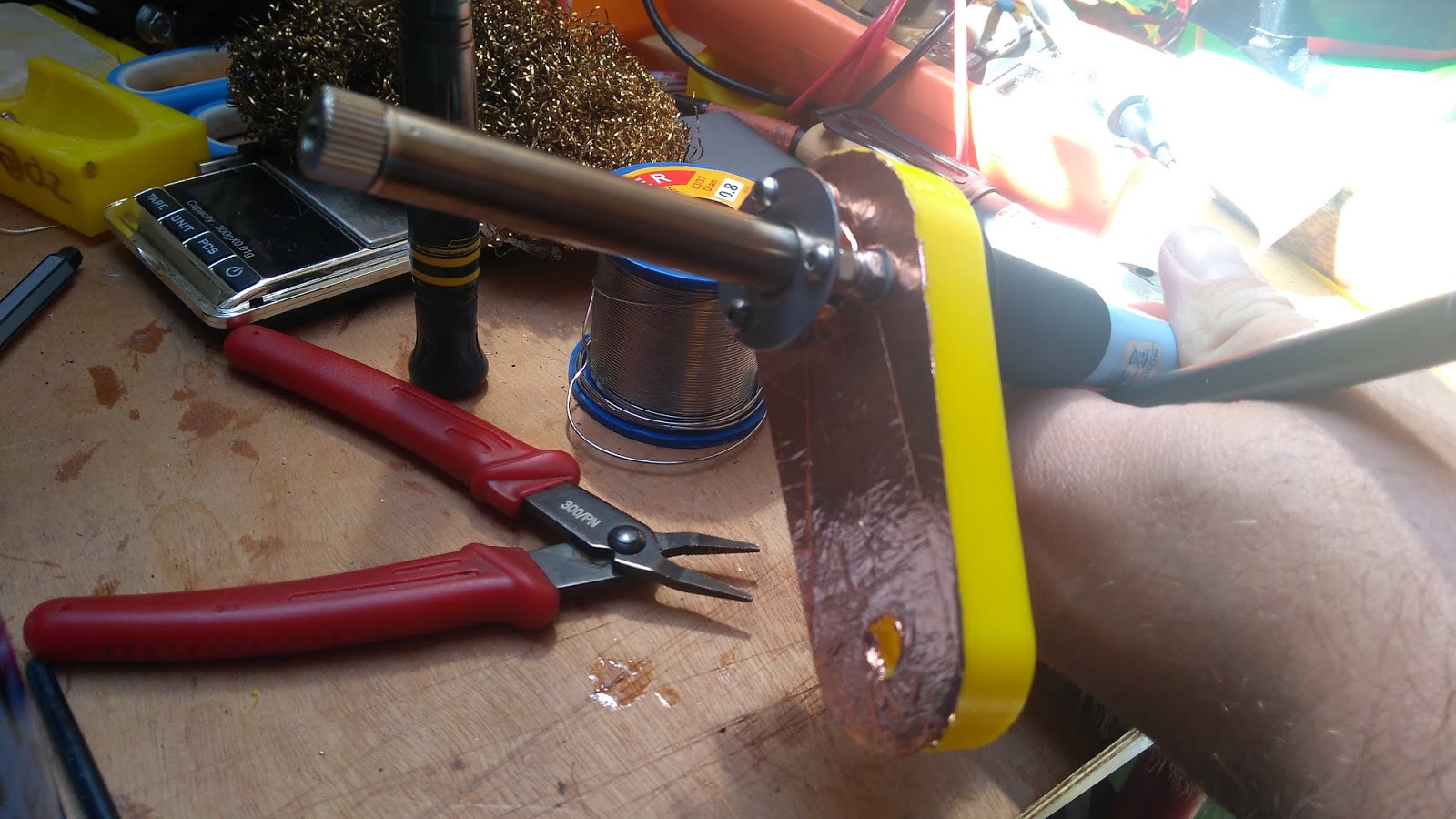
Whenever one is working around a design that already exists, it pays to be flexible and adjust to the unexpected. The Dremel 220 has a holder intended to clamp a rotary tool, and the original plan was to simply design and print an adapter so a soldering iron could sit in place of the rotary tool. That plan changed upon realizing that the entire rotary tool holder disconnected from the tool’s frame with a single bolt. It made much more sense to make the soldering iron replace the rotary tool holder, instead.

The resulting modified soldering iron is mounted via standoffs to a 3D-printed adapter with a copper foil heat shield. [concretedog] admits it’s not ideal from a heat management perspective, but it makes a fine prototype that seems to work well for light duty. The next step would be a metal version.

If you’re intrigued by threaded heat-set inserts, you can learn all about how to use them from Joshua Vasquez’s guide to the handy things. And should you prefer to make your own DIY press from 3D printed parts and off-the-shelf hardware, we have that covered as well.