Mini Marble-Powered Synth Pays Homage To Its Bigger Cousins

If imitation is the sincerest form of flattery, what then are we to make of something that shares only a few of the original’s design elements, operates in a completely different way, and has been scaled down to a fifth its size? Still seems like flattery to us.

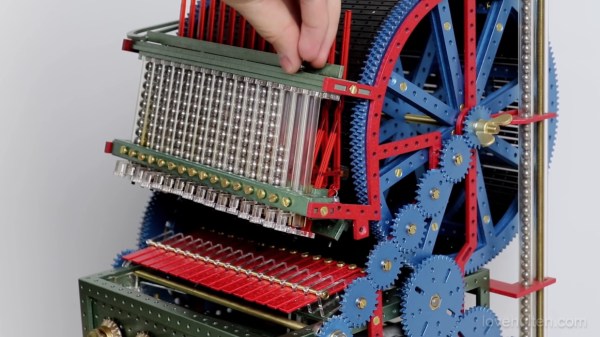
Despite the changes, it’s clear where [Love Hultén] took inspiration for his miniature Marble Machine XS. Readers will no doubt see in it elements from [Martin Molin]’s original Marble Machine, the fantastic plywood and Lego musical contraption, along with his new Marble Machine X, the construction of which never seems to end. Like the originals, [Love]’s miniature version uses a lot of steel balls, albeit considerably scaled down, and it still uses a programming drum to determine where and when to drop them. But rather than strike real traditional instruments, the falling balls strike synthesizer keys, triggering a range of sounds through its built-in speaker. The whole thing is powered by a small electric motor rather than being hand-cranked and is small enough to sit on a desktop, a decided advantage over the mammoth machines to which it pays homage.

We have to say that as much as we love the hacksmanship of the original Marble Machine and the craftsmanship of its successor, the look and feel of [Love]’s machine just blows us away. We’re not sure what materials he used, but the whole hammertone paint scheme and Meccano look is a feast for nostalgic eyes.

Continue reading “Mini Marble-Powered Synth Pays Homage To Its Bigger Cousins”

Eavesdropping On Satellites For Fun And Profit

Geosynchronous satellites, girdling the Earth from their perches 36,000 km above the equator, are remarkably useful devices. Depending on where they’re parked, they command views of perhaps a third of the globe at a time, making them perfect communications relays. But as [James Pavur] points out in his DEF CON Safe Mode talk, “Whispers Among the Stars”, geosynchronous satellite communication links are often far from secure.

[James], a D. Phil. student in Systems Security at Oxford University, relates that his exploits rely on the wide areas covered by the downlink signals from the satellites, coupled with security as an afterthought, if it was even thought of at all by satellite service providers. This lackadaisical approach let him use little more than a regular digital satellite TV dish and a tuner card for a PC — off-the-shelf stuff that you’d really have to try hard to spend more than $300 on — to tap into sensitive information.

While decoding the digital signals from satellites into something parseable can be done with commercial applications, [James] and his colleagues built a custom tool, GSExtract, to pull data from the often noisy signals coming down from on high. The setup returned an amazing bounty of information, like maritime operators relaying the passport information of crew members from ship to shore, point-of-sale terminal information from cruise ships in the Mediterranean, and in-flight entertainment systems in jet airliners. The last example proved particularly alarming, as it revealed an exploitable connection between the systems dedicated to keeping passengers content and those in the cockpit, which clearly should not be the case.

We found [James’] insights on these weaknesses in satellite communications fascinating, and it’s well worth the 45 minutes to watch the video below and perhaps try these exploits, which amount to side-channel attacks, for yourself.

Continue reading “Eavesdropping On Satellites For Fun And Profit”

Printing, Plating, And Baking Makes DIY Microlattices Possible

To be honest, we originally considered throwing [Zachary Tong]’s experiments with ultralight metallic microlattices into the “Fail of the Week” bucket. But after watching the video below for a second time, it’s just not fair to call this a fail, so maybe we’ll come up with a new category — “Qualified Success of the Week”, perhaps?

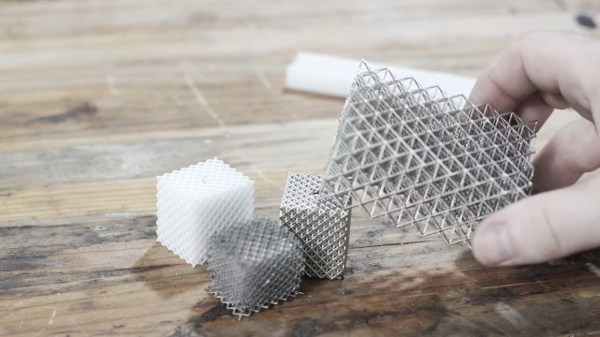
[Zachary]’s foray into the strange world of microlattices began when he happened upon a 2011 paper on the subject in Science. By using a special photocurable resin, the researchers were able to use light shining through a mask with fine holes to create a plastic lattice, which was then plated with nickel using the electroless process, similar to the first half of the electroless nickel immersion gold (ENIG) process used for PCBs. After removing the resin with a concentrated base solution, the resulting microlattice is strong, stiff, and incredibly light.

Lacking access to the advanced materials and methods originally used, [Zachary] did the best he could with what he had. An SLA printer with off-the-shelf resin was used to print the skeleton using the same algorithms used in the original paper. Those actually turned out pretty decent, but rather than electroless plating, he had to go with standard electroplating after a coat of graphite paint. The plated skeletons looked great — until he tried to dissolve the resin. When chemical approaches failed, into the oven went the plated prints. Sadly, it turns out that the polymers in the resin expand when heated, which blew the plating apart. A skeleton in PLA printed on an FDM printer fared little better; when heated to drive out the plastic, it became clear that the tortuous interior of the lattice didn’t plate very well.

From aerogels to graphene, we love these DIY explorations of new and exotic materials, so hats off to [Zachary] for giving it a try in the first place.

Continue reading “Printing, Plating, And Baking Makes DIY Microlattices Possible”

Open And Sustainable Engineering Hack Chat

Join us on Wednesday, August 19 at noon Pacific for the Open and Sustainable Engineering Hack Chat with Joshua Pearce!

Since the first of our hominid ancestors learned to pick up a rock and make it into a tool, we humans have been using our engineering skills to change the world. For most of the 2 million or so years since that first technological leap, natural materials like stone and wood were the focus of our engineering projects, and except for a few tantalizing remnants, most of what was built has returned to the Earth whence it came.

Then we discovered other materials; we learned to free metals from rocks and how to harvest the fossilized hydrocarbon remains of ancient plants. Iron, aluminum, plastic, and silicon became our stock in trade, and the planet is now layered so thick with these materials and the byproducts of harvesting them that a new geological epoch, the Anthropocene Epoch, has been proposed to cover this time of human activity and its impact on the geological record.

But if we humans are clever enough to make such an impact, we should be clever enough to think our way out of the mess, and wise enough to see the need. That’s where the efforts of Dr. Pearce’s research at the Michigan Tech Open Sustainability Technology (MOST) lab are focused. Dr. Pearce envisions a sustainable future powered by pervasive solar photovoltaic systems and using open-source technologies like 3D printing to drive new models for manufacturing. We’ve recently seen interesting work from his lab, like this grinder that makes custom compression screws for plastic recycling. The MOST page on Hackaday.io is filled with other great examples of the technology that supports their mission, from low-cost environmental testing instruments to 3D-printable microfluidics.

Dr. Pearce will join us on the Hack Chat to talk about open and sustainable engineering. Be sure to stop by with your questions and to find out what you can do to engineer a brighter future, starting right in your own shop.

join-hack-chatOur Hack Chats are live community events in the Hackaday.io Hack Chat group messaging. This week we’ll be sitting down on Wednesday, August 19 at 12:00 PM Pacific time. If time zones baffle you as much as us, we have a handy time zone converter.

Click that speech bubble to the right, and you’ll be taken directly to the Hack Chat group on Hackaday.io. You don’t have to wait until Wednesday; join whenever you want and you can see what the community is talking about.

Continue reading “Open And Sustainable Engineering Hack Chat”

Hackaday Links Column Banner

Hackaday Links: August 16, 2020

Potentially bad news for those of us who prefer not to be assimilated into the Google hive mind: Mozilla seems to be on the rocks. Citing revenue problems, the maker of Firefox and other popular tools will be trimming 250 employees, about a quarter of its workforce, and shuttering its office in Taipei. CEO Mitchell Baker specifically mentioned that “development tools, internal tooling, and platform feature development” in the Firefox team would see reduced investment. Like a lot of companies do these days, she managed to blame COVID-19 for the company’s woes. That seems a little specious to us, but whatever the reason for the downturn in revenue, here’s hoping that Mozilla can keep Firefox alive.

Speaking of our evil overlords, looks like it another one of those “oopsies” moment for Google when it “accidentally” activated some of its smart speakers to listen into household events without the wake word. In this case, a user reported getting a text about a smoke alarm going off in their home. The alarm was not a surprise, since the user was cooking at the time, but the notification was, since they didn’t opt into that particular service. Google’s response was that an update pushed to the speaker accidentally activated that feature, a situation that they say has since been rectified. To be clear, this is an interesting feature and one of the more compelling use cases we’ve seen for a smart speaker, but it’s something we’d certainly want to sign off on before it’s activated. Yes, accidents happen, but these kinds of accidents seem to happen to Google an awful lot lately.

We’ve probably all had the experience over the last few months of being in public when the urge to cough hits. Masked or not, you struggle to fight back the tickle, lest someone hear you and think you’re infected. But now it’s possible for a computer to cough-shame you, thanks to a deep learning cough locater. The model was trained against recordings of people coughing and is coupled to an acoustic camera, which identifies the cougher with a bounding box and a contour image of the cough which looks for all the world like a virtual cloud of microbes. It’s genuinely interesting technology, sort of the public health version of ShotSpotter, but we doubt it’ll be of much practical use in public; if you want to find someone who has just coughed, someone acting like this will likely already be on the case.

Modern jet fighter technology is advancing rapidly, so much so that the forces they can apply during extreme maneuvers can quickly be lethal to pilots. Given that humans aren’t likely to evolve the ability to resist turning into a puddle of goo under high g-forces anytime soon, fighters of the future will likely incorporate AI of some sort. To prepare for that eventuality, the Defense Advanced Research Projects Agency (DARPA) is running some AI fighter competitions this week that really look interesting. Dubbed Alpha Dogfight Trials, the challenge starts with simulated dogfights between AI systems. The winner of those rounds will go up against a human pilot in the final match, which will be streamed live with commentary and multi-screen coverage. You need to register to get in on the action, and time is limited.

And finally, let these three words roll around in your head for a minute: robotic chameleon tongue. It’s actually nowhere near as disturbing as it sounds, since at its heart the “Snatcher” is actually just a beefed-up tape measure. Designed for remote retrieval tasks, the Snatcher can shoots it steel proboscis out almost a meter in just 600 milliseconds. Its designers envision uses for it on drones, but we can see it potentially being deployed on satellites too. It shouldn’t be too hard to build something like this at home, either.

Abused Hard Drive Becomes POV Clock

We all know that there’s not much to do with an old hard drive. Once you render the platters unreadable and perhaps harvest those powerful magnets, there’s not much left of interest. Unless, of course, you turn the whole thing into a persistence-of-vision clock.

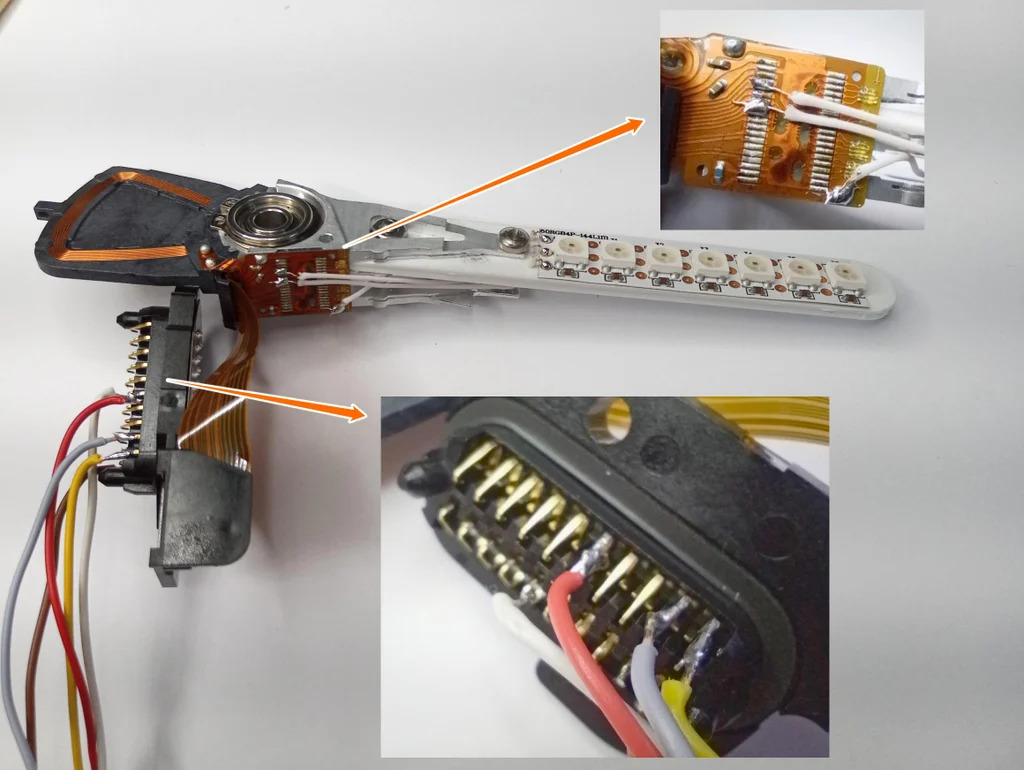
At least that’s what [Leo] did when he created “PendoLux”. The clock itself is pretty simple; like any POV project, it just requires a way to move an array of flashing LEDs back and forth rapidly enough that they can trick the eye into seeing a solid image. [Leo] put the read head mechanism of an old HDD into use for that, after stripping the platters and motor out of it first.

The voice coil and magnet of the head arm are left intact, while a 3D-printed arm carrying seven RGB LEDs replaces the old heads. [Leo] added a small spring to return the arm to a neutral position, and used an Arduino to drive the coil and flash the LEDs. Getting the timing just right was a matter of trial and error; he also needed to eschew the standard LED libraries because of his heavy use of interrupts and used direct addressing instead.

POV clocks may have dropped out of style lately — this hard drive POV clock and a CD-ROM version were posted years ago. But [Leo]’s clock is pretty good looking even for a work in progress, so maybe the style will be making a comeback.

Continue reading “Abused Hard Drive Becomes POV Clock”

Moving Fridge Magnets Make For Unique Clock

We see a ton of clock projects around these parts, and being hackers, we love to feature them all. But every once in a while we stumble upon a great new way to display the time that really gets our attention and requires a closer look, such as this moving fridge magnet clock.

The fridge magnets [Craig Colvin] built this unique clock around are the colorful plastic kinds that have adorned the lower regions of refrigerators in toddler-filled households for ages. Instead of residing on a fridge, [Craig] laminated a sheet of white acrylic to a thin sheet of steel, to give the magnets something to hold onto. Moving the numbers is the job of a CoreXY-style mechanism. The belt-driven Cartesian movement maneuvers a head to to the right location to pick up a number; a servo in the head moves two powerful magnets into position under the number. The head then moves the number to the right spot, releases its magnets, and the number stays put on the board. You can see it in action in the video after the break.

While we love this as it is, it brings to mind some great mods. One can imagine the addition of letters to make a legit word clock, or to just add a calendar display. We’d also love to see these magnets in their natural habitat by building this into the door of a working fridge.

Continue reading “Moving Fridge Magnets Make For Unique Clock”