Retrotechtacular: The Nernst Lamp

After dominating the illumination market for more than a century, it’s easy to think of the glowing filament of the standard incandescent lamp as the only way people found to turn electricity into light. But plenty of fertile minds turned out alternative designs, one of which is the fascinating Nernst lamp, which we’d previously never heard of.

If the name sounds familiar, it’s likely through exposure to [Walther Nernst]’s equation for electrochemistry, or for his “New Heat Theorem” which eventually became the Third Law of Thermodynamics. Pal of [Einstein] and eventual Nobel laureate, [Nernst] was also a bit of a tinkerer, and he came up with a design for an incandescent lamp in 1897 that was twice as efficient as carbon-filament lamps. The video below, from the Edison Tech Center, details the design, which used a ceramic “glower rod” that would incandesce when current flowed through it. The glower, though, was not conductive until it was quite hot, so separate heater coils that gave the glower a start on the process were included; these were switched off by a relay built into the base of the lamp once the glower started conducting.

It’s a complicated design, but its efficiency, coupled with a better light spectrum and the fact that it didn’t need a vacuum bulb since the glower wouldn’t oxidize like a carbon or tungsten filament, gave it certain advantages that let it stake out a decent share of the early market for electric illumination. It was even the light source for one of the first facsimile machines. We find it a very clever use of what were at the time exotic materials, and wonder if this could have lead to something like vacuum tubes without the vacuum.

Continue reading “Retrotechtacular: The Nernst Lamp”

PPE Testing Hack Chat

Join us on Wednesday, June 17 at noon Pacific for the PPE Testing Hack Chat with Hiram Gay and Lex Kravitz!

When the COVID-19 pandemic unfolded in early 2020, the hacker community responded in the most natural way possible: by making stuff. Isolation and idleness lead to a creative surge as hackers got to work on not only long-deferred fun projects but also potential solutions to problems raised by an overloaded medical system and choked supply chains. And so workshops and hackerspaces the world over churned out everything from novel ventilators to social-distancing aids.

But perhaps the greatest amount of creative energy was set loose on the problem of personal protective equipment, or PPE. This was due in no small part to predictions of a severe shortage of the masks, gowns, and gloves that front-line medical workers would need to keep them safe while caring for pandemic victims, but perhaps also because, at least compared to the complexity of something like a ventilator, building a mask seems easy. And indeed it is as long as you leave unanswered the crucial question: does the thing work?

Answering that question is not as easy as it seems, though. It’s not enough to assume that putting some filtration between the user and the world will work; you’ve got to actually make measurements. Hiram Gay and Lex Kravitz, colleagues at the Washington University School of Medicine in St. Louis, actually crunched the numbers on the full-face snorkel mask they modified for use as a face shield for medical PPE, and they have a lot of insights to share about proper testing of such devices. They’ll join the Hack Chat this week to discuss their findings, offer advice to builders, and reveal how they came up with their idea for a different way to build and test PPE.

join-hack-chatOur Hack Chats are live community events in the Hackaday.io Hack Chat group messaging. This week we’ll be sitting down on Wednesday, June 17 at 12:00 PM Pacific time. If time zones have you down, we have a handy time zone converter.

Click that speech bubble to the right, and you’ll be taken directly to the Hack Chat group on Hackaday.io. You don’t have to wait until Wednesday; join whenever you want and you can see what the community is talking about.
Continue reading “PPE Testing Hack Chat”

Hackaday Links Column Banner

Hackaday Links: June 14, 2020

You say you want to go to Mars, but the vanishingly thin atmosphere, the toxic and corrosive soil, the bitter cold, the deadly radiation that sleets down constantly, and the long, perilous journey that you probably won’t return from has turned you off a little. Fear not, because there’s still a way for you to get at least part of you to Mars: your intelligence. Curiosity, the Mars rover that’s on the eighth year of its 90-day mission, is completely remote-controlled, and NASA would like to add some self-driving capabilities to it. Which is why they’re asking for human help in classifying thousands of images of the Martian surface. By annotating images and pointing out what looks like soil and what looks like rock, you’ll be training an algorithm that one day might be sent up to the rover. If you’ve got the time, give it a shot — it seems a better use of time than training our eventual AI overlords.

We got a tip this week that ASTM, the international standards organization, has made its collection of standards for testing PPE available to the public. With titles like “Standard Test Method for Resistance of Medical Face Masks to Penetration by Synthetic Blood (Horizontal Projection of Fixed Volume at a Known Velocity)”, it seems like the standards body wants to make sure that that homebrew PPE gets tested properly before being put into service. The timing of this release is fortuitous since this week’s Hack Chat features Hiram Gay and Lex Kravitz, colleagues from the Washington University School of Medicine who will talk about what they did to test a respirator made from a full-face snorkel mask.

There’s little doubt that Lego played a huge part in the development of many engineers, and many of us never really put them away for good. We still pull them out occasionally, for fun or even for work, especially the Technic parts, which make a great prototyping system. But what if you need a Technic piece that you don’t have, or one that never existed in the first place? Easy — design and print your own custom Technic pieces. Lego Part Designer is a web app that breaks Technic parts down into five possible blocks, and lets you combine them as you see fit. We doubt that most FDM printers can deal with the fine tolerances needed for that satisfying Lego fit, but good enough might be all you need to get a design working.

Chances are pretty good that you’ve participated in more than a few video conferencing sessions lately, and if you’re anything like us you’ve found the experience somewhat lacking. The standard UI, with everyone in the conference organized in orderly rows and columns, reminds us of either a police line-up or the opening of The Brady Bunch, neither of which is particularly appealing. The paradigm could use a little rethinking, which is what Laptops in Space aims to do. By putting each participant’s video feed in a virtual laptop and letting them float in space, you’re supposed to have a more organic meeting experience. There’s a tweet with a short clip, or you can try it yourself. We’re not sure how we feel about it yet, but we’re glad someone is at least trying something new in this space.

And finally, if you’re in need of a primer on charlieplexing, or perhaps just need to brush up on the topic, [pileofstuff] has just released a video that might be just what you need. He explains the tri-state logic LED multiplexing method in detail, and even goes into some alternate uses, like using optocouplers to drive higher loads. We like his style — informal, but with a good level of detail that serves as a jumping-off point for further exploration.


No Need For Speed With This Arduino-Based Inkjet Printer

When it comes to computers, it seems like the only thing that matters is speed. The more the better, in general, and the same applies to peripherals. We want the fastest network adapters, the fastest video card, and the fastest printer. So why in the world would anyone intentionally build a really slow inkjet printer? For art, of course.

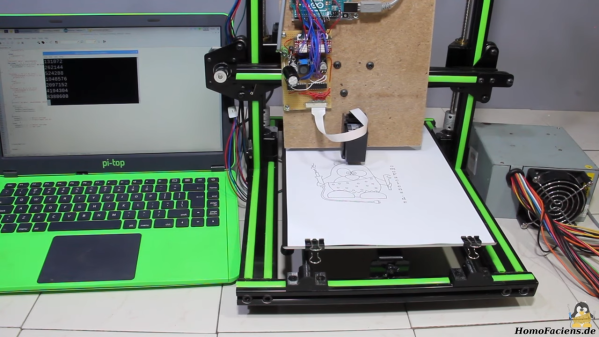
At least that’s the story [HomoFaciens] tells us in the video below. His efforts are in support of a friend’s art project, which seeks to print slowly but continuously on a roll of paper. [HomoFaciens]’s printer is based on an H-P C6602 inkjet cartridge, one of those high-priced consumables that make buying a new printer more attractive than replacing them once depleted. After figuring out how to drive the printhead — 5 to 6 μs pulses of 18 volts through a ULN2803 Darlington array driver chip seemed to do the trick — he mounted everything to the gantry of an old 3D printer. It’s interesting to watch the images slowly being built up — something that printers usually hide from prying eyes — and to see how the DPI count of the printer can be increased by interlacing each printed line.

Near the end of the video, we get a glimpse of his “tattoo gun printer”, which reminded us of all the other cool things he’s done over the years. From a CNC machine made from paperclips and cardboard to an encoder made from a wheel of resistors, [HomoFaciens] has some interesting designs that you really should check out.

Continue reading “No Need For Speed With This Arduino-Based Inkjet Printer”

Cheap Lab Balance Needs Upgrades, Gets Gutted Instead

What is this world coming to when you spend seven bucks on a digital scale and you have to completely rebuild it to get the functionality you need? Is nothing sacred anymore?

Such were the straits [Jana Marie] found herself in with his AliExpress special, a portable digital scale that certainly looks like it’s capable of its basic task. Sadly, though, [Jana] was looking for a few more digits of resolution and a lot more in the way of hackability. And so literally almost every original component was ripped out of the scale, replaced by a custom PCB carrying an STM32 microcontroller and OLED display. The PCB has a complicated shape that allows the original lid to attach to it, as well as the stainless steel pan and load cell. [Jana] developed new firmware that fixes some annoying traits, for example powering down after 30 seconds, and adds new functionality, such as piece-counting by weight. The video below shows some of the new features in action.

Alas, [Jana] reports that even the original load cell must go, as it lacks the accuracy her application requires. So she’ll essentially end up building the scale from scratch, which we respect, of course. At this rate, she might even try to build her own load cell from SMD resistors too.

Continue reading “Cheap Lab Balance Needs Upgrades, Gets Gutted Instead”

Retrotechtacular: Wire Splicing The Army Way

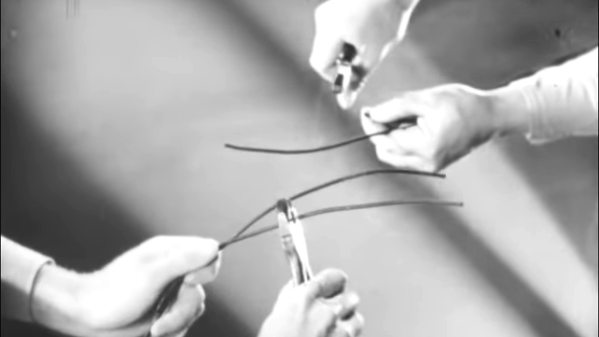
For those of us who started experimenting with electricity when we were very young, one of the essential first skills was learning how to twist wires together. It seems like there’s not much to learn, but after a few failed attempts with nothing but your fingers, you learned a few tricks that are probably still with you to this day. It’s not surprising, then, that there’s an official US Army way to twist wires together, as this Signal Corps training film from 1941 shows.

Considering that the Signal Corps had nearly 80 years of experience with wiring battlefield communications at the outbreak of World War II, their methods were pretty solid, as were their materials. The film mainly concerns the splicing together of rolls of type W110-B field wire, used by the Signal Corps to connect command posts to forward positions, observation posts, and the rear echelons. More often than not laid directly upon the ground, the wire had to be tough, waterproof, and conductive enough that field telephone gear would still work over long loop lengths. As such, the steel-reinforced, rubber-and-fabric clad cable was not the easiest stuff to splice. Where we might cringe at the stresses introduced by literally tying a conductor in knots, it was all part of the job for the wire-laying teams that did the job as quickly as possible, often while taking enemy fire.

The film also has a section on splicing a new line into an existing, in-service circuit, using a T-splice and paying careful attention to the topology of the knots used, lest they come undone under stress. It’s fascinating how much thought was put into something as mundane as twisting wires, but given the stakes, we can appreciate the attention to detail.

Continue reading “Retrotechtacular: Wire Splicing The Army Way”

Autonomous Sentry Gun Packs A Punch And A Ton Of Build Tips

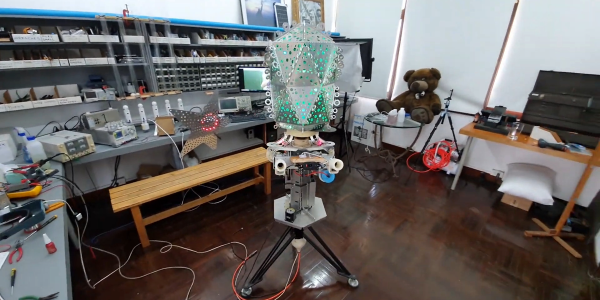
What has dual compressed-air cannons, 500 roll-on deodorant balls, and a machine-learning brain with a bad attitude? We didn’t know either, until [Leo Fernekes] dropped this video on his autonomous robot sentry gun and saw it in action for ourselves.

Now, we’ve seen tons of sentry guns on these pages before, shooting everything from water to various forms of Nerf. And plenty of those builds have used some form of machine vision to aim the gun onto the target. So while it might appear that [Leo]’s plowing old ground here, this build is chock full of interesting tips and tricks.

It started when [Leo] saw a video on TensorFlow basics from our friend [Edje Electronics], which gave him the boost needed to jump into an AI project. The controller he ended up with looks for humans in the scene and slews the turret onto target, where the air cannons can do their thing. The hefty ammo is propelled by compressed air, which is dumped into the chamber using a solenoid valve with an interesting driver that maximizes the speed at which it opens. Style points go to the bacteriophage T4-inspired design, and to the sequence starting at 1:34 which reminded us of the factory scene from RoboCop.

[Leo] really put a ton of work into this project, and the results show. He is hoping to get an art gallery or museum to show it as an interactive piece to comment on one possible robot-human future, presumably after getting guests to sign a release. Whatever happens to it, the robot looks great and [Leo] learned a lot from it, as did we.

Continue reading “Autonomous Sentry Gun Packs A Punch And A Ton Of Build Tips”