Imagine being asked to provide sound reinforcement for a meeting that occurs in a large room, where anyone can be the speaker, and in a situation where microphones would hinder the flow of the meeting. Throw in a couple of attendees who have hearing disabilities, and you’ve got quite a challenge to make sure everyone gets heard.
Such a situation faced [David Schneider] at his Quaker meetinghouse, which he ended up solving with this home-brew audio induction loop system. The worship style of conservative sects of the Religious Society of Friends, as the Quakers are formally known, is “silent worship”, where congregants sit together in silence until someone feels moved to share something. Anyone can speak at any time from anywhere in the room, leading to the audio problem.
Rooms mics and a low power FM transmitter didn’t work because those using radio as aids to hearing the service felt awkward, so [David] decided to take advantage of a feature in the hearing aids worn by some members: telecoils. These are inductive receivers built into some hearing aids to send sound directly to them using magnetic fields generated by a loop in the listening area. [David]’s loop ended up being 240 meters of 20-gauge copper wire in the attic above the meeting room. The impedance ended up close to 8 ohms, perfect for feeding directly from the speaker terminals of an old stereo amplifier. Pumping 160 Watts into the coil allows the hearing-aid wearers below hear the service now.
There’s still work to be done on the input side to improve audio quality, but [David]’s solution is elegant in that it helps those who need it most using technology they already have. And perhaps those who need but don’t yet have hearing aids can roll their own.
In most of the developed world, when people go to see a doctor, they’re used to seeing the latest instruments and devices used. Most exam rooms have fancy blood pressure cuffs, trays of shiny stainless steel instruments, and a comfortable exam table covered by a fresh piece of crisp, white paper. Exams and procedures are conducted in clean, quiet places, with results recorded on a dedicated PC or tablet.
Such genteel medical experiences are far from universal, though. Many clinics around the world are located in whatever building is available, if they’re indoors at all. Supplies may be in chronically short supply, and to the extent that the practitioners have the instruments they need to care for patients, they’ll likely be older, lower-quality versions.
Tarek Loubani is well-versed in the practice of medicine under conditions like these, as well as far worse situations. As an emergency physician and researcher in Canada, he’s accustomed to well-appointed facilities and ample supplies. But he’s also involved in humanitarian relief, taking his medical skills and limited supplies to places like Gaza. He has seen first-hand how lack of the correct tools can lead to poor outcomes for patients, and chose to fight back by designing a range of medical devices and instruments that can be 3D-printed. His Glia Project has free plans for a high-quality stethoscope that can be built for a couple of dollars, otoscopes and pulse oximeters, and a range of surgical tooling to make the practice of medicine under austere conditions a little easier. Continue reading “Open-Source Medical Devices Hack Chat”→
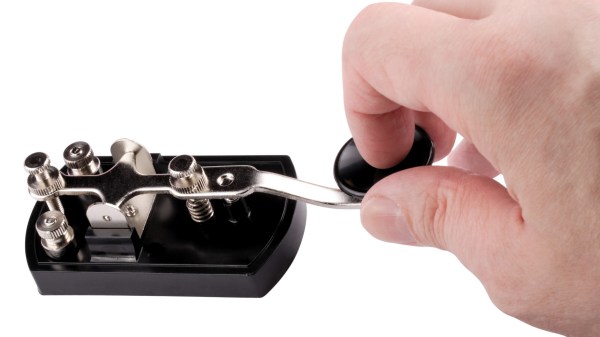
Conventional wisdom holds that the best way to learn a new language is immersion: just throw someone into a situation where they have no choice, and they’ll learn by context. Militaries use immersion language instruction, as do diplomats and journalists, and apparently computers can now use it to teach themselves Morse code.
The blog entry by the delightfully callsigned [Mauri Niininen (AG1LE)] reads like a scientific paper, with good reason: [Mauri] really seems to know a thing or two about machine learning. His method uses curated training data to build a model, namely Morse snippets and their translations, as is the usual approach with such systems. But things take an unexpected turn right from the start, as [Mauri] uses a Tensorflow handwriting recognition implementation to train his model.
Using a few lines of Python, he converts short, known snippets of Morse to a grayscale image that looks a little like a barcode, with the light areas being the dits and dahs and the dark bars being silence. The first training run only resulted in about 36% accuracy, but a subsequent run with shorter snippets ended up being 99.5% accurate. The model was also able to pull Morse out of a signal with -6 dB signal-to-noise ratio, even though it had been trained with a much cleaner signal.
Other Morse decoders use lookup tables to convert sound to text, but it’s important to note that this one doesn’t. By comparing patterns to labels in the training data, it inferred what the characters mean, and essentially taught itself Morse code in about an hour. We find that fascinating, and wonder what other applications this would be good for.
The news this week was dominated by the novel coronavirus outbreak centered in Wuhan, China. Despite draconian quarantines and international travel restrictions, the infection has spread far beyond China, at least in small numbers. A few cases have been reported in the United States, but the first case reported here caught our eye for the technology being used to treat it. CNN and others tell us that the traveler from Wuhan is being treated by a robot. While it sounds futuristic, the reality is a little less sci-fi than it seems. The device being used is an InTouch Vici, a telemedicine platform that in no way qualifies as a robot. The device is basically a standard telepresence platform that has to be wheeled into the patient suite so that providers can interact with the patient remotely. True, it protects whoever is using it from exposure, but someone still has to gown up and get in with the patient. We suppose it’s a step in the right direction, but we wish the popular press would stop slapping a “robot” label on things they don’t understand.
Also in health news, did you know you’re probably not as hot as you think you are? While a glance in the mirror would probably suffice to convince most of us of that fact, there’s now research that shows human body temperature isn’t what it used to be. Using medical records from the Civil War-era to the 1930s and comparing them to readings taken in the 1970s and another group between 2007 and 2017, a team at Stanford concluded that normal human body temperature in the USA has been slowly decreasing over time. They proposed several explanations as to why the old 98.6F (37C) value is more like 97.5F (36.4C) these days, the most interesting being that general overall inflammation has decreased as sanitation and food and water purity have increased, leading the body to turn down its thermostat, so to speak. Sadly, though, if the trend holds up, our body temperature will reach absolute zero in only 111,000 years.
Wine, the not-an-emulator that lets you run Windows programs on POSIX-compliant operating systems, announced stable release 5.0 this week. A year in the making, the new version’s big features are multi-monitor support with dynamic configuration changes and support for the Vulkan spec up to version 1.1.126.
Any color that you want, as long as it’s amorphous silicon. Sono Motors, the German start-up, has blown past its goal of raising 50 million euros in 50 days to crowdfund production of its Sion solar-electric car. The car is planned to have a 255 km range on a full charge, with 34 km of that coming from the solar cells that adorn almost every bit of the exterior on the vehicle. Living where the sun doesn’t shine for a third of the year, we’re not sure how well this will pay off, but it certainly seems smarter than covering roads with solar cells.
And finally, here’s a trip down memory lane for anyone who suffered through some of the cringe-worthy depictions of technology that Hollywood came up with during the 70s, 80s, and 90s. Looking back through the clips shown in “copy complete” reminds us just how many movies started getting into the tech scene. It wasn’t just the sci-fi and techno-thrillers that subjected us to closeups of scrolling random characters and a terminal that beeped every time something changed on the screen. Even straight dramas like Presumed Innocent and rom-coms like You’ve Got Mail and whatever the hell genre Ghost was got in on the act. To be fair, some depictions were pretty decent, especially given the realities of audience familiarity with tech before it became pervasive. And in any case, it was fun to just watch and remember when movies were a lot more watchable than they are today.
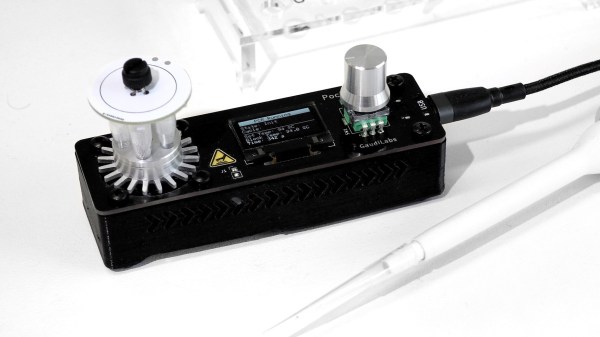
When the first thermal cyclers for the polymerase chain reaction came out in the 1980s, they were as expensive as a market driven by grant money could make them. Things haven’t got much better over the years, largely shutting STEM classes and biohackers out of the PCR market. That may be about to change, though, if the €99.00 PocketPCR thermal cycler takes hold.
PCR amplifies DNA in a three-step process: denaturation, which melts double-stranded DNA into single strands; annealing, which lets small pieces of primer DNA bind to either side of the region of interest; and elongation, where the enzyme DNA polymerase zips along the single strands starting at the primer to replicate the DNA. The cycle repeats and copies of the original DNA accumulate exponentially. Like any thermal cycler, [Urs Gaudenz]’s PocketPCR automates those temperature shifts, using a combination of PCB-mounted heating elements and a cooling fan. The coils rapidly heat a reaction block up to the 99°C denaturation temperature, the fan brings that down to the 68°C needed for annealing, and then the temperature ramps back up to 72°C for elongation with thermostable DNA polymerase. PID loops keep the reaction temperature precisely controlled. The whole thing is, as the name suggests, small enough to fit in a pocket, and can either be purchased in kit form or scratch-built from the build files on GitHub.
We applaud [Urs]’ efforts to get the power of PCR into the hands of citizen scientists. Quick and dirty thermal cyclers are one thing, but Pocket PCR has a great fit and finish that makes it more accessible.
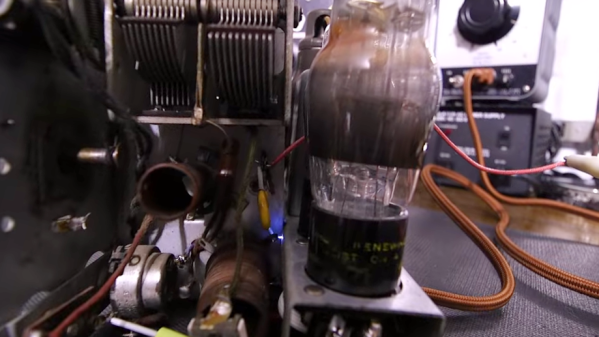
[Mr. Carlson]’s shocking tale began with a quiet evening in his jam-packed lab as a snowstorm raged outside. He heard a rhythmic clicking coming from the speakers of his computer, even with the power off. Other speakers in the lab were getting into the act, as was an old radio receiver he had on the bench. The radio, which was connected to an outdoor antenna by a piece of coax, was arcing from a coil to the chassis in the front end of the radio. The voltage was enough to create arcs a couple of millimeters long and bright blue-white, with enough current to give [Mr. Carlson] a good bite when he touched the coax. The discharges were also sufficient to destroy an LED light bulb in a lamp that was powered off but whose power cord was unlucky enough to cross the antenna feedline.
Strangely, the coil from which the arc sprang formed a 36-ohm shunt to the radio’s chassis, giving the current an apparently easy path to ground. But it somehow found a way around that, and still managed to do no damage to the sturdy old radio in the process. [Mr. Carlson] doesn’t offer much speculation as to the cause of the phenomenon, but the triboelectric effect seems a likely suspect. Whatever it is, he has set a trap for it, to capture better footage and take measurements should it happen again. And since it’s the Great White North, chances are good we’ll see a follow-up sometime soon.
With the benefit of decades of advances in miniaturization, looking back at the devices of yore can be entertaining. Take camcorders; did we really walk around with these massive devices resting on our shoulders just to record the family trip to Disneyworld? We did, but even if those days are long gone, the hardware remains for the picking in closets and at thrift stores.
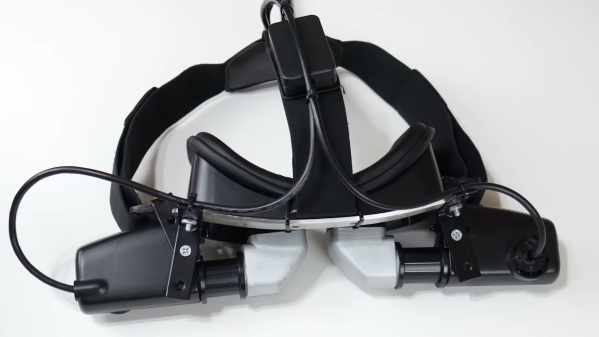
Those camcorders can be turned into cool things such as this CRT-based virtual reality headset. [Andy West] removed the viewfinders from a pair of defunct Panasonic camcorders from slightly after the “Reggievision” era, leaving their housings and optics as intact as possible. He reverse-engineered the connections and hooked up the composite video inputs to HDMI-to-composite converters, which connect to the dual HDMI ports on a Raspberry Pi 4. An LM303DLHC accelerometer provides head tracking, and everything is mounted to a bodged headset designed to use a phone for VR. The final build is surprisingly neat for the number of thick cables and large components used, and it bears a passing resemblance to one of those targeting helmets attack helicopter pilots use.
The software is an amalgam of whatever works – Three.js for browser-based 3D animation, some off-the-shelf drivers for the accelerometers, and Python and shell scripts to glue it all together. The video below shows the build and a demo; we don’t get the benefit of seeing what [Andy] is seeing in glorious monochrome SD, but he seems suitably impressed. As are we.
We’ve seen an uptick in projects using CRT viewfinders lately, including this tiny vector display. Time to scour those thrift stores before all the old camcorders are snapped up.