Assessing Nozzle Wear In 3D-Printers

How worn are your nozzles? It’s a legitimate question, so [Stefan] set out to find out just how bad 3D-printer nozzle wear can get. The answer, as always, is “It depends,” but exploring the issue turns out to be an interesting trip.

Reasoning that the best place to start is knowing what nozzle wear looks like, [Stefan] began by printing a series of Benchies with brand-new brass nozzles of increasing diameter, to simulate wear. He found that stringing artifacts, interlayer holes, and softening of overhanging edges and details all worsened with increasing nozzle size. Armed with this information, [Stefan] began a torture test of some cheap nozzles with both carbon-fiber filament and a glow-in-the-dark filament, both of which have been reported as nozzle eaters. [Stefan] found that to be the case for at least the carbon-fiber filament, which wore the nozzle to a nub after extruding only 360 grams of material.

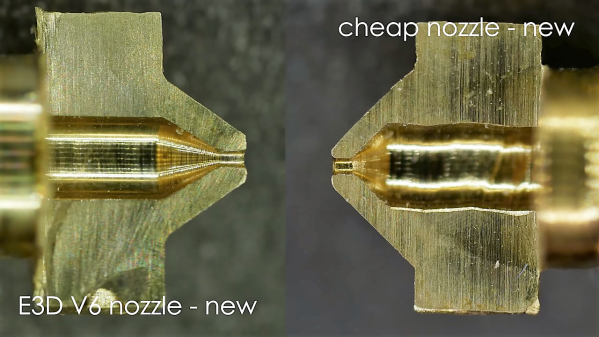
Finally, [Stefan] did some destructive testing by cutting used nozzles in half on the mill and looking at them in cross-section. The wear on the nozzle used for carbon-fiber is dramatic, as is the difference between brand-new cheap nozzles and the high-quality parts. Check out the video below and please sound off in the comments if you know how that peculiar spiral profile was machined into the cheap nozzles.

Hats off to [Stefan] for taking the time to explore nozzle wear and sharing his results. He certainly has an eye for analysis; we’ve covered his technique for breaking down 3D-printing costs in [Donald Papp]’s  “Life on Contract” series.

Continue reading “Assessing Nozzle Wear In 3D-Printers”

Storm Chasers Score Bullseye On Tornado With Instrument-Packed Rocket

Model rockets are a heck of a lot of fun, and not a few careers in science and engineering were jump-started by the thrilling woosh and rotten-egg stench of an Estes rocket launch. Adding simple instrumentation to the rocket doubles the fun by allowing telemetry to be sent back, or perhaps aiding in recovery of a lost rocket. Sending an instrument-laden rocket into a tornado is quite a few notches past either of those scenarios, and makes them look downright boring by comparison.

A first and hopefully obvious point: just don’t do this. [ChasinSpin] and [ReedTimmer] are experienced storm chasers, and have a small fleet of purpose-built armored vehicles at their disposal. One such vehicle, the Dominator, served as a mobile launch pad for their rocket as they along with [Sean Schofer] and [Aaron Jayjack] chased what developed into an EF4 monster tornado near Lawrence, Kansas on May 28. They managed to score a direct hit on the developing tornado, only 100 feet (30 meters) away at the time, and which took the rocket to 35,000 ft (10.6 km) and dragged it almost 30 miles (42 km) downrange. They lost touch with it but miraculously recovered it from a church parking lot.

They don’t offer a lot of detail on the rocket itself, but honestly it looks pretty much off-the-shelf, albeit launched from an aimable launchpad. [ChasinSpin] does offer a few details on the instrument package, though – a custom PCB with GPS, IMU, a temperature/humidity/barometric pressure sensor, and a LoRa link to send a data packet back every second. The card also supported an SD card for high-resolution measurements at 10 times per second. Check out the launch in the video below, and be sure to mouse around to get a look at the chaotic environment they were working in.

Even if this isn’t as cool as sending a sounding rocket into an aurora, it’s still really cool. We’re looking forward to seeing what kind of data this experiment collected, and what it reveals about the inner workings of these powerful storms.

Continue reading “Storm Chasers Score Bullseye On Tornado With Instrument-Packed Rocket”

Rare Earth Metals Caught In Trade War

It seems these days that the news is never good. Speaking from experience, that’s really nothing new; there’s always been something to worry about, and world leaders have always been adept at playing the games that inevitably lead to disturbing news. Wars always result in the very worst news, of course, and putting any kind of modifier in front of the word, like “Cold” or “proxy”, does little to ameliorate the impact.

And so the headlines have been filled these last months with stories of trade wars, with the primary belligerents being the United States and China. We’ve covered a bit about how tariffs, which serve as the primary weapons in any trade war, have impacted the supply of electronic components and other materials of importance to hackers.

But now, as the trade war continues, a more serious front is opening up, one that could have serious consequences not just to the parties involved but also to the world at large. The trade war has escalated to include rare earth metals, and if the threats and rumors currently circulating come to fruition, the technologies and industries that make up the very core of modern society will be in danger of grinding to a halt, at least temporarily.

Continue reading “Rare Earth Metals Caught In Trade War”

Disrupting Cell Biology Hack Chat With Incuvers

Join us on Wednesday 5 June 2019 at noon Pacific for the Disrupting Cell Biology Hack Chat with Incuvers!

A lot of today’s most successful tech companies have creation myths that include a garage in some suburban neighborhood where all the magic happened. Whether there was literally a garage is not the point; the fact that modest beginnings can lead to big things is. For medical instrument concern Incuvers, the garage was actually a biology lab at the University of Ottawa, and what became the company’s first product started as a simple incubator project consisting of a Styrofoam cooler, a space blanket, and a Soda Stream CO2 cylinder controlled by an Arduino.

From that humble prototype sprang more refined designs that eventually became marketable products, setting the fledgling company on a course to make a huge impact on the field of cell biology with innovative incubators, including one that can image cell growth in real time. What it takes to go from prototype to product has been a common theme in this year’s Hack Chats, and Noah, Sebastian, and David from Incuvers will drop by Wednesday to talk about that and more.

join-hack-chatOur Hack Chats are live community events in the Hackaday.io Hack Chat group messaging. This week we’ll be sitting down on Wednesday June 5 at 12:00 PM Pacific time. If time zones have got you down, we have a handy time zone converter.

Click that speech bubble to the right, and you’ll be taken directly to the Hack Chat group on Hackaday.io. You don’t have to wait until Wednesday; join whenever you want and you can see what the community is talking about.

Hackaday Podcast 021: Chasing Rockets, Tripping On Vintage Synthesizers, A Spectacular IoT Security Fail, And Early Alzheimer’s Detection Via VR

Mike Szczys is on a well-deserved vacation this week, so staff writer Dan Maloney joins managing editor Elliot Williams for a look at all the great hacks of the week. On this episode we’re talking about licensing fees for MIDI 2.0, a two-way fail while snooping on employees, and the potential for diagnosing Alzheimer’s with virtual reality. We also dive into the well-engineered innards of a robotic cheetah, a personal assistant safe enough for kids to use, and how listening to your monitor reveals more about you than you’d think. You don’t want to miss a space nerd’s quest for fire or a hacker’s guide to solder and soldering. And you’ve got to catch the story of a hapless hacker’s contact high from a vintage synthesizer. It’s quite a trip.

Take a look at the links below if you want to follow along, and as always, tell us what you think about this episode in the comments!

Take a look at the links below if you want to follow along, and as always, tell us what you think about this episode in the comments!

Direct download (60 MB or so.)

Continue reading “Hackaday Podcast 021: Chasing Rockets, Tripping On Vintage Synthesizers, A Spectacular IoT Security Fail, And Early Alzheimer’s Detection Via VR”

Fail Of The Week: How Not To Do IoT Security

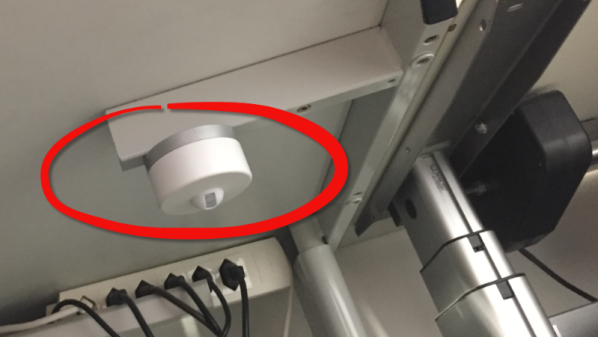
There are a lot of bad days at work. Often it’s the last day, especially when it’s unexpected. For the particularly unlucky, the first day on a new job could be a bad day. But the day you find an unknown wireless device attached to the underside of your desk has to rank up there as a bad day, or at least one that raises a lot of serious questions.

As alarming as finding such a device would be, and for as poor as the chain of decisions leading these devices being attached to the workstations of the employees at a mercifully unnamed company, that’s not the story that [Erich Styger] seeks to tell. Rather, this is a lesson in teardown skills – for few among us would not channel the anger of finding something like this is into a constructively destructive teardown – and an investigation into the complete lack of security consideration most IoT devices seem to be fielded with these days.

Most of us would recognize the device as some kind of connected occupancy sensor; the PIR lens being the dead giveaway there. Its location under a single person’s desk makes it pretty clear who’s being monitored.

The teardown revealed that the guts of the sensor included a LoRa module, microcontroller, a humidity/temperature sensor, and oddly for a device apparently designed to stick in one place with magnets, an accelerometer. Gaining access to the inner workings was easy through the UART on the microcontroller, and through the debug connectors and JTAG header on the PCB. Everything was laid out for all to see – no firmware protection, API keys in plain text, and trivially easy to reflash. The potential for low-effort malfeasance by a compromised device designed to live under a desk boggles the mind.

The whole article is worth a read, if only as a lesson in how not to do security on IoT devices. We know that IoT security is hard, but that doesn’t make it optional if you’re deploying out in the big wide world. And there’s probably a lot to learn about properly handling an enterprise rollout too. Spoiler alert: not like this.

Automate The Freight: Amazon’s Robotic Packaging Lines

In the “Automate the Freight” series, I’ve concentrated on stories that reflect my premise that the killer app for self-driving vehicles will not be private passenger cars, but will more likely be the mundane but necessary task of toting things from place to place. The economics of replacing thousands of salary-drawing and benefit-requiring humans in the logistics chain are greatly favored compared to the profits to be made by providing a convenient and safe commuting experience to individuals. Advances made in automating deliveries will eventually trickle down to the consumer market, but it’ll be the freight carriers that drive innovation.

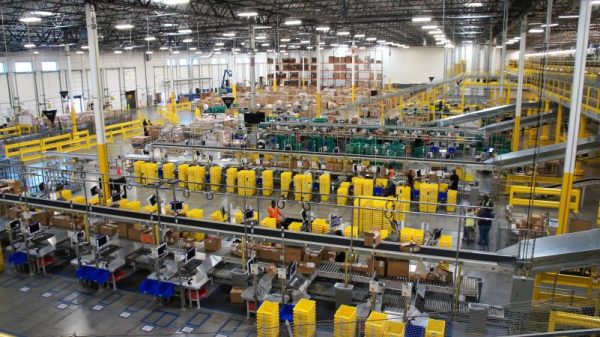
While I’ve concentrated on self-driving freight vehicles, there are other aspects to automating the supply chain that I’ve touched on in this series, from UAV-delivered blood and medical supplies to the potential for automating the last hundred feet of home delivery with curb-to-door robots. But automation of the other end of the supply chain holds a lot of promise too, both for advancing technology and disrupting the entire logistics field. This time around: automated packaging lines, or how the stuff you buy online gets picked and wrapped for shipping without ever being touched by human hands.

Continue reading “Automate The Freight: Amazon’s Robotic Packaging Lines”