Custom Joystick For An Old Commodore Finds An Unlikely Home

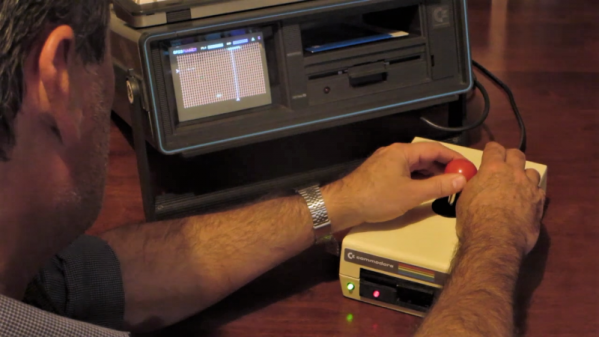
Retro hardware is getting harder and harder to come by, with accessories such as joysticks and mice dropping out of the market the fastest. So if your old machine needs a new joystick, you may find yourself whipping it up yourself. While you’re at it, you might as well have some fun as [Tom Tilley] did when he built a C-64 joystick inside a replica disk drive case for his rare SX-64 luggable.

Anyone who remembers the amount of desk space the classic Commodore 1541 disk drive occupied might wonder why someone would want such an enormous base for a joystick. But rest assured that no actual 1541s were harmed in the making of this joystick; rather, [Tom] created a smaller replica of the drive case from MDF. The face of the case is about 80% original size, and the depth is cut down to about half the original, so the joystick actually ends up being a manageable size while offering a nice, broad wrist support. The drive door is 3D-printed and painted, and adorned with the original green and red LEDs. Decorations like the front badge and even replicas of the original rear panel labels, connectors, and switches were printed from files off a website devoted to recreating Commodore hardware from paper. Because Commodore love knows no bounds.

It’s silly, but it works, and we love the attention to detail. Hat’s off to [Tom] for not settling for yet another joystick build, and for keeping the Commodore flame burning. They may be tough machines, but they won’t be around forever.

Continue reading “Custom Joystick For An Old Commodore Finds An Unlikely Home”
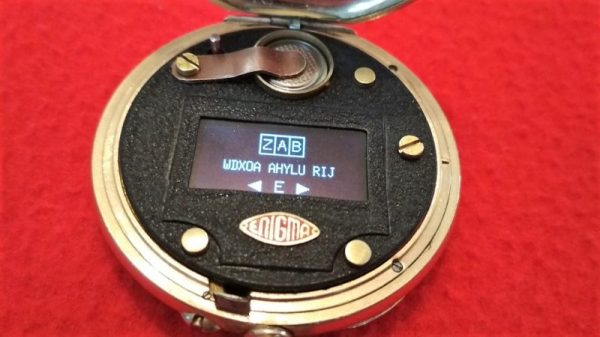
An Arduino Wrapped In An OLED Wrapped Inside An Enigma Pocket Watch

A pocket watch, tucked into a waistcoat pocket and trailing a long chain, is a retro-hip accessory. A pocket watch gutted of its mechanical innards and updated as a smart appliance might be a horological abomination, but would still be a cool hack. A pocket watch converted to a digital Enigma machine is in a class all by itself.

[Simon] admits that he has a thing for pocket timepieces, having a sizable collection of old and not-so-old watches, some that even serve for everyday carry. Trouble is, they eventually break, and qualified watchmakers are getting hard to come by. So refitting defunct watches has become a hobby for him, and this example is a doozy. It uses an Enigma emulator running on an Arduino, similar to one that he stuffed into a somewhat oversized wristwatch a few years ago. Fitting it into a pocket watch case required a bit of finagling, including a 0.5-mm thick main PCB that flexes a bit to fit the contours of the case. A small OLED screen peeks through the front bezel, which is done up in an attractive black crinkle finish with brass buttons for a nice retro look. There’s even an acid-etched brass badge on the front cover with his special logo, complete with a profile of the original Enigma rotors.

Very impressive workmanship, and we don’t even care that it doesn’t tell time. Need a little background on the original Enigma? [Steve Dufresne] did a great job going through the basics a while back.

Continue reading “An Arduino Wrapped In An OLED Wrapped Inside An Enigma Pocket Watch”

Why Is Continuous Glucose Monitoring So Hard?

Everyone starts their day with a routine, and like most people these days, mine starts by checking my phone. But where most people look for the weather update, local traffic, or even check Twitter or Facebook, I use my phone to peer an inch inside my daughter’s abdomen. There, a tiny electrochemical sensor continuously samples the fluid between her cells, measuring the concentration of glucose so that we can control the amount of insulin she’s receiving through her insulin pump.

Type 1 diabetes is a nasty disease, usually sprung on the victim early in life and making every day a series of medical procedures – calculating the correct amount of insulin to use for each morsel of food consumed, dealing with the inevitable high and low blood glucose readings, and pinprick after pinprick to test the blood. Continuous glucose monitoring (CGM) has been a godsend to us and millions of diabetic families, as it gives us the freedom to let our kids be kids and go on sleepovers and have one more slice of pizza without turning it into a major project. Plus, good control of blood glucose means less chance of the dire consequences of diabetes later in life, like blindness, heart disease, and amputations. And I have to say I think it’s pretty neat that I have telemetry on my child; we like to call her our “cyborg kid.”

But for all the benefits of CGM, it’s not without its downsides. It’s wickedly expensive in terms of consumables and electronics, it requires an invasive procedure to place sensors, and even in this age of tiny electronics, it’s still comparatively bulky. It seems like we should be a lot further along with the technology than we are, but as it turns out, CGM is actually pretty hard to do, and there are some pretty solid reasons why the technology seems stuck.

Continue reading “Why Is Continuous Glucose Monitoring So Hard?”

Fail Of The Week: How Not To Electric Vehicle

If you ever doubt the potential for catastrophe that mucking about with electric vehicles can present, check out the video below. It shows what can happen to a couple of Tesla battery modules when due regard to safety precautions isn’t paid.

The video comes to us by way of [Rich], a gearhead with a thing for Teslas. He clearly knows his way around the EV world, having rebuilt a flood-soaked Tesla, and aspires to open an EV repair shop. The disaster stems from a novelty vehicle he and friend [Lee] bought as a side project. The car was apparently once a Disney prop car, used in parades with the “Mr. Toad’s Wild Ride” theme. It was powered by six 6-volt golf cart batteries, which let it maintain a stately, safe pace on a crowded parade route. [Rich] et al would have none of that, and decided to plop a pair of 444-cell Tesla modules into it. The reduced weight and increased voltage made it a real neck-snapper, but the team unwisely left any semblance of battery management out of the build.

You can guess what happened next, or spin up to the 3:00 mark in the video to watch the security camera mayhem. It’s not clear what started the fire, but the modules started cooking off batteries like roman candles. Quick action got it pushed outside to await the fire department, but the car was a total loss long before they showed up. Luckily no other cars in the garage were damaged, nor were there any injuries – not that the car didn’t try to take someone out, including putting a flaming round into [Lee]’s chest and one into the firetruck’s windshield.

[Rich] clearly knew he was literally playing with fire, and paid the price. The lesson here is to respect the power of these beefy batteries, even when you’re just fooling around.

Continue reading “Fail Of The Week: How Not To Electric Vehicle”

Keep Both Hands On The Probes With This Oscilloscope Footswitch

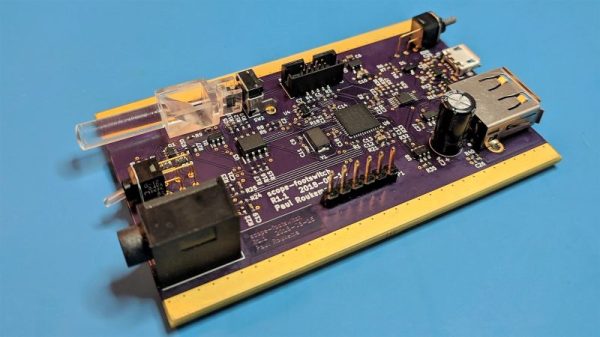
We’ve got two hands, so it’s natural to want to use both of them while diagnosing a circuit with an oscilloscope. Trouble is, keeping both hands on the probes makes it a touch difficult to manipulate the scope. If only there were some way to put your idle lower appendages to work.

This multipurpose oscilloscope footswitch interface makes so much sense that we wonder why such a thing isn’t standard equipment on more scopes. [Paul Roukema]’s interface relies on the USB Test and Measurement Class (USBTMC) protocol that allows most modern scopes to be remotely controlled, somewhat like the General Purpose Interface Bus (GPIB) protocol of old. [Paul]’s interface uses an STM32 microcontroller to talk USBTMC to either Keysight’s Infinium scopes or the Tektronix DPO line, since those were what he had to test against. Tapping the footswitch cycles the acquisition mode on and off or triggers a single acquisition. He’s thoughtfully included the USBTMC specs in his GitHub project, so adapting it to other scopes should be straightforward. We’d even wager that older scopes with GPIB could enjoy the same handsfree control.

Have a down-market scope but still want to go handsfree? [Jenny List]’s primer on running a Rigol with Python might offer some hints on where to start.

CNC Machine Most Satisfyingly Mills Double-Sided PCBs

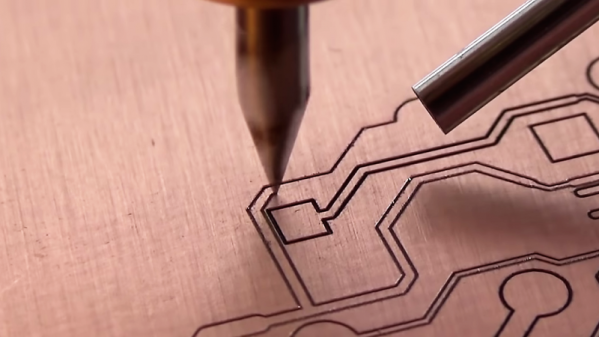
We know that by this point in the development of CNC technology, nothing should amaze us. We’ve seen CNC machines perform feats of precision that shouldn’t be possible, whether it be milling a complex jet engine turbine blade or just squirting out hot plastic. But you’ve just got to watch this PCB milling CNC machine go through its paces!

The machine is from an outfit called WEGSTR, based in the Czech Republic. While it appears to be optimized for PCB milling and drilling, the company also shows it milling metals, wood, plastic, and even glass. The first video below shows the machine milling 0.1 mm traces in FR4; the scale of the operation only becomes apparent when a gigantic toothbrush enters the frame to clear away a little swarf. As if that weren’t enough, the machine then cuts traces on the other side of the board; vias created by filling drilled holes with copper rivets and peening them over with a mandrel and a few light hammer taps connect the two sides.

Prefer your boards with solder resist and silkscreening? Not a problem, at least judging by the second video, which shows a finished board getting coated with UV-cure resist and then having the machine mill away just the resist on the solder pads. We’re not sure how they deal with variations in board thickness or warping, but they sure have it dialed in. Regardless of how they optimized the process, it’s a pleasure to watch.

At about $2,600, these are not cheap machines, but they may make sense for someone needing high-quality boards with rapid turnaround. And who’s to say a DIY machine couldn’t do as good a job? We’ve seen plenty of them before, and covered the pros and cons of etching versus milling too.

Continue reading “CNC Machine Most Satisfyingly Mills Double-Sided PCBs”

Simple, Low-Cost Rig Lets The Budding Biohacker Run DNA Gels

We all the know the basic components for building out an electronics lab: breadboards, bench power supply, a selection of components, a multimeter, and maybe an oscilloscope. But what exactly do you need when you’re setting up a biohacking lab?

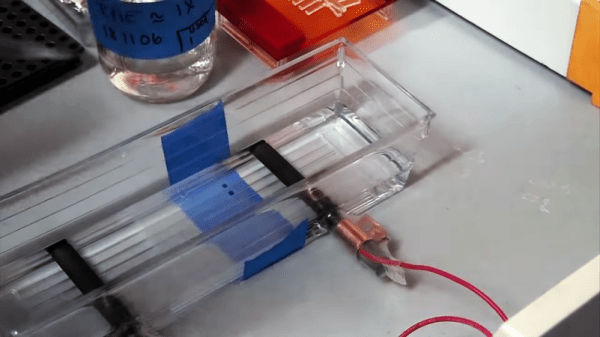
That’s the question that [Justin] from The Thought Emporium is trying to answer with a series of videos where he does exactly that – build a molecular biology lab from scratch. In the current installment, [Justin] covers the basics of agarose gel electrophoresis, arguably the fundamental skill for aspiring bio-geeks. Electrophoresis is simply using an electric field to separate a population of macromolecules, like nucleic acids and proteins, based on their sizes. [Justin] covers the basics, from building a rig for running agarose gels to pouring the gels to doing the actual separation and documenting the results. Commercial grade gear for the job is priced to squeeze the most money out of a grant as possible, but his stuff is built on the cheap, from dollar-store drawer organizers and other odd bits. It all works, and it saves a ton of money that can be put into the things that make more sense to buy, like fluorescent DNA stain for visualizing the bands; we’re heartened to see that the potent carcinogen ethidium bromide that we used back in the day is no longer used for this.

We’re really intrigued with [Justin]’s bio lab buildout, and it inspires us to do the same here. This and other videos in the series, like his small incubators built on the cheap, will go a long way to helping others get into biohacking.

Continue reading “Simple, Low-Cost Rig Lets The Budding Biohacker Run DNA Gels”