Air Bubble Characters Float Along This Unique Scrolling Display

We’ve seen a lot of unique large-format scrolling message boards on these pages, but most of them use some sort of established technology – LEDs, electromechanical flip-dots, and the like – in new and unusual ways. We’re pretty sure this air-bubble dot matrix display is a first, though.

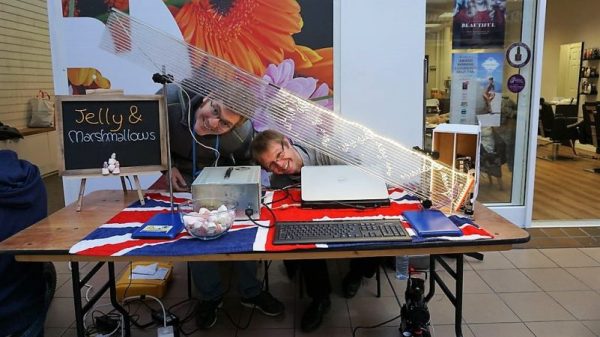
While it may not be destined for the front of a bus or a train station arrivals and departures board, [jellmeister]’s bubble display shows some pretty creative thinking. It started with a scrap of multiwall polycarbonate roofing – Corotherm is the brand name – of the type to glaze greenhouses and other structures. The parallel tubes are perfect for the display, although individual tubes could certainly be substituted. A plastic end cap was fabricated; air nozzles in each channel were plumbed to an air supply through solenoid valves. An Arduino with a couple of motor driver hats allows pulses of air into each channel to create reasonably legible characters that float up the tube. The video below shows it in use at a Maker Faire, where visitors could bubble up their own messages.

It took some tweaking to get it looking as good as it does, but there’s plenty of room for improvement. We wonder whether colored liquid might help, or perhaps adding a Neopixel or even a laser to each channel to add some contrast. Maybe something to cloud the water slightly would help; increasing the surface tension with a salt solution might make the bubbles more distinct. We doubt it’ll ever have the contrast ratio of a flip-dot display, but it certainly has a charm all its own.

Continue reading “Air Bubble Characters Float Along This Unique Scrolling Display”
SDR Is At The Heart Of This Soup-Can Doppler Radar Set

Want to explore the world of radar but feel daunted by the mysteries of radio frequency electronics? Be daunted no more and abstract the RF complexities away with this tutorial on software-defined radar by [Luigi Cruz].

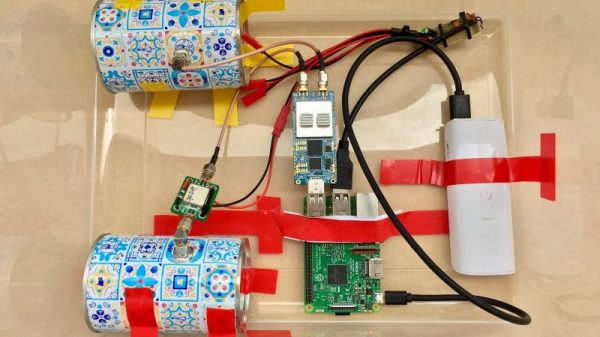
Taking inspiration from our own [Gregory L. Charvat], whose many radar projects have graced our pages before, this plunge into radar is spare on the budgetary side but rich in learning opportunities. The front end of the radar set is almost entirely contained in a LimeSDR Mini, a software-defined radio that can both transmit and receive. The only additional components are a pair of soup can antennas and a cheap LNA for the receive side. The rest of the system runs on GNU Radio Companion running on a Raspberry Pi; the whole thing is powered by a USB battery pack and lives in a plastic tote. [Luigi] has the radar set up for the 2.4-GHz ISM band, and the video below shows it being calibrated with vehicles passing by at known speeds.

True, the LimeSDR isn’t exactly cheap, but it does a lot for the price and lowers a major barrier to getting into the radar field. And [Luigi] did a great job of documenting his work and making his code available, which will help too. Continue reading “SDR Is At The Heart Of This Soup-Can Doppler Radar Set”

Katrina Nguyen Automates Her Mice

When embarking on a career in the life sciences, it seems like the choice of which model organism to study has more than a little to do with how it fits into the researcher’s life. I once had a professor who studied lobsters, ostensibly because they are a great model for many questions in cell biology; in actuality, he just really liked to eat lobster. Another colleague I worked with studied salt transport in shark rectal glands, not because he particularly liked harvesting said glands — makes the sharks a tad grumpy — but because he really liked spending each summer on the beach.

Not everyone gets to pick a fun or delicious model organism, though, and most biologists have had to deal with the rats and mice at some point. It’s hard to believe how needy these creatures can be in terms of care and feeding, and doubly so when feeding is part of the data you’re trying to collect from them. Graduate student Katrina Nguyen learned this the hard way, but rather than let her life be controlled by a bunch of rodents, she hacked a solution that not only improved her life, but also improved her science. She kindly dropped by the Hackaday Superconference to tell us all about how she automated her research.

Continue reading “Katrina Nguyen Automates Her Mice”

Interstellar 8-Track: The Not-So-Low-Tech Data Recorders Of Voyager

On the outside chance that we ever encounter a space probe from an alien civilization, the degree to which the world will change cannot be overestimated. Not only will it prove that we’re not alone, or more likely weren’t, depending on how long said probe has been traveling through space, but we’ll have a bonanza of super-cool new technology to analyze. Just think of the fancy alloys, the advanced biomimetic thingamajigs, the poly-godknowswhat composites. We’ll take a huge leap forward by mimicking the alien technology; the mind boggles.

Sadly, we won’t be returning the favor. If aliens ever snag one of our interstellar envoys, like one of the Voyager spacecraft, they’ll see that we sent them some really old school stuff. While one team of alien researchers will be puzzling over why we’d encode images on a phonograph record, another team will be tearing apart – an 8-track tape recorder?

Continue reading “Interstellar 8-Track: The Not-So-Low-Tech Data Recorders Of Voyager”

SauceBot Uses G-Code To Apply Condiments With Precision

You just can’t please some people. Take a 3D-printer disguised as a condiment dispenser to a public event and next thing you know people actually expect you to build a 3D-condiment dispenser for the next time. How can you help but oblige?

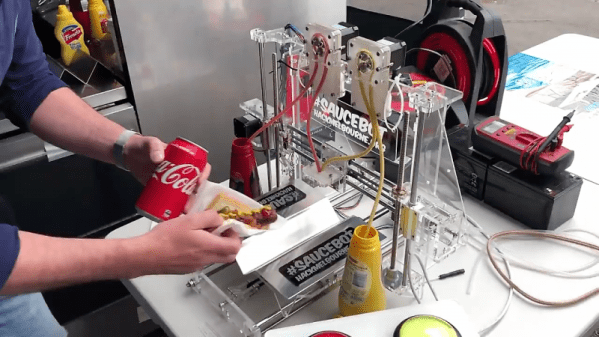
We have to admit to more than a little alarm when [ShaneR] sent us this tip, as on first reading it seemed to endorse the culinary sin of putting ketchup on barbecue. But then we watched the video below and realized this dispenser is only applying ketchup and mustard to hot dogs, and while some purists would quibble with the ketchup, we’ll let that slide. The applicator, dubbed SauceBot by the crew at Connected Community HackerSpace in Melbourne, appears to be purpose-built entirely from laser-cut acrylic, including the twin peristaltic pumps for extruding the ketchup and mustard. We’re not sure the Z-axis is entirely necessary for dispensing onto hot dogs, but since this was a community outreach event, it makes sense to go all in. The video below shows it in use at a fundraiser, and while the novelty of it probably sold quite a few dogs, it’s safe to say the food service industry won’t be alarmed that this particular robot will be stealing jobs anytime soon.

Seriously, if your hackerspace is going to have public events with food, something like this could really get the conversation started. Then again, so might a CD execution chamber.

Plug Your Ears And Hop On This Jet-Powered EBike

Ah, the simple pleasures of a bike ride. The rush of the wind past your ears, the gentle click of the derailleurs as you change gears, the malignant whine of the dual electric jet turbines pushing you along. Wait, what?

Yes, it’s a jet bike, and its construction was strictly a case of “Why not?” for [Tech Ingredients]. They recently finished up a jet engine build using a hybrid design with electric ducted fans as compressors and fueled with propane. It was quite a success, and pretty spectacular, but left an embarrassment of riches upon its passing in terms of spare parts. The ducted fans, monstrous 90-mm 12s beasts, along with dual 150A ESCs found their way onto a mountain bike by way of a rear luggage rack. Pannier bags on each side hold the batteries, and a quick control panel went on the handlebar. The video below shows the build details and a couple of test rides, which show just how fast you can go with this setup. It may not be very practical compared to a more traditional hub motor, but it’s nowhere near as cool. Just be sure to wear your hearing protection.

Is this the first jet engine on a bike we’ve featured? Of course not. But for an impromptu build, it’s pretty impressive. Continue reading “Plug Your Ears And Hop On This Jet-Powered EBike”

Designing Space-Rated PCBs

We’ve reduced printed circuit board design to practice so much that we hardly give a thought to the details anymore. It’s so easy to bang out a design, send it to a fab house, and have ten boards in your hands in no time at all. All the design complexities are largely hidden from us, abstracted down to a few checkboxes on the vendor’s website.

There’s no doubt that making professional PCB design tools available to the hobbyist has been a net benefit, but there a downside. Not every PCB design can be boiled down to the “one from column A, one from column B” approach. There are plenty of applications where stock materials and manufacturing techniques just won’t cut it. PCBs designed to operate in space is one such application, and while few of us will ever be lucky enough to have a widget blasted to infinity and beyond, learning what’s behind space-rated PCBs is pretty interesting.

Continue reading “Designing Space-Rated PCBs”