[Ben Krasnow] Builds A One-Component Interferometer

When we think of physics experiments, we tend to envision cavernous rooms filled with things like optical benches, huge coils in vacuum chambers, and rack after rack of amplifiers and data acquisition hardware. But it doesn’t have to be that way – you can actually perform laser interferometry with a single component and measure sub-micron displacements and more.

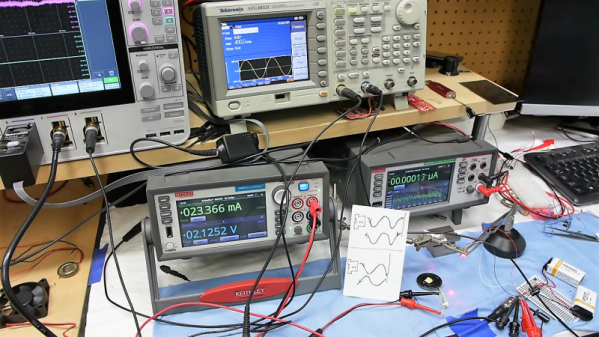
The astute viewer of [Ben Krasnow]’s video below will note that in order to use the one component, a laser diode, as an interferometer, he needed a whole bunch of support gear, like power supplies, a signal generator, and a really, really nice mixed-signal oscilloscope. But the principle of the experiment is the important bit, which uses a laser diode with a built-in monitoring photodiode. Brought out to a third lead, older laser diodes often used these photodiodes to control the light emitted by the laser junction. But they also respond to light reflected back into the laser diode, and thanks to constructive and destructive interference, can actually generate a signal that corresponds to very slight displacements of a reflector. [Ben] used it to measure the vibrations of a small speaker, the rotation of a motor shaft, and with a slight change in setup, to measure the range to a fixed target with sub-micron precision. It’s fascinating stuff, and the fact you can extract so much information from a single component is pretty cool.

We really like [Ben]’s style of presentation, and the interesting little nooks and crannies of physics that he finds a way to explore. He recently looked at how helium can kill a MEMS sensor, an equally fascinating topic.

Continue reading “[Ben Krasnow] Builds A One-Component Interferometer”
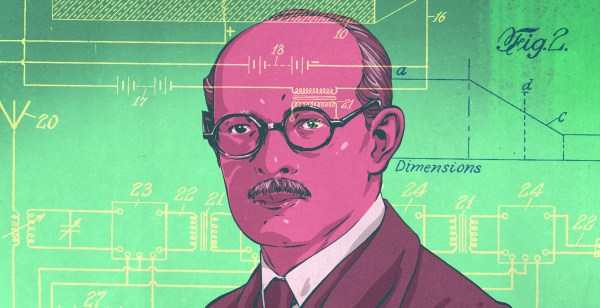
Julius Lilienfeld And The First Transistor

Here’s a fun exercise: take a list of the 20th century’s inventions and innovations in electronics, communications, and computing. Make sure you include everything, especially the stuff we take for granted. Now, cross off everything that can’t trace its roots back to the AT&T Corporation’s research arm, the Bell Laboratories. We’d wager heavily that the list would still contain almost everything that built the electronics age: microwave communications, data networks, cellular telephone, solar cells, Unix, and, of course, the transistor.

But is that last one really true? We all know the story of Bardeen, Brattain, and Shockley, the brilliant team laboring through a blizzard in 1947 to breathe life into a scrap of germanium and wires, finally unleashing the transistor upon the world for Christmas, a gift to usher us into the age of solid state electronics. It’s not so simple, though. The quest for a replacement for the vacuum tube for switching and amplification goes back to the lab of  Julius Lilienfeld, the man who conceived the first field-effect transistor in the mid-1920s.

Continue reading “Julius Lilienfeld And The First Transistor”

ABS: Three Plastics In One

It would be really hard to go through a typical day in the developed world without running across something made from ABS plastic. It’s literally all over the place, from toothbrush handles to refrigerator interiors to car dashboards to computer keyboards. Many houses are plumbed with pipes extruded from ABS, and it lives in rolls next to millions of 3D-printers, loved and hated by those who use and misuse it. And in the form of LEGO bricks, it lurks on carpets in the dark rooms of children around the world, ready to puncture the bare feet of their parents.

ABS is so ubiquitous that it makes sense to take a look at this material in terms of its chemistry and its properties. As we’ll see, ABS isn’t just a single plastic, but a mixture that takes the best properties of its components to create one of the most versatile plastics in the world.

Continue reading “ABS: Three Plastics In One”

Dozens Of Servos Flip The Segments Of This 3D-Printed Digital Clock

A digital clock based on seven-segment displays? Not exciting. A digital clock with seven-segment displays that’s really big and can be read across a football field? That’s a little more interesting. A large format digital clock that uses electromechanical seven-segment displays? Now that’s something to check out.

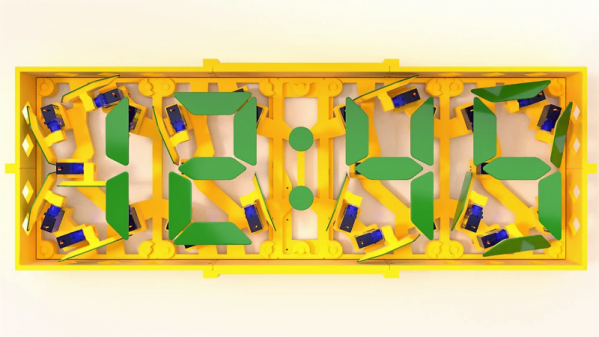
This clock comes to us by way of [Otvinta] and is a nice example of what you can do with 3D-printing and a little imagination. Each segment of the display is connected to a small hobby servo which can flip it 90°. Mounted in a printed plastic frame, the segments are flipped in and out of view as needed to compose the numerals needed to display the time. The 28 servos need two Pololu controller boards, which talk to a Raspberry Pi running Windows IoT, an interesting design choice that we don’t often see. You’d think that 28 servos clattering back and forth might be intolerable, but the video below shows that the display is actually pretty quiet. We’d love to see this printed all in black with white segment faces, or even a fluorescent plastic; how cool would that look under UV light?

We’re not saying this is the only seven-segment servo clock we’ve seen, but it is a pretty slick build. And of course there’s more than one way to use servos to tell the time.

Continue reading “Dozens Of Servos Flip The Segments Of This 3D-Printed Digital Clock”

A Scratch-Built Forgotten Classic Of The Early PC Age

All the retrocomputer love for Commodore machines seems to fall on the C64 and Amiga, with a little sprinkling left over for the VIC-20. Those machines were truly wonderful, but what about the Commodore machine that paved their way? What about the machine that was one of the first to be gobbled up in the late 1970s by school districts eager to convert a broom closet into the new “computer lab”?

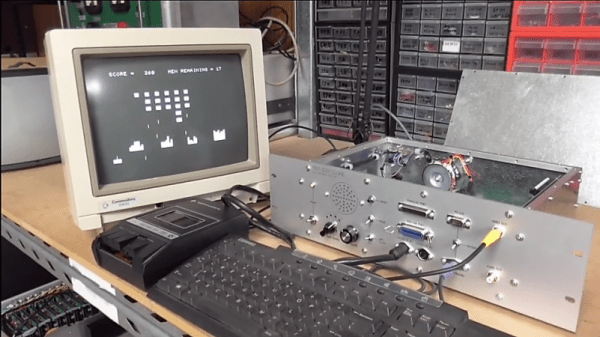
The PET 2001 might be a little hard to fall in love with given its all-in-one monitor, cassette recorder, and horrible chiclet keyboard, but some still hold a torch for it. [Glen] obviously felt strongly enough about the machine to build a PET from current production parts, and the results are pretty neat. When trying to recreate a 40-year old machine from scratch, some concessions must be made, of course. The case doesn’t attempt to replicate the all-in-one design, and the original keyboard was mercifully replaced by a standard PS/2 keyboard. But other than that the architecture is faithfully replicated using new production 65xx chips and 74HCT family logic chips. [Glen] had to jump through some hoops to get there, but as the video below shows, the finished machine plays a decent game of Space Invaders.

We’ve seen a PET brought back from the grave by FPGA and a C64 emulated on a Raspberry Pi, but going back to basics and building this from scratch was a fitting homage to an important machine in PC history.

Continue reading “A Scratch-Built Forgotten Classic Of The Early PC Age”

The Complete Beginner’s Guide To Building A CNC Machine

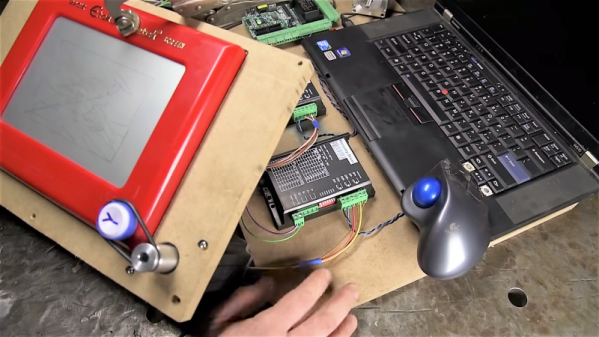
Despite appearances, [This Old Tony]’s latest series has little to do with CNC-ifying an Etch A Sketch. Although he certainly achieves that, more or less, automating the classic toy is just the hook for a thorough lesson in CNC machine building starting with the basics.

Fair warning: we said basics, and we mean it. [Old Tony]’s intended audience is those who haven’t made the leap into a CNC build yet and need the big picture. Part one concentrates on the hardware involved – the steppers, drivers, and controller. He starts with one of those all-in-one eBay packages, although he did upgrade the motion controller to a Mach4 compatible board; still, the lessons should apply to most hardware.

By the end of part one, the Etch A Sketch is connected to two of the steppers and everything is wired up and ready to go for part two, the first part of which is all about inputs and outputs. Again, this is basic stuff, like how relays work and why you might need to use them. But that’s the kind of stuff that can baffle beginners and turn them off to the hobby, so kudos to [Old Tony] for the overview. The bulk of the second part is about configuring Mach4 Hobby, with a ton of detail and some great tips and tricks for getting a machine ready to break some end mills.

For someone looking to get into a CNC build, [Old Tony]’s hard-won CNC experience really fills in the gaps left by other tutorials. And it looks like a third part, dealing with making all this into something more than an automated Etch A Sketch, is in the works. We’re looking forward to that.

Continue reading “The Complete Beginner’s Guide To Building A CNC Machine”

Daphne Oram And The Birth Of Electronic Music

For most of human history, musical instruments were strictly mechanical devices. The musician either plucked something, blew into or across something, or banged on something to produce the sounds the occasion called for. All musical instruments, the human voice included, worked by vibrating air more or less directly as a result of these mechanical manipulations.

But if one thing can be said of musicians at any point in history, it’s that they’ll use anything and everything to create just the right sound. The dawn of the electronic age presented opportunities galore for musicians by giving them new tools to create sounds that nobody had ever dreamed of before. No longer would musicians be constrained by the limitations of traditional instruments; sounds could now be synthesized, recorded, modified, filtered, and amplified to create something completely new.

Few composers took to the new opportunities offered by electronics like Daphne Oram. From earliest days, Daphne lived at the intersection of music and electronics, and her passion for pursuing “the sound” lead to one of the earliest and hackiest synthesizers, and a totally unique way of making music.

Continue reading “Daphne Oram And The Birth Of Electronic Music”