Real-Time FPGA Finger Detection

The student projects that come out of [Bruce Land]’s microcontroller- and FPGA-programming classes feature here a lot, simple because some of them are amazing, but also because each project is a building-block for another. And we hope they will be for you.

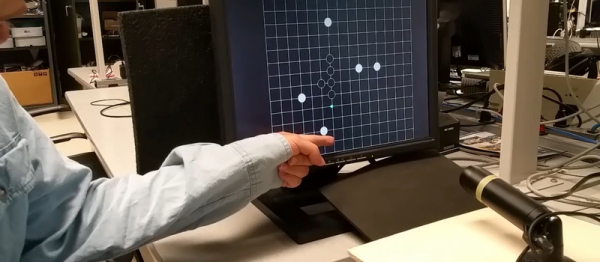
This time around, [Junyin Chen] and [Ziqi Yang] created a five-in-a-row video game that is controlled by a pointing finger. A camera, pointed at the screen, films the player’s hand and passes the VGA data to an FPGA. And that’s where things get interesting.

An algorithm in the FPGA detects skin color and, after a few opening and closing operations, comes up with a pretty good outline of the hand. The fingertip localization is pretty clever. They sum up the number of detected pixels in the X- and Y-axis, and since a point finger is long and thin, locate the tip because it’s going to have a maximum value in one axis and a minimum along the other. Sweet (although the player has to wear long sleeves to make it work perfectly).

How does the camera not pick up the game going on in the background? They use a black-and-white game field that the skin-color detection simply ignores. And the game itself runs in a Nios embedded processor in the FPGA. There’s a lot more detail on the project page, and of course there’s a demo video below.

We love to follow along with Prof. Land‘s classes. His video series is invaluable, and the course projects have been an inspiration.

Continue reading “Real-Time FPGA Finger Detection”

Flying Balls Of Molten Aluminum!

We’re replacing “holy moley” in our vocabulary. Levitating globs of molten aluminum are that much more amazing. It’s not that we couldn’t believe it would work — we understand the physics after the fact. It’s just that we never would have thought to build an induction forge that can simultaneously melt and levitate a chunk of aluminum. (Video embedded below.)

[imsmoother] has had plans for 3 kW and 10 kW induction heaters online since at least 2011, and we’re wondering how we haven’t covered it before. Anyway, in the video, he’s using the smaller of the two to melt a chunk of aluminum. Continue reading “Flying Balls Of Molten Aluminum!”

Minimal MQTT: Power And Privacy

In this installment of Minimal MQTT, I’m going to cover two loose ends: one on the sensor node side, and one on the MQTT server side. Specifically, I’ll tackle the NodeMCU’s sleep mode to reduce power and step you through bridging MQTT servers to get your data securely out of your home server and into “the cloud”, which is really just other people’s servers.

If you’re just stepping into this series now, you should really check out the other three posts, where I set up a server, then build up some sensor nodes, and then flesh-out a few ways to control everything from your phone or the web. That’s the coolest material, anyway. This last installment just refines what we’ve built on. Let’s go!

Continue reading “Minimal MQTT: Power And Privacy”

Feeding The Cat, Reinventing The Wheel

There are few projects that we see as many iterations of as the pet feeder or the plant waterer. (What is it with you people? Are you all as forgetful as we are?) Still, the fun is in the details of the implementation. Or at least that’s the case with [Emmaanuel]’s cat feeder.

The writeup is split into three parts: the worm-drive, the electronics, and the housing (here in English: worm, electronics, housing). And of course, there’s a video inlined below.

The auger and motor housing make great use of PVC pipe and 3D printing, and the dispenser unit looks quite professional. There’s not all that much to say about the electronics — an Arduino clone, an LCD, and a cheap gear motor do just about what you’d expect.

The CNC’ed case with spring-fit tabs steals the show, however. It’s made out of MDF, which doesn’t take well to screwing or glueing. With carefully routed pins and tabs that have a little spring in them, [Emmaanuel] was able to take the pieces off the mill table and just snap them together. Awesome.

Continue reading “Feeding The Cat, Reinventing The Wheel”

Hackaday Prize Entry: You Know, For Kids

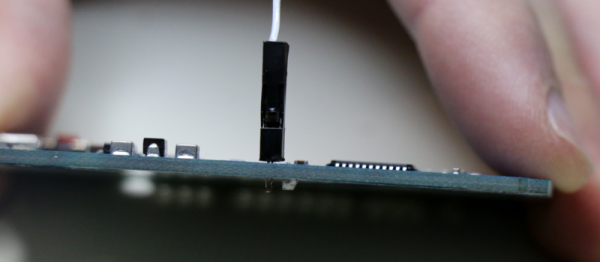
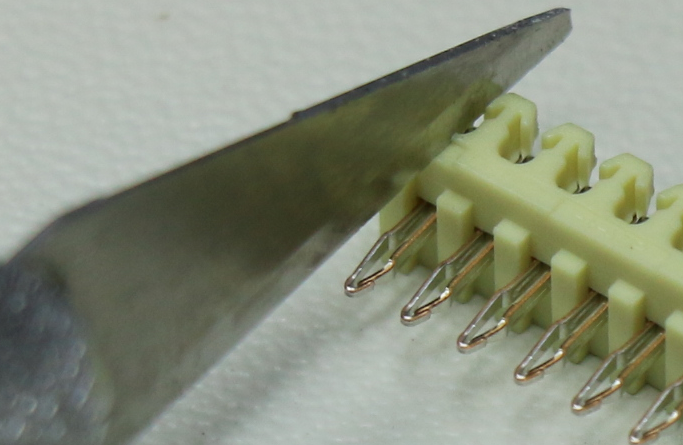
Like the fictitious invention of the Hula Hoop in Hudsucker Proxy, [David Spinden]’s big idea is small and obvious once you’ve seen it. And we’re not saying that’s a bad thing at all. What he’s done is to make a new kind of prototyping connector; one that hooks into a through-plated hole like a pogo pin, but in the horizontal direction.

9092981463539177581This means that your test-points can do double duty as header connectors, when you need to make something more permanent, or vice-versa. That’s a lot of flexibility for a little wire, and it takes one more (mildly annoying) step out of prototyping — populating headers.

[David] makes them out of readily available header pins that already have the desired spring-like profile, and simply cuts them out and connects them to a standard Dupont-style hookup wire. Great stuff.

When we opened up the “Anything Goes” category for the Hackaday Prize, we meant it. We’re excited to see people entering large and small ideas that improve the world, even if it’s just the world of hackers.

Continue reading “Hackaday Prize Entry: You Know, For Kids”

The Most Powerful Diesel Engine

Ever. Literally.

A gearhead friend of ours sent along a link to a YouTube video (also embedded below) promising the world’s most powerful engine. Now, we’ll be the first to warn you that it’s just an advertisement, and for something that you’re probably not going to rush out and buy: the Wärtsilä 14RT marine engine.

A tiny bit of math: 96 cm cylinder diameter times 250 cm piston stroke = 1,809,557 CC. And it generates around 107,000 HP. That’s a fair bit, but it runs at a techno-music pace: 120 BPM RPM. With twelve cylinders, we’d love to hear this thing run. Two-strokes make such a wonderful racket! Wonder if they’ve tried to red-line it? It’s a good thing we don’t work at Wärtsilä.

Continue reading “The Most Powerful Diesel Engine”

Gutting And Rebuilding A Classic Watch

No, that watch isn’t broken. In fact, it’s better.

[Lukas] got so used to his binary-readout ez430 Chronos watch that when the strap disintegrated he had to build his own to replace it. But most DIY wristwatches are so clunky. [Lukas] wanted something refined, something small, and something timeless. So he shoe-horned some modern components, including an MSP430, into a Casio F-91W watch.

The result is a watch that tells time in binary, has a built-in compass, and with some more work will be updatable through an IR receiver that he also managed to fit in there somehow. Now he has the watch that Casio would make today, if fashion had stayed stuck firmly in the early 1990s. (Or not. Apparently, Casio still makes and sells the F-91W. Who knew?)

Anyway, back to an epic and pointless hack. Have a look at the tiny, tiny board that [Lukas] made. Marvel in the fact that he drove the original LCD screen. Dig the custom Kicad parts that match the watch’s originals. To get an accurate fit for the case, [Lukas] desoldered the piezo buzzer contact and put the board onto a scanner, which is a great trick when you need to get accurate dimensions. It’s all there, and well-documented, in his GitHub, linked above.

All in all, it’s an insane hack, but we love the aesthetics of the result. And besides, sometimes the hacking is its own reward.