It was a good weekend to be geeky in Bavaria. In addition to our own Hackaday Prize Bring-a-Hack party, there was the reason that we scheduled it in the first place, Munich’s independent DIY expo, Make Munich.
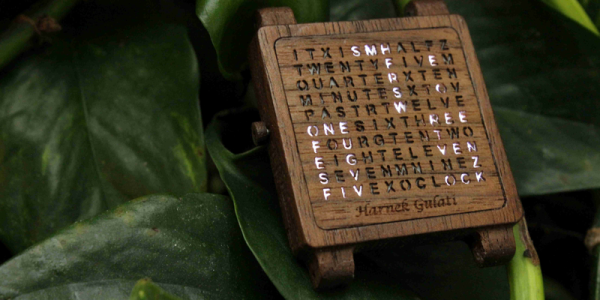
If you’re a loyal Hackaday reader, many of the projects would seem uncannily familiar. I walked in and was greeted by some beautiful word clocks in both German and English, for instance. Still, seeing the Open Theremin being sold with an “as seen on Hackaday” sticker made us smile. And then we had a great conversation about [Urs Gaudenz]’s other project: DIY biological apparatus, also seen on Hackaday.
There were robots galore. Someone (from Gmünd?) was driving around a graffiti-bot and spraying the floor with water instead of paint or chalk to very nice effect. The full evolution of the Zoobotics robot family was on display. Even the Calliope (a German version of the micro:bit) booth had this cute Bluetooth vibrobot. Join me after the break as I dive into all of the great stuff on display over the weekend.
Thanks to everyone who came to the Hackaday Prize Make Munich Meetup and Bring-a-Hack last night! We had a great time, and there were a bunch of cool projects on display, some of which we even got pictures of. Frankly, we were enjoying chatting too much to be peering through a camera lens.
Around 30 people made it over to the Munich CCC, including some familiar faces from the last time we had a party in Munich. Although it was a mostly local crowd, we also had visitors from Switzerland, Austria, and even the US of A: TV-B-Gone inventor, HaD Prize judge, and mad hacker [Mitch Altmann] was in the house.
After we got a little food and drink, we opened up the floor for the projects, lightning-talk style. The largest projects were probably a tie between an own-design CoreXY 3D printer and a boombox with some serious sound output. One guest’s automated bacterial culture apparatus probably wouldn’t have fit on the table, so it’s OK that it got left in the lab. The smallest hack? Probably [Alex]‘s super-mini USB LED clock gizmo, complete with hand-soldered 0402 LEDs, and “even smaller stuff on the backside”.
If you’re in Munich, Germany this weekend and you’ve got a sweet hack to show off and a thirst for beer and/or good geeky company, then you’re in luck! Come join Hackaday at the muCCC for a Hackaday Prize Bring a Hack.
The location is Schleißheimer Str. 41, a short walk west along Heßstraße from the Theresienstraße U-Bahn. No reservation is needed, but it’d be swell if you’d let us know in the comments that you’re coming (or better yet, click the “join this event” button in the upper right of the event page) so that we have enough pizza on hand.
The party starts at 20:00, not entirely coincidentally as soon as exhibitor setup at Make Munich closes. So if you’re setting up a booth, come on over to the other side of town where you can show off a small project to a select audience of fellow hackers. If you’re only going to be attending Make Munich, this is a great warm up.
Hackaday’s [Elliot Williams] will be there and taking photos if you’ve got something portable that you’d like to show the world! Otherwise, relax and hang out with kindred spirits. Need a time and place to get a team together for the Hackaday Prize? Here, with beer! (Or Spezi, but nothing rhymes with Spezi.)
Just two weeks ago our favorite supplier of cheap ESP8266 boards, WeMos, released the long-awaited LOLIN32 ESP-32 board, and it’s almost a killer. Hackaday regular [deshipu] tipped us off, and we placed an order within minutes; if WeMos is making a dirt-cheap ESP32 development board, we’re on board! It came in the mail yesterday. (They’re out of stock now, more expected soon.)
If you’ve been following the chip’s development, you’ll know that the first spin of ESP-32s had some silicon bugs (PDF) that might matter to you if you’re working with deep sleep modes, switching between particular clock frequencies, or using the brown-out-reset function. Do the snazzy new, $8, development boards include silicon version 0 or 1? Read on to find out!
We’re not sure if this is art, anti-snooping guerilla warfare, or just a cheeky hack, but we do know that we like it! [Jasper van Loenen]’s Linger keeps the SSIDs that your cell phone (for example) spits out whenever it’s not connected to a WiFi network, and replays them after you’re gone.
Some retail stores and other shady characters use MAC addresses and/or the unique collection of SSIDs that your phone submits in probe requests to fingerprint you and track your movement, either through their particular store or across stores that share a tracking provider. Did you know that you were buying into this when you enabled “location services”? Did the tracking firms ask you if that was ok? Of course not. What are you going to do about it?
Linger replays the probe requests of people who have already moved on, making it appear to these systems as if nobody ever leaves. Under the hood, it’s a Raspberry Pi Zero, two WiFi dongles, and some simple Python software that stores probe requests in a database. There’s also a seven-segment display to indicate how many different probe-request profiles Linger has seen. We’re not sure the price point on this device is quite down to “throwie” level, but we’d love to see some of these installed in the local mall. Continue reading “Linger Keeps You Around After You’ve Gone”→
Attention Europe! Next weekend, May 6th and 7th, is Make Munich. Hackaday wants to help you warm up with a Bring-a-Hack party on Friday, May 5th from 20:30 and on at the Munich local branch of the Chaos Computer Club.
Immediately following build-up for exhibitors at Make Munich, head on over to Schleißheimer Str. 41 (corner Heßstrasse, U-Bahn Theresienstraße) where Hackaday will be providing beer, Mate, and pizza for anyone who brings along a small project that they’re working on. We’ll have Hackaday.com and Hackaday Prize stickers galore, and a few copies of the Hackaday Omnibus on hand for those who really wow us, or just ask really nicely.
Afterwards, get a little sleep and then head back over to Make Munich on Saturday morning. We’ll be wandering around at least on Saturday, so if you see anyone in a Hackaday t-shirt, say hi! There is a lot to see.
Unlike other similar fairs, Make Munich is entirely volunteer-run, and a great way to show your support for the local scene is to help out. The deal: hang out with cool people and help run the show for four hours, and you get in free. We’ve heard that they still have some shifts open.
Non-terrible robots.
Saturday night is the Hebocon terrible robot battle, which is always absurd, and always worth the price of admission. (And you’ve already paid that if you’re going to attend on Saturday anyway.) Rules are sumo-esque, and if your lump of, well whatever, moves — it’s a robot and it has a chance. Battle starts at 18:30. Check out the video from last year embedded below.
If you still want more Make Munich, it goes on Sunday as well. We’ll be at home typing up the previous days’ events so the rest of you can read about it while sipping coffee.
Just in case you missed it in all the hubbub, we repeat: Hackaday Prize Bring-a-Hack at μC3, Friday May 5th from 20:30 on.
Come say hi to [Elliot Williams] and all of your other favorite Munich hackers! Bring a hack, show and tell, pizza and beer. And Mate, and probably Spezi. If you’re coming, shout out in the comments, and let us know your favorite toppings. Continue reading “Hackaday Prize Bring-a-Hack At Make Munich Next Week!”→
That’s a lot of qualifications, but we’re pretty sure that you can’t accuse us of hyperbole in the title: this is one of the tightest little 3D printer builds we’ve ever seen. Add in the slightly esoteric CoreXY kinematics and the thick aluminum frame, and it’s a speed demon in addition to being a looker.
[René] had built a few 3D printers before, so he had a good feel for the parameters and design tradeoffs before he embarked on the DICE project. Making a small print volume, for instance, means that the frame can be smaller and thus exponentially more rigid. This means that it’s capable of very fast movements — 833 mm/s is no joke! It also looks to make very precise little prints. What could make it even more awesome? Water-cooled stepper motors, magnetic interchangeable printheads, and in-built lighting.
The build looks amazing, and there is video documentation of the whole thing on [René]’s site, including a full bill of materials and designs. It’s certainly not the cheapest 3D printer we’ve ever seen, and the tiny build platform makes it a bad choice for a general-purpose machine, but if you need a second printer and you want one with style, the DICE looks hard to beat.