Doomed Incandescent Light Blinker

[Jānis]’s entry for the Flashing Light Prize was doomed from the start. Or should we say Doomed? It was a complicated mess of Rube-Goldbergery that essentially guaranteed that he’d have no time for making a proper video and submitting and entry. But it also ran Doom. Or at least ran on Doom.

(Note: [Jānis] sent us this hack in the e-mail — there’s no link for this blog post. You’re reading it here and now.)
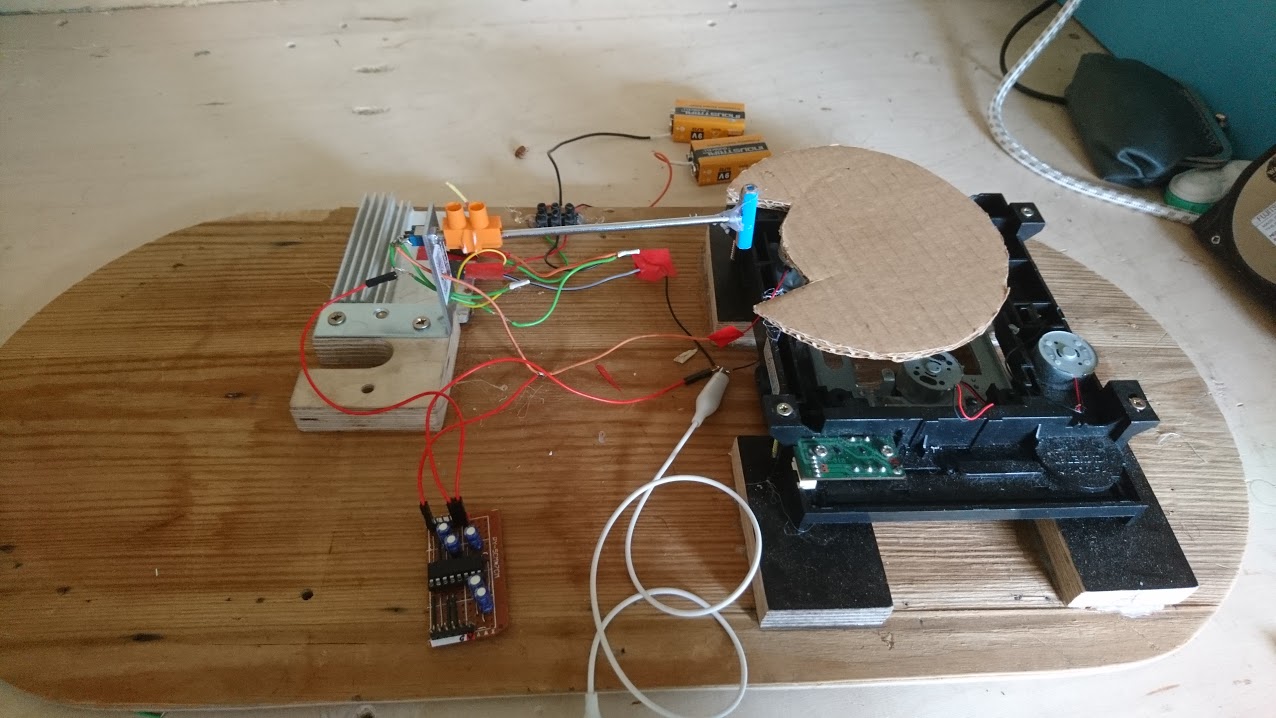
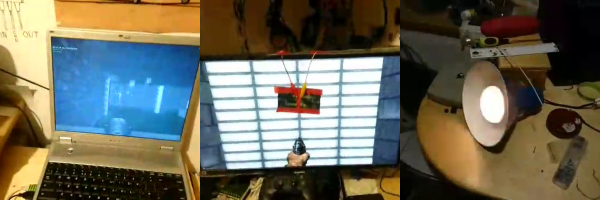
It starts with a DC motor salvaged from a DVD player that spins a wheel that flips a switch back and forth, which in turn flips the polarity of the power on the motor. It’s like a most-useless machine, but with no human involved. This contraption periodically presses a button on a gutted mouse.
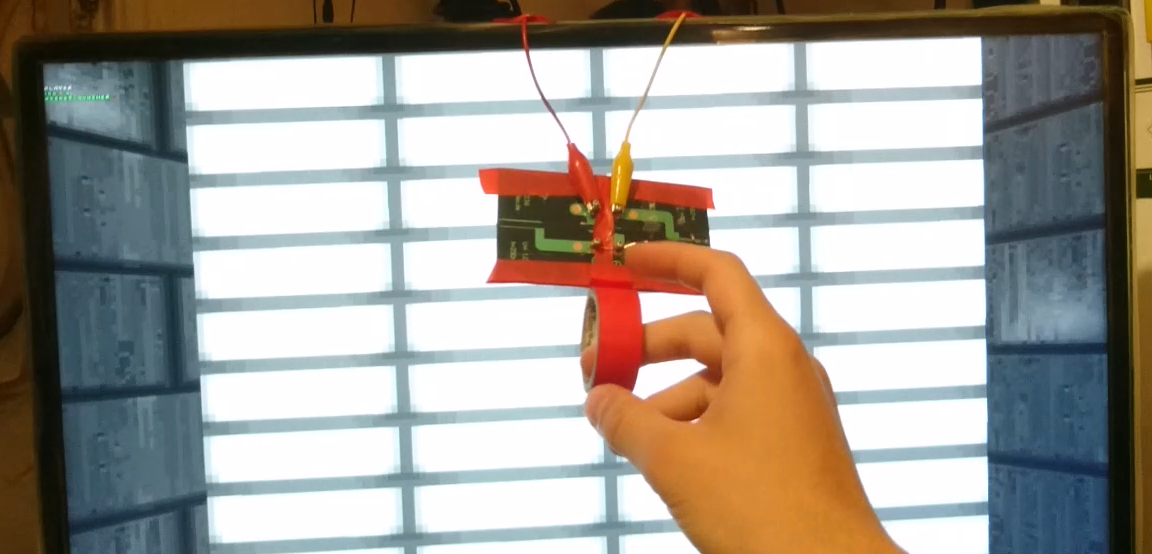
Pressing the mouse button on one computer fires a rocket in a multiplayer Doom game, and triggers a light on a wall when it does. A second Doom player, on another computer, sits facing the wall. Solar cells dangled in front of Player 2’s monitor emit high and low voltages as the LCD blinks on and off. That output goes into the ADC of an Arduino clone that drives a transistor that drives a relay that turns on and off a lightbulb.

We had a lot of fun watching all of the entries for the Flashing Light Prize, and we were also stoked by the presence of so many Hackaday regulars in the Honourable Mention list. (Sad to see [Sprite]’s ping-flasher didn’t make the cut!)

If you, like [Jānis] are still sitting on a design, don’t fret. It looks like the prize will make a return next year. Woot!

Continue reading “Doomed Incandescent Light Blinker”

Wooden Word Wristwatch Wows Woomies

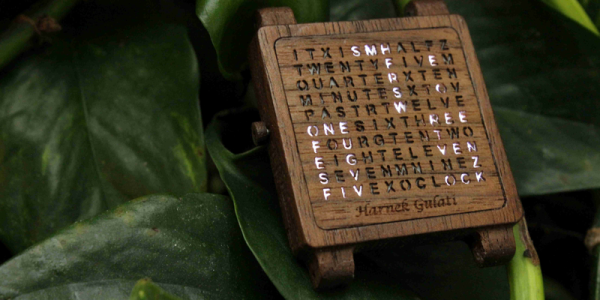
[HakuG] wanted to make a watch for his roommates, and had a design project due. He killed two birds with one stone, and then some. The result is a classic word clock, but with a refined all-wood look that’s also small enough to wear on your wrist.

Nothing good ever comes out right the first time, and the log of [HakuG]’s different versions is full of different attempts, all of them just fine in their own right, but none of them “perfect”. Kudos to [HakuG] for sticking with it and refining the project far past the initial prototype stage to something that really looks like a finished product.

Of course we’ve covered word clocks before. Heck, we’ve even seen a beautiful wooden one. But we’re pretty sure that this is the first wooden word-clock watch we’ve ever written up, and it’s surely one of the nicest.

Thanks [Paul Hein] for the link!

Filaween 2.0 Is Go

[Thomas Sanladerer] is at it again: testing all of the 3D-printer filaments that are fit to print (with). And this year, he’s got a new and improved testing methodology — video embedded below. And have a search for “filaween2” to see what he’s reviewed so far. There’s some sexy filaments in there.

We really love the brand-new impact strength test, where a hammer is swung on a pivot (3D printed, natch), breaks through the part under test, and swings back up to a measurable height. The difference in swing height reflects the amount of energy required to break the test piece. Sweet physics.

[Thomas] ran a similar few-month-long series last year, and we’re stoked to see it return with all the improvements. Here’s to watching oddball plastics melt!

Continue reading “Filaween 2.0 Is Go”

Complete IR Control

What can you do with an IR remote? How about anything? Maybe not. We’ll settle for issuing arbitrary commands and controlling tasks on our computer.

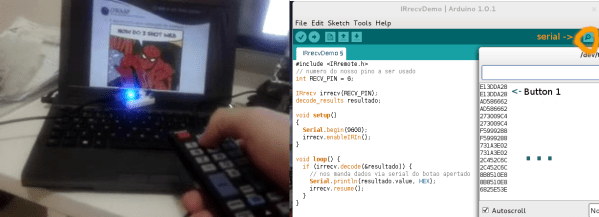
The first step in [Fungus]’s hack is straightforward: buy an IR receiver for a buck, plug it into an Arduino, and load up some IR-decoding code. If you haven’t done this before, you owe it to yourself to take some time now. Old IR remotes are very useful, and dead simple, to integrate into your projects.

But here comes the computer-control part. Rather than interpret the codes on the Arduino, the micro just sends them across the USB serial to a laptop. A relatively straightforward X11 program on the (Linux) computer listens for codes and does essentially anything a user with a mouse and keyboard could — that is to say, anything. Press keys, run programs, open webpages, anything. This is great for use with a laptop or desktop, but it’d also be a natural for an embedded Raspberry Pi setup as well.

Hacking the code to do your particular biddings is a simple exercise in monkey-patching. It’s like a minimal, hacked-together, USB version of LIRC, and we like it.

Thanks [CoolerVoid] for the tip!

FLEX Pager Protocol In Depth

We love pager hacks. One of our earliest head-slappers was completely reverse-engineering a restaurant pager’s protocol, only to find out that it was industry-standard POCSAG. Doh!

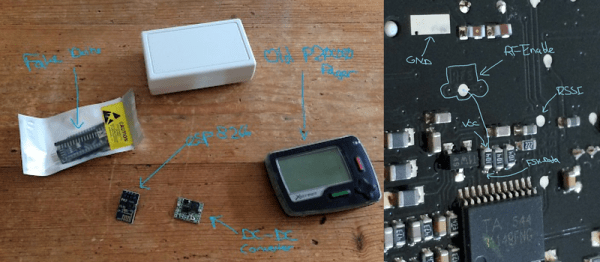
[Corn] apparently scratches the same itch, but in the Netherlands where the FLEX protocol is more common. In addition to walking us through all of the details of the FLEX system, he bought a FLEX pager, gutted it, and soldered on an ATMega328 board and an ESP8266. The former does the FLEX decoding, and the latter posts whatever it hears on his local network.

These days, we’re sure that you could do the same thing with a Raspberry Pi and SDR, but we love the old-school approach of buying a pager and tapping into its signals. And it makes a better stand-alone device with a lot lower power budget. If you find yourself in possession of some old POCSAG pagers, you should check out [Corn]’s previous work: an OpenWRT router that sends pages.

Making A Cheap Radar Unit Awesome

[JBeale] squeezed every last drop of performance from a $5 Doppler radar module, and the secrets of that success are half hardware, half firmware, and all hack.

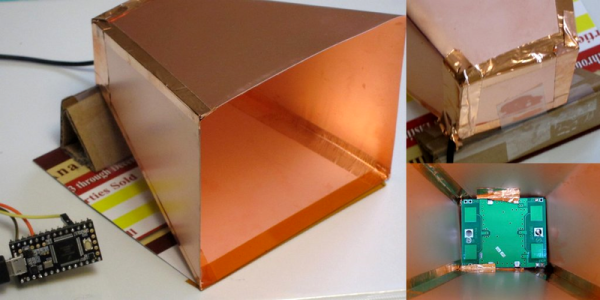
On the hardware side, the first prototype radar horn was made out of cardboard with aluminum foil taped around it. With the concept proven, [JBeale] made a second horn out of thin copper-clad sheets, but reports that the performance is just about the same. The other hardware hack was simply to tack a wire on the radar module’s analog output and add a simple op-amp gain stage, which extended the sensing range well beyond the ten feet or so that these things are usually used for.

With all that signal coming in, [JBeale] separates out the noise by taking an FFT of the Doppler frequency-shift signal. Figuring that people walk around 2.2 miles per hour, [JBeale] focuses on the corresponding 70 Hz frequency bin and finds that the radar will detect people out to 80 feet. Wow!

This trick of taking an el-cheapo radar unit and amplifying the signal to do something useful isn’t new to Hackaday. [Mathieu] did it with the very same HB-100 unit way back in 2013, and then again with a more modern CDM324 model. But [JBeale]’s hacked horn and clever backend processing push out the limits of what you can expect to do with these cheap units. Kudos.

[via PJRC]

Get Inside A TCXO Clock Chip

[Pete] wondered how real-time clock modules could be selling on eBay for $1.50 when the main component, the Maxim DS3231 RTC/TCXO chip, cost him more like $4 apiece. Could the cheap modules contain counterfeit chips?

Well, sure they could. But in this case, they didn’t, and [Pete] has the die shots to prove it. He started off by clipping the SOIC leads rather than desoldering — he’s not going to be reusing this chip after he’s cut it in half. Next was a stage of embrittling the case by heating it up with a lighter and dunking it in water. Then he went at it with sandpaper.

It’s cool. You can see the watch crystal inside, and all of the circuitry. The DS3231 includes a TCXO — temperature-corrected crystal oscillator — and it seems to have a bank of capacitors that it connects and disconnects depending on the chip’s temperature to keep the oscillator running at the right speed. [Pete] used one in an offline situation, and it only lost sixteen seconds over a year, so we’d say that they work fine.

If you’d like to know more about how crystals are used to keep time, check out [Jenny]’s excellent article. And if sixteen second per year is way too much for you, tune up your rubidium standard and welcome to the world of the time nuts.