The UA723 As A Switch Mode Regulator

If you are an electronic engineer or received an education in electronics that went beyond the very basics, there is a good chance that you will be familiar with the Fairchild μA723. This chip designed by the legendary Bob Widlar and released in 1967 is a kit-of-parts for building all sorts of voltage regulators. Aside from being a very useful device, it may owe some of its long life to appearing as a teaching example in Paul Horowitz and Winfield Hill’s seminal text, The Art Of Electronics. It’s a favourite chip of mine, and I have written about it extensively both on these pages and elsewhere.

The Fairchild switching regulator circuit. From the μA723 data sheet in their 1973 linear IC databook, page 194 onwards.

For all my experimenting with a μA723 over the decades there is one intriguing circuit on its data sheet that I have never had the opportunity to build. Figure 9 on the original Fairchild data sheet is a switching regulator, a buck converter using a pair of PNP transistors along with the diode and inductor you would expect. Its performance will almost certainly be eclipsed by a multitude of more recent dedicated converter chips, but it remains the one μA723 circuit I have never built. Clearly something must be done to rectify this situation.

Continue reading “The UA723 As A Switch Mode Regulator”

Returning A Lost Sheep To The NASA Fold

About three weeks ago, we reported that a satellite enthusiast in Canada found an unexpected signal among his listening data. It was a satellite, and upon investigation it turned out to be NASA’s IMAGE satellite, presumed dead since a power failure in 2005 interrupted its mission to survey the Earth’s magnetosphere.

This story is old news then, they’ve found IMAGE, now move on. And indeed the initial excitement is past, and you might expect that to be it from the news cycle perspective. But this isn’t the Daily Mail, it’s Hackaday. And because we are interested in the details of stories like these it’s a fascinating read to take a look at NASA’s detailed timeline of the satellite’s discovery and subsequent recovery.

In it we read about the detective work that went into not simply identifying the probable source of the signals, but verifying that it was indeed IMAGE. Then we follow the various NASA personnel as they track the craft and receive telemetry from it. It seems they have a fully functional spacecraft with a fully charged battery reporting for duty, the lost sheep has well and truly returned to the fold!

At the time of writing they are preparing to issue commands to the craft, so with luck by the time you read this they will have resumed full control of it and there will be fresh exciting installments of the saga. Meanwhile you can read our report of the discovery here, and read about a previous satellite brought back from the dead.

Picture of IMAGE satellite: NASA public domain.

Need Strength? It’s Modified Wood You Want!

Wood is surely one of the most versatile materials available. It can be found in a huge variety of colours and physical properties depending on the variety of the tree that grew it, and it has been fashioned into all conceivable devices, products, and structures over millenia. It’s not without shortcomings though, and one of the most obvious is that it can’t match the strength of some other materials. To carry large forces with a piece of wood that piece has to be made much larger than a corresponding piece of steel, something which is not a problem in a roof truss, but significantly difficult in a car body.

There have been a variety of attempts to strengthen the structure of wood in the past, and the latest has recently been published as a Nature paper. In it is described a process of first treating natural wood in a chemical bath to remove lignin and leave only the cellulose structure, followed by sustained compression at high temperature. This causes the cellulose fibres to interlock, and leaves a much denser wooden board with an equivalent strength that is described as near that of steel. They’ve posted a video which we’ve placed below the break, showing some ballistic tests on their material.

All new materials are of interest, but assuming that this one can be commercialised it makes for a particularly exciting set of possibilities. Wooden motor vehicles for example, new techniques for wooden aircraft or boats, or as an alternative in some applications where carbon fibre might currently find an application.

We’ve looked at a very similar process in the past for producing transparent wood. The good news for Hackaday readers that takes this from esoteric scientific paper to fascinating possibility though is that it can be done at home. Can any of you replicate the pressing step to take it to the next level?

Continue reading “Need Strength? It’s Modified Wood You Want!”

Will John Deere Finally Get Their DMCA Comeuppance?

When it comes to activism, there are many different grades of activist aside from the few who you may encounter quietly and effectively working for change in their field. There are the self-proclaimed activists who sit in their armchairs and froth online about whatever their Cause is, but ultimately aside from making a lot of noise are pretty ineffectual. Then there are the Rebels With A Cause, involved in every radical movement of the moment and always out on the streets about something or other, but often doing those causes more harm than good. Activists can be hard work, at times.

If you are within whatever Establishment that has aroused the collective ire it is not the screamers and banner-wavers that should worry you, instead it is the people who are normally quiet. When people who spend their lives getting things done rather than complaining turn round en masse and rebel, it’s time to sit up and take notice. If people like the farmers or the squaddies are on the streets, the probability of your ending up on the wrong side of history has just increased exponentially and maybe it’s time to have a little think about where you’re going with all this.

The video below the break follows a group of Nebraska farmers fighting for the right to maintain their farm machinery, in particular the products of John Deere. Since all functions of a modern Deere are tied into the machine’s software, the manufacturer has used the DMCA to lock all maintenance into their dealer network. As one farmer points out, to load his combine harvester on a truck and take it on a 100-mile round trip to the dealer costs him $1000 every time a minor fault appears, and he and other farmers simply can’t afford that kind of loss. We’re taken to the Nebraska State Legislature and shown the progress of a bill that will enshrine the right to repair in Nebraskan law, and along the way we see the attempts by lobbyists to derail it.

We normally write Hackaday stories in the third person, but it’s worth saying that this is being written from a small farming community in Southern England, and that there is a green and yellow tractor parked outside somewhere. Thus it’s from first-hand experience that you can be told that Deere is in danger of becoming a damaged brand among its staunchest supporters. They still make damn fine tractors, but who wants to be caught with brief weather window to get on the land, and a machine that’s bricked itself? It’s hardly as though Deere are the only manufacturer of agricultural machinery after all.

This video is quite important, because it is a step towards the wider story becoming more than just a concern to a few farmers, hardware hackers, and right-to-repair enthusiasts. The last word should go to one of the farmers featured, when he points out that all his older tractors are just as capable of going out and doing the same day’s work without the benefit of all the computerized technology on their modern siblings.

Continue reading “Will John Deere Finally Get Their DMCA Comeuppance?”

All The Stuff You Wished You Knew About Fourier Transforms But Were Afraid To Ask

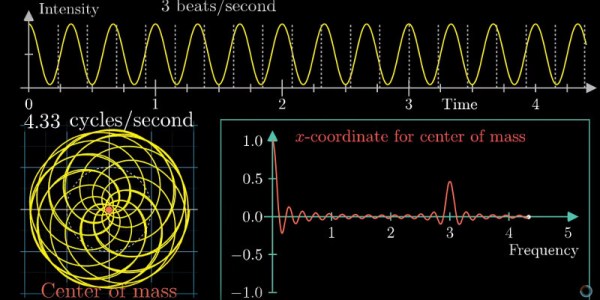
The Fourier transform underpins so much of our technological lives, in most cases probably without our realising it. The ability to mathematically split a waveform into its frequency components and vice versa underpins much of the field of digital signal processing, and DSP has become an essential part of many electronic devices we take for granted.

But while most of us will know what a Fourier transform is, fewer of us will know anything of how one works. They are a function called from a library rather than performed in themselves. Even when they are taught in schools or university courses they remain something that not all students “get”, and woe betide you if (as your scribe did) you have a sub-par maths lecturer.

The video below the break then is very much worth a look if Fourier transforms are a bit of a mystery to you. In it [Grant Sanderson] explains them through a series of simple graphical examples in a style that perhaps may chalk-and-talk mathematics teachers should emulate. You may still only use Foruier transforms through a library, but after watching this video perhaps some of their mysteries will be revealed.

Continue reading “All The Stuff You Wished You Knew About Fourier Transforms But Were Afraid To Ask”

Review: CXG E90W Temperature-Controlled Soldering Iron

It’s an entertaining pastime when browsing the array of wonders available from the other side of the world at the click of the mouse, to scour the listings of the unusual, the interesting, or the inexpensive. Sometimes when you find something unexpected you are rewarded with a diamond in the rough, while at other moments your bargain basement purchase is revealed as a hilariously useless paperweight. This is a game in which the stake is relatively low and the reward can be significant, so rarely does an order for some parts or sundries go by without a speculative purchase.

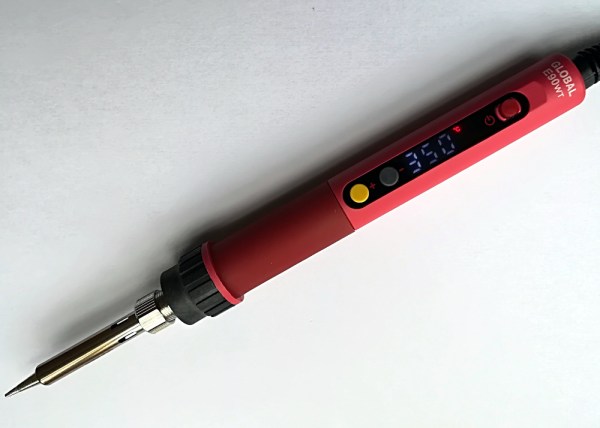
The latest to arrive is a soldering iron. The CXG E90W is a 90W mains-powered temperature controlled iron with its control electronics built into its handle. Such irons are by no means unusual, what makes this one different is that it has a low price tag.

The Miniware TS100, an iron I quite like and the current darling of the pack, is priced at nearly £50 ($71). Just how can this iron priced at just under £15 ($21) be any good? I placed one on the order, and waited for delivery.

Continue reading “Review: CXG E90W Temperature-Controlled Soldering Iron”

A RISC-V That The Rest Of Us Can Understand

There is great excitement in the world of microprocessors, surrounding the RISC-V architecture. This is an open source modular instruction set specification that has seen implementations on FPGAs, and is starting to emerge in dedicated silicon.

If you are not yet up to speed on what is probably going to be the most important microprocessor development of a generation, you should watch this video. As [Robert Baruch] sets out to demonstrate, the combination of RISC technology and a modular instruction set means that the simplest processor compliant with the RISC-V specification can be surprisingly accessible. And to demonstrate this he’s building one from LSI and MSI TTL CMOS chips, something we’d more usually expect to see in a recreation of a much older architecture.

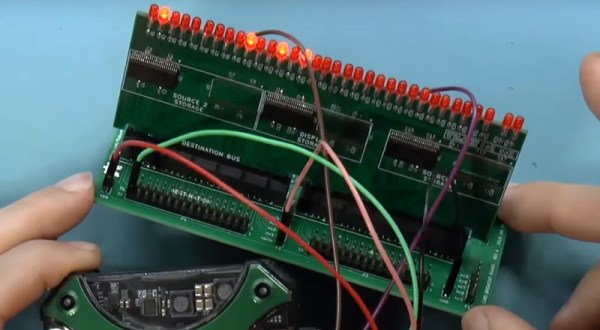
The video below the break is the first of a forthcoming series, and in it he introduces the project and gives us an easily-understandable overview of RISC-V before explaining the mechanics of a register for his RISC-V implementation. This will be his first module, and he’s created a PCB for it. He runs through its design, his choice of indicator LEDs, and then his choice of PCB house. There is also a breakout board, with two of the PCI sockets he’ll be using for his backplane. Finally we see the board being tested, with LEDs lighting up in response to values being stored in a completed register.

[Robert] has appeared on these pages many times before, among the most recent with his TMS9900-based breadboard computer. This build moves away from his retro fare though, and should be well worth watching for future installments.

Continue reading “A RISC-V That The Rest Of Us Can Understand”