Smartphone Bench Instrument Apps: Disappointment Or Delight?

If you are interested in electronics or engineering, you’ll have noticed a host of useful-sounding apps to help you in your design and build work. There are calculators, design aids, and somewhat intriguingly, apps that claim to offer an entire instrument on your phone. A few of them are produced to support external third-party USB instrument peripherals, but most of them claim to offer the functionality using just the hardware within the phone. Why buy an expensive oscilloscope, spectrum analyzer, or signal generator, when you can simply download one for free?

Those who celebrate Christmas somewhere with a British tradition are familiar with Christmas crackers and the oft-disappointing novelties they contain. Non-Brits are no doubt lost at this point… the crackers in question are a cardboard tube wrapped in shiny paper drawn tight over each end of it. The idea is that two people pull on the ends of the paper, and when it comes apart out drops a toy or novelty. It’s something like the prize in a Cracker Jack Box.

Engineering-oriented apps follow this cycle of hope and disappointment. But there are occasional exceptions. Let’s tour some of the good and the bad together, shall we?

Continue reading “Smartphone Bench Instrument Apps: Disappointment Or Delight?”

Characterizing A Cheap 500MHz Counter Module

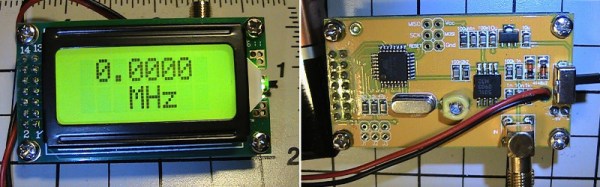
An exciting development over the last few years has been the arrival of extremely cheap instrumentation modules easily bought online and usually shipped from China. Some of them have extremely impressive paper specifications for their price, and it was one of these that caught the eye of [Carol Milazzo, KP4MD]. A frequency counter for under $14 on your favourite online retailer, and with a claimed range of 500 MHz. That could be a useful instrument in its own right, and with a range that significantly exceeds the capabilities of much more expensive bench test equipment from not so long ago.

Just how good is it though, does it live up to the promise? [Carol] presents the measurements she took from the device, so you can see for yourselves. She took look at sensitivity, VSWR, and input impedance over a wide range, after first checking its calibration against a GPS-disciplined standard and making a fine adjustment with its on-board trimmer.

In sensitivity terms it’s a bit deaf, requiring 0.11 Vrms for a lock at 10 MHz. Meanwhile its input impedance decreases from 600 ohms at the bottom of its range to 80 ohms at 200 MHz, with a corresponding shift in VSWR. So it’s never going to match a high-end bench instrument from which you’d expect much more sensitivity and a more stable impedance, but for the price we’re sure that’s something you can all work around. Meanwhile it’s worth noting from the pictures she’s posted that the board has unpopulated space for an SPI interface header, which leaves the potential for it to be used as a logging instrument.

We think it’s worth having as much information as possible about components like this one, both in terms of knowing about new entrants to the market and in knowing their true performance. So if you were curious about those cheap frequency counter modules, now thanks to [Carol] you have some idea of what they can do.

While it’s convenient to buy a counter module like this one, of course there is nothing to stop you building your own. We’ve featured many over the years, this 100MHz one using a 74-series prescaler or this ATtiny offering for example, or how about this very accomplished one with an Android UI?

Spinning 3D POV Display: A High School Term Project

If you are a fan of sci-fi shows you’ll be used to volumetric 3D displays as something that’s going to be really awesome at some distant point in the future. It’s been about forty years since a virtual 3D [Princess Leia] was projected to Star Wars fans from [R2D2]’s not-quite-a-belly-button, while in the real world it’s still a technology with some way to go. We’ve seen LED cubes, spinning arrays, and lasers projected onto spinning disks, but nothing yet to give us that Wow! signaling that the technology has truly arrived.

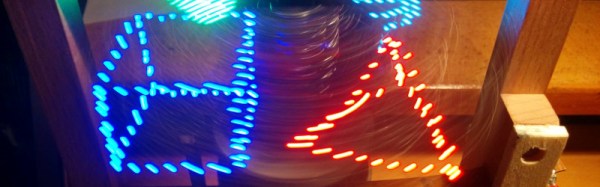
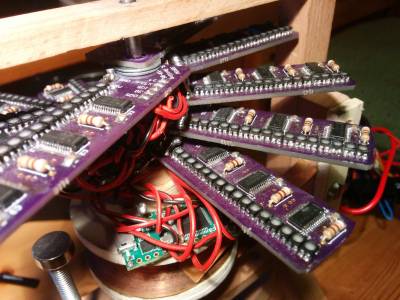
We are starting to see these displays move from the high-end research lab into the realm of hackers and makers though, and the project we have for you here is a fantastic example. [Balduin Dettling] has created a spinning LED display using multiple sticks of addressable LEDs mounted on a rotor, and driven by a Teensy 3.1. What makes this all the more remarkable is that he’s a secondary school student at a Gymnasium school in Germany (think British grammar school or American prep school).

volumetric-pov-display-built-by-high-schooler-led-boardsThere are 480 LEDs in his display, and he addresses them through TLC5927 shift registers. Synchronisation is provided by a Hall-effect sensor and magnet to detect the start of each rotation, and the Teensy adjusts its pixel rate based on that timing. He’s provided extremely comprehensive documentation with code and construction details in the GitHub repository, including a whitepaper in English worth digging into. He also posted the two videos we’ve given you below the break.
What were you building in High School? Did it involve circuit design, mechanical fabrication, firmware, and documentation? This is an impressive set of skills for such a young hacker, and the type of education we like to see available to those interested in a career in engineering.

Continue reading “Spinning 3D POV Display: A High School Term Project”

How To Control Your Instruments From A Computer: It’s Easier Than You Think

There was a time when instruments sporting a GPIB connector (General Purpose Interface Bus) for computer control on their back panels were expensive and exotic devices, unlikely to be found on the bench of a hardware hacker. Your employer or university would have had them, but you’d have been more likely to own an all-analogue bench that would have been familiar to your parents’ generation.

A GPIB/IEEE488 plug. Alkamid [CC BY-SA 3.], via Wikimedia Commons
A GPIB/IEEE488 plug. Alkamid [CC BY-SA 3.], via Wikimedia Commons.
The affordable instruments in front of you today may not have a physical GPIB port, but the chances are they will have a USB port or even Ethernet over which you can exert the same control. The manufacturer will provide some software to allow you to use it, but if it doesn’t cost anything you’ll be lucky if it is either any good, or available for a platform other than Microsoft Windows.

So there you are, with an instrument that speaks a fully documented protocol through a physical interface you have plenty of spare sockets for, but if you’re a Linux user and especially if you don’t have an x86 processor, you’re a bit out of luck on the software front. Surely there must be a way to make your computer talk to it!

Let’s give it a try — I’ll be using a Linux machine and a popular brand of oscilloscope but the technique is widely applicable.

Continue reading “How To Control Your Instruments From A Computer: It’s Easier Than You Think”

An SDR For The Rest Of Them

If you are a radio enthusiast it is very likely that you will own at least one software defined radio. With the entry point into the world of SDRs starting with the ultra-cheap RTL2382 based USB receiver sticks originally designed for digital TV, it’s a technology that passed long ago into the impulse purchase bracket.

If you are not a radio enthusiast, or not even a Hackaday reader, you may not have heard of SDR technology. Even the humblest up-to-date radio or TV may well contain it somewhere within its silicon, but at the user interface it will still resemble the device you would have had in the 1950s: analogue tuning, or a channel-flipper.

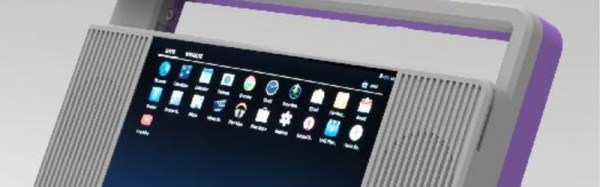
It is interesting to see an attempt to market a consumer device that is unashamedly an SDR, indeed that is its unique selling point. The Titus II SDR bills itself as the “World’s First Consumer Ready SDR Package”, and is based around an Android tablet mated with a 100 kHz to 2 GHz SDR tuner and a pair of speakers in a portable radio styled case. It will support all modes including digital broadcasting through software plugins, and there will be an open plugin API for developers. They are taking pre-orders, and claim that the launch price will be under $100.

It sounds like an exciting product, after all who wouldn’t want a radio with those capabilities at that price! However it leaves us wondering whether the price point is just a little too ambitious for the hardware in question, and we’ll reluctantly say we’ll believe it when we see real devices on the market. A $100 consumer price doesn’t get you much in the tablet world, and that is from high-volume Chinese manufacturing without the extra cost of the SDR hardware and the overhead of smaller volume from a niche product. There are pictures online of real prototypes at trade shows, but we’d like to see a website with fewer renders and more hard plastic.

There is another angle to this device that might interest Hackaday readers though. It should remind anyone that building one yourself is hardly a difficult task. Take an RTL2382 stick with or without the HF modification, plug it into a tablet with an OTG cable, install an app like SDR Touch, and away you go. 3D print your own case and speaker surrounds as you see fit, and post the result on hackaday.io.

Via the SWLing Post.

Medium Over Message: A CD-ROM Multimedia Bubble Survivor’s Tale

Sometimes in the never-ending progression of technology, people take wrong turns. They pursue dead-ends they believe represent a bright future, often in spite of obvious indications to the contrary. IBM doggedly insisting Micro Channel Architecture was the future of PC hardware, for example, or Nokia’s seeming inability to recognise that the mobile phone experience had changed for ever when the first iPhones and Android devices appeared.

Every once in a while, that collective delusion grips an entire industry. All the players in a particular market nail their colours to a technology, seemingly without heed to what seems with hindsight to have been a completely obvious threat from the alternative that sidelined them. It is a tale of personal experience that prompts this line of thought, for the industry that tempted me away from hardware to a career in electronic publishing in the early 1990s was CD-ROM multimedia.

Continue reading “Medium Over Message: A CD-ROM Multimedia Bubble Survivor’s Tale”

A Linux Exploit That Uses 6502 Code

With ubiquitous desktop computing now several decades old, anyone creating an operating system distribution now faces a backwards compatibility problem. Each upgrade brings its own set of new features, but it must maintain compatibility with the features of the previous versions or risk alienating users. If you are a critic of Microsoft products for their bloat, this is one of the factors behind that particular issue.

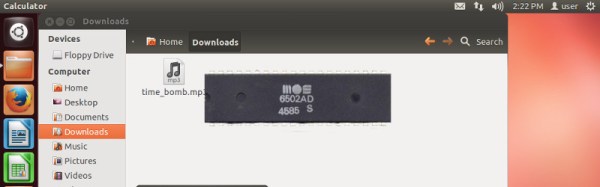
As well as a problem of compatibility, this extra software overhead creates one of security. A piece of code descended from a DOS word processor of the 1980s for example was not originally created with any idea that it might one day be hiding in a library on a machine visible to the entire world by the Internet. Our subject today is a good example, just such a vulnerability hiding in an old piece of code whose purpose is to maintain an obscure piece of backward compatibility. [Chris Evans] has demonstrated a vulnerability in an Ubuntu version by playing an NES music file that contains exploit code emulated by the player on a virtual 6502 processor.

The NES Sound Format is a music file standard that packages Nintendo game music for playback. It contains a scripting language, and it is this that is used to trigger the vulnerability. When you open an NSF file on the affected Ubuntu system it finds its way via your music player and the gstreamer multimedia framework to libgstnsf.so, a gstreamer plugin for playing NSF files.

Rather unbelievably, his plugin works by emulating a real 6502 as found in a NES to derive the musical output, and it is somewhere here that the vulnerability exists. So not only do we have layer upon layer of backward compatibility to play an obscure music file format, there is also a software emulation of some 8-bit silicon from the 1970s. [Chris] comments “Is that cool or what?“, and while we agree that a 6502 emulator buried in a modern distro is cool, we can’t help thinking something’s been lost along the way.

A proof-of-concept is provided for Ubuntu 12.04. It’s an older version, but he points out that while he thinks the most recent releases should not contain exactly the same vulnerability, it certainly exists in more than one still-supported version. There’s also a worrying twist in that due to the vagaries of Ubuntu’s file manager it auto-opens when its folder is accessed from the GUI. The year 2000 called, they want their auto-opening Windows ME worms back.

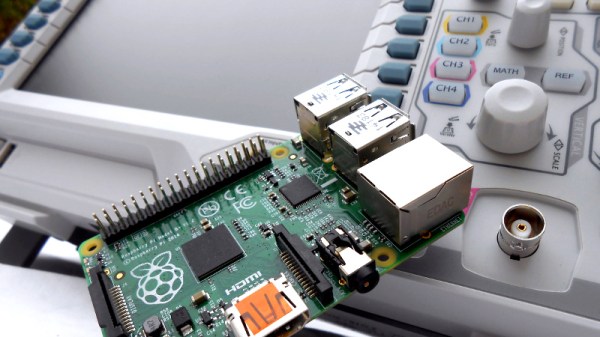
Sadly we suspect the 6502 lurking in this music player can’t be put to more general-purpose use. If you manage it, please do share it with us! But if emulated 6502s are your thing, take a look at this 150MHz 6502 co-processor for an Acorn BBC Micro that someone made using a Raspberry Pi.

[via r/hacking]

6502 image, Dirk Oppelt, (CC BY-SA 3.0) via Wikimedia Commons.