We Dig This LEGO Excavator Conversion

[Frank] was lucky enough to score a bucket wheel excavator LEGO set as a birthday present, and we won’t lie – we’re jealous. However, out of the box, the kit is somewhat limited; there is only one motor to animate the entire machine and it can’t be fully remote controlled. But don’t worry — [Frank] set out to change that (Google Translation).

The first part of the build was to add motors to control the different functions of the excavator. One motor was added for each of the two tracks to allow the machine to drive forwards, backwards, and turn. Two more motors were added to raise and lower the digging buckets, and spin the tower. Finally, the original motor was left in place to turn the conveyor.

With that done, [Frank] then used a Raspberry Pi 3 to control all the hardware, being sure to house the new electronics in LEGO for an original look. The Raspberry Pi might be a lot of muscle to simply control a few motors, but it made it quick and easy for [Frank] to implement a Wiimote as a controller over Bluetooth. You can check out a couple demo videos in his most recent update.

It’s a great project, and we’d love to see the Raspberry Pi put to good use by allowing control over the Internet so we can dig in the sand over lunch breaks. We’ve seen some great LEGO hacks before, like this method of modifying cheap gear motors to work with LEGO parts.

Home Built PCB Mill Reportedly Doesn’t Suck

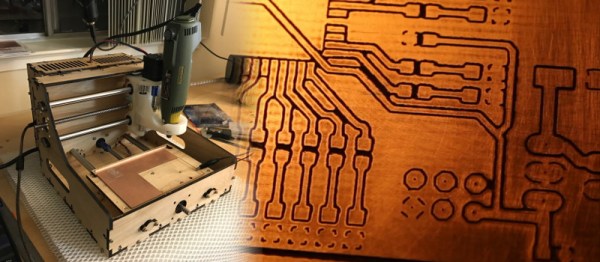
It’s 2017, and getting a PCB professionally made is cheaper and easier than ever. However, unless you’re lucky enough to be in Shenzhen, you might find it difficult to get them quickly, due to the vagaries of international shipping. Whether you want to iterate quickly on designs, or just have the convenience of speed, it can be useful to be able to make your own PCBs at home. [Timo Birnschein] had just such a desire and set about building a PCB mill that doesn’t suck.

It might sound obvious, but it bears thinking about — if you know you’re incapable of building a good PCB mill in a reasonable period of time, you might save yourself a lot of pain and lost weekends by just ordering PCBs elsewhere. [Timo] was fairly confident however that the build would be able to churn out some usable boards, however, and got to work.

The build is meant to be accessible to the average hacker who wants one. The laser cut & 3D printed parts are readily available these days thanks to online services that can manufacture for those who don’t have the machines at home. [Timo] uses a rotary multitool for a spindle, a common choice for a budget CNC build.

With the hardware complete, [Timo] has spent time working on optimising the software side of things. Through careful optimisation of the G-Code, [Timo] has been able to improve performance and reduce stress on the tooling. It’s not enough to just build a good mill — you’ve got to have your G-Code squared away as well.

Overall, the results speak for themselves. The boards don’t suck; the mill can do traces down to 8 mil, and even drill the holes. We’d love to have one on the workbench when busting out some quick prototypes. For another take on the home-built PCB mill, why not check out this snap-together version?

How To MIDI Interface Your Toys

There’s a great number toys in the world, many of which make all manner of pleasant or annoying noises for the entertainment of children. If you’re a musician, these toys may be of interest due to their unique or interesting sounds. However, due to their design being aimed at play rather than performance, it may be difficult to actually use the toy as a musical instrument. One way around this is to record the sounds of the toy into a sampler, but it’s not the only way. [little-scale] is here to demonstrate how to MIDI interface your toys. 

[little-scale] starts out by discussing the many ways in which one can interface with a toy. The article discusses how a simple button can be replaced with a relay, or a multiplexer, and be interfaced to all manner of other devices to control the toy. This is demonstrated by using a mobile phone toy which makes sounds when buttons are pressed.

A Teensy 3.6 is used to run the show, acting as a USB-MIDI interface so the toy can be controlled by music software like Abelton. It’s connected to the toy’s buttons through a multiplexer. The toy’s speaker is cut off and used as an audio output instead, allowing the toy to be easily connected to other audio hardware for performance or recording. It’s also fed through a digital pot so MIDI commands can control the volume. A resistor is used to control pitch in the toy, so this too was replaced with a digital pot as well, to allow sample pitch to be controlled.

The project is incredibly well documented, with [little-scale] first tearing down the toy and highlighting the points of interest, before stepping through each stage of interfacing the toy to the digital world. We’ve seen some of [little-scale]’s work before, too – namely, this MIDI DAC for controlling vintage synthesizers. Video after the break. Continue reading “How To MIDI Interface Your Toys”

Using Nanotubes To Strengthen 3D Prints

3D printing has brought the production of plastic parts to the desktops and workshops of makers the world over, primarily through the use of FDM technology. The problem this method is that when squirting layers of hot plastic out to create a part, the subsequent vertical layers don’t adhere particularly well to each other, leading to poor strength and delamination problems. However, carbon nanotubes may hold some promise in solving this issue.

A useful property of carbon nanotubes is that they can be heated with microwave energy. Taking advantage of this, researchers coated PLA filament in a polymer film containing carbon nanotubes. As the layers of the print are laid down, the nanotubes are primarily located at the interface between the vertical layers. By using microwaves to heat the nanotubes, this allows the print to be locally heated at the interface between layers, essentially welding the layers together. As far as results are concerned, the team reports an impressive 275% improvement in fracture strength over traditionally printed parts.

The research paper is freely available, which we always like to see. There’s other methods to improve your print strength, too – you could always try annealing your printed parts.

[Thanks ????[d] ???? for the tip]

Using Machine Learning To Cut Down Surgical Videos

Recording video of medical surgeries is a great way to both educate doctors in training and identify process improvements. However, surgeries can be very time consuming, and it can be a gargantuan task to sort through endless hours of video searching for relevant points where the action happens. To tackle this issue, researchers at MIT have used machine learning techniques to analyse videos of surgical procedures.

There’s some fairly serious mathematics behind this sort of videographic analysis.

The machine learning algorithm needed to be trained to identify the relevant parts of surgical videos. To do this, the laparoscopic surgeries being investigated were split up into distinct stages, each relating to a different part of the surgical process. Researchers would then watch recordings of prior surgeries and mark the start of each stage. This data was used to train the model which was then used to sift through other recordings to capture the key moments of each surgery.

The time-saving advantages of such technology could be applied to a great many fields – such an algorithm could be put to great use to sort through hours of uneventful security footage looking for anomalies, or rapidly cut together holiday footage so you only have to see the good parts. We’d love to see the researchers release footage showing the algorithm’s work – thus far, all we have to go off is the project paper.

If you’re thirsty for more machine learning knowledge, read up on the state of working with neural networks in 2017.

Animated Bathroom Sign

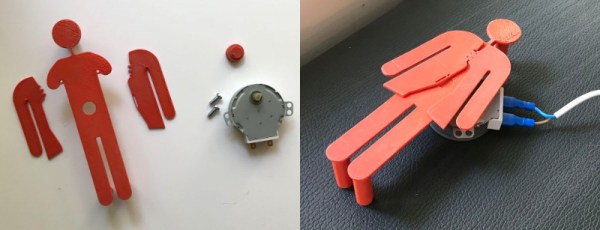
Once upon a time, pants were created. After a while, women were allowed to wear them too. This has made a lot of people happy and been widely regarded as a good thing. There is a problem, however – bathroom signage is largely predicated on the idea that there are two rigid genders which all humans must be sorted into, and they’re defined by whether you’re wearing pants or a dress. [Robb Godshaw], among others, disagrees with this, and set about building a gender fluid bathroom sign.

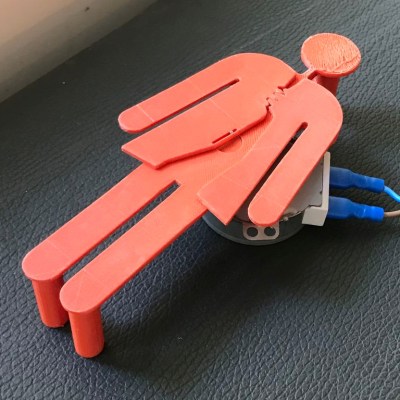
The sign assembled on the motor.

The project seeks to exploit the traditional symbols of “male” and “female” – the human figures wearing pants or a dress – by creating a sign that switches between the two every 15 seconds. This is likely to initially confuse – one might imagine the bathroom is actually changing its gender designation rapidly, forcing users to complete their business in an incredibly short timeframe. However, the message behind the project is to highlight the absurdity of defining gender by pants, colours, or indeed in a binary nature at all. [Robb] also helpfully points out that all humans have to pass waste, regardless of gender.

The sign is built with 3D-printed components, using a crank mechanism to actuate the moving parts. The mechanism is designed to give equal time to the pants and dress configurations. [Robb] shares the important details necessary to replicate the build, such as how to assemble the metal crank pin insert with a paperclip and a lighter. It’s particularly tidy the way the mechanism is integrated into the parts themselves. In true hacker style, the motor is a standard microwave oven turntable motor, which can be harvested easily from a junk appliance and can be plugged straight into mains power to operate, if you know what you’re doing. If you don’t, check out our primer on the topic.

Overall, the project is a great use of hacker techniques, like 3D printing and harvesting parts, to make a statement and start a conversation, while being fun, to boot. We’ve also seen some of [Robb]’s work before, like this giant hamster wheel for people. Video after the break.

Continue reading “Animated Bathroom Sign”

Fake Your ID Photos – The 3D Way

Photographs for identification purposes have strict requirements. Lighting, expression, and framing are all controlled to enable authorities to quickly and effectively use them to identify individuals reliably. But what if you created an entirely fake photograph from scratch? That’s exactly what [Raphael Fabre] set out to do.

With today’s 3D modelling tools, human faces can be created in extreme detail. Using these, [Raphael] set out to create a 3D model of himself, which was then used to render images simulating a passport photograph. Not content to end the project there, [Raphael] put his digital doppelgänger to the test – applying for a French identification card. He succeeded.

While the technology to create and render high-quality human faces has existed for a while, it’s impressive that [Raphael]’s work passed for genuine human. Obviously there’s something to be said for the likelihood of an overworked civil servant catching this sort of ruse, but the simple fact is, the images made it through the process, and [Raphael] has his ID. Theoretically, this leaves open the possibility of creating entirely fictitious characters and registering them as real citizens with the state, for all manner of nefarious purposes. If you do this, particularly on a grand scale, be sure to submit it to the tip line.

We’ve seen other concerning ID hacks before, such as this attempt at hacking RFIDs in Passport Cards.