Shenzhen Tour And UnHuman Soldering Classes With DP

dp-hacker-camp

If you’re free the first week of April and don’t mind sitting on a plane for a looooong time you should check out the Hacker Camp that Dangerous Prototypes is planning. We’re sure you remember [Ian Lesnet] who is a Hackaday Alum, creator of the Bus Pirate, and geeky world traveler. Now’s your chance to try out what to him is a way of life.

The event is April 3-5 in Shenzhen, China. Although marketed as a “Hacker Camp”, to us it sounds more like training for those interested in running hardware companies that use the Shenzhen manufacturing district as the anchor of their supply chain. Part of the prep-work for the trip includes submitting board files which will be fabbed and ready for you on the first day. [Ian] and his crew will be your guides for the culture of the area; complete with meals and bar time. But there are also soldering workshops as part of the package. Don’t pooh-pooh the idea. This is unhuman soldering… BGA and QFN soldering instruction from the people who repair cellphones and other microelectronics.

This [Rick Steves] style adventure is the first that we remember hearing about that targets the open hardware community. But we must admit, it sounds like a lot more fun than a European river cruise!

[Thanks Akiba]
Update: Tetris Handheld Get PCB And Case

update-handheld-tetris

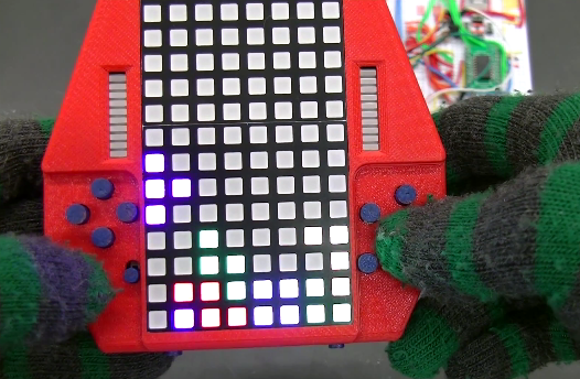
Check out this sweet-piece of homemade handheld gaming! [Jianan Li] has been hard at work on the project and published the updates in two parts, one that shows off the PCB he had fabbed for the project, and another which details the 3D printed case. This is, of course, is the culmination of the Tetris project we first saw as an incredbily packed, yet thouroughly tidy breadboarded circuit.

We really enjoy the 8-sided PCB design which hosts all the parts and gives you a place to hold and control the unit, all without seeming to waste much real estate. The case itself is quite impressive. The openings for the square-pixel LED matrices (the original design had round pixels) and the bar graphs all have nice bevel features around them. The control area has a pleasant swooping cutout, with blue buttons which stand out nicely against the red. Check out the slider switch by his left thumb. He printed matching covers for this slider, and the two that stick out the bottom. Also on the bottom are female pin headers so that you don’t need to disassemble the case to interface with the electronics.

All of this and more are shown off in the clip after the break.

Continue reading “Update: Tetris Handheld Get PCB And Case”

Retrotechtacular: Where The Linux/UNIX TTY Came From

retrotechtacular-tty-demystified

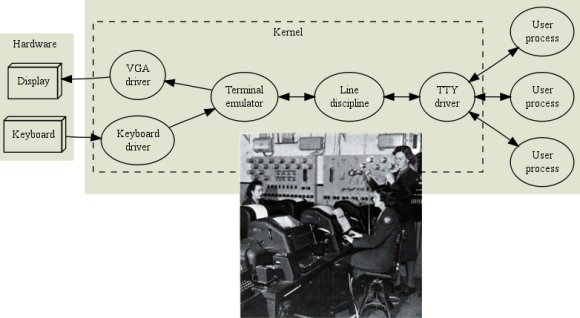
From time to time we realize that sayings which make sense to us probably will have no meaning for future generations. Two of the examples that spring to mind are “hang up the phone” or in a vehicle you might “roll down the window”. And so is the case for today’s Retrotechtacular. Linux users surely know about TTY, but if you look up the term you actually get references to “Teletypewriter”. What’s that all about?

[Linus Akesson] wrote a fantastic essay on the subject called The TTY Demystified. We often feature old video as the subject of this column, but we think you’ll agree that [Linus’] article is worth its weight in film (if that can be possible). The TTY system in Linux is a throwback to when computers first because interactive in real-time. They were connected to the typewriter-mutant of the day known as a teletype machine and basically shot off your keystrokes over a wire to the computer the terminal was controlling.

This copper pipeline to the processor is still basically how the terminal emulators function today. They just don’t require any more hardware than a monitor and keyboard. We consider ourselves fairly advanced Linux users, but the noob and expert alike will find nuggets and tidbits which are sure to switch on the lightbulb in your mind.

[Thanks Chuck]

Retrotechtacular is a weekly column featuring hacks, technology, and kitsch from ages of yore. Help keep it fresh by sending in your ideas for future installments.

Cobalt RaQ Retrofit Help Geek Up Your Entertainment Center

cobalt-raq-jukebox

Even network engineers who toil away in hot server rooms (which aren’t actually all that hot because they’re well climate controlled) deserve nice things. That’s why Cobalt came out with these gorgeous front bezels for their rack mounted equipment… around twenty years ago. [Geekmansworld] is reviving the look, but he’s not hiding it away in a server rack. He scrapped the guts and used the front bezel and controls as part of his media server.

His first new addition to the case was a pair of hard drives which connect to an eSATA hub also stored in the enclosure. He buttoned it up and gave it a test run. Everything worked smoothly and he hopes that it will continue that way without overheating when the summer rolls around again.

Of course a dead front bezel is no fun so he cut off the portion of the original circuit board which hosts the buttons seen on the right. These buttons now connect to a U-HID board which turns the button presses into mouse or keyboard inputs using a USB connection. The original display was swapped out for a backlit character LCD. The LEDs to the left are a refit which turns the status indicators into a VU-Meter. See the entire thing at work after the break.

Continue reading “Cobalt RaQ Retrofit Help Geek Up Your Entertainment Center”

Java Grinder Spits Out DsPIC And MSP430 Assembly Code

java-code-grinder

[Michael Kohn] sent in a link to the set of projects he’s been working on lately. The Java Grinder is a project that converts Java code for use on microcontrollers. This actually started back in 2009, when he mentioned that the project was worthless because there were already a ton of Java virtual machines out there. But if he had really thought that he’d never learn anything. We’re glad [Michael] picked this back up and made something out of it.

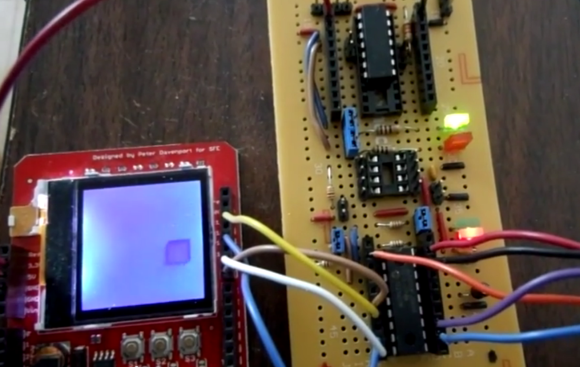
The image above shows the proof of concept. It’s a box bouncing around the Nokia 6100 screen. He wrote the animation in Java, and used his grinder to turn the code into dsPIC assembly, which was then compiled and flashed onto the microcontroller. That’s not all, he’s also coded a Mandelbrot set generator or the same hardware. As it stands he can also produce assembly code for use on MSP430 chips.

This kind of exploration is great for the brain. We see it as a natural extension of the learning you acquire from Nand2Tetris which walks through the essential text The Elements of Computing Systems. If you’re not familiar, that’s a trip from building your first logic gate, which you plunk together with others to build an ALU, then start coding all the way up to a virtual machine to run on your simulated hardware.

Video of the bouncing box and Mandelbrot set is below.

Continue reading “Java Grinder Spits Out DsPIC And MSP430 Assembly Code”

Hackaday Links: February 9, 2014

hackaday-links-chain

Here’s a quick tip to extend the usefulness of your multimeter. It’s a set of mini test hooks soldered to alligator clips with a short hunk of stranded wire in between. You can buy mini test hooks that go right on the metal probes of your meter, but the weight and bulk of the meter probes and cords sometimes get in the way. This rig allows more flexibility because of that wire.

Staying on the theme of test equipment tips, here’s a simple way to make a Y-connector for logic analyzers. [Thomas] uses a dual-row pin header, shorting each pair of pins so that both rows are connected. When this is plugged into a pin socket it leave two pins for connecting your test equipment and the rest of the project hardware.

After seeing our feature of a 3-wire Character LCD [Chad] wrote in to mention he built a 1-wire version using an ATmega328.

If you’re going to be in Anaheim this week you can stop by the ATX-West expo and see a 3D printer with a 1m x 1m x 0.5m printing area. [Thanks Martin]

Speaking of 3D printers, here’s a big delta robot (seven feet tall) outfitted for alternative material printing. It’s printing a CT scan of ribs and a heart in hot glue. This seems to be a popular material for more artistic uses. We just saw a hexapod which deposits hot glue as it roams.

The weaponized quadcopter post from Tuesday was a controversial one. The really bad part of it was the laser, which strapped to anything is extremely dangerous. But the other hack may have just been poorly executed. Hackaday alum [Jeremy Cook] wrote in to mention that fireworks and quadcopters can be used more responsibly. He strapped a sparkler to his quadro and used it to make light graffiti. You may remember that [Jeremy] wrote an introduction to light graffiti for us back in November.

Router Robot A Promising Playground For Young Hacker

router-robot-project

[Stephen Downward] has put together a very impressive Internet controlled robot. There are so many things about his video presentation (also embedded below) which we find delightful. Notably, it’s obvious that he knows what he’s talking about when discussing everything from the electronics chosen for the project, the mechanical assembly and the issues with its current state, as well as the software backend that gives him control of the rover.

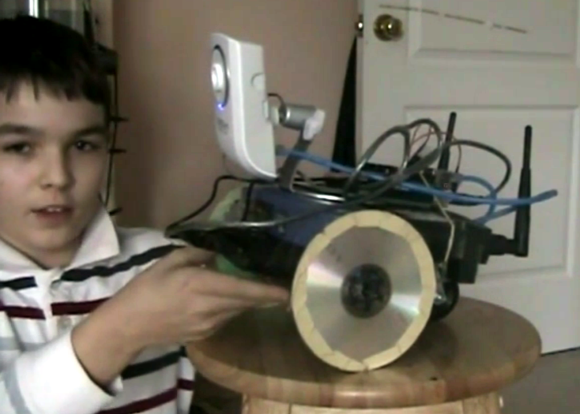
The bulk of the rover is the Linksys WRT-54G router which he picked up at a thrift shop. This has been a popular model for building rovers for quite some time. [Stephen] is not driving directly from the router’s serial port, but that could be an adventure for him down the road. For now he’s using an Arduino Mega along with an Ethernet shield to connect the motors to his network. The IP camera on the front gives him the video feed to operate this completely over the Internet using his own program written in C#. He mentions that the CD wheels he has aren’t ideal because of their thin tread area (covered in masking tape) and the inaccurate mounting which leaves one of them at an angle. He’s hoping to design and print his own. He plans rent some time on a 3D printer at the local University when their 3D printing service comes back online.

We think the hardest part with robot building is getting your first platform up and running. Now that he’s got that it’s a matter of making improvements and add-ons. Since he’s got the I/O of the Mega at his disposal we’d like to see him implement a bunch of different sensor: line following, bump sensors, distance sensor, heck… maybe someday he’ll scavenge some Lidar for it!

Continue reading “Router Robot A Promising Playground For Young Hacker”