Tailgating This Car Carries A Heavy Penalty

This hack seems simple enough:

  1. 1. Open hatchback
  2. 2. Insert jet engine
  3. 3. Profit

Actually, the guy who added a jet engine to a VW Beetle has a PhD in Mechanical Engineering from Stanford. He claims this is street legal, and even has a snapshot of the police trying to figure out what to charge him with after stopping him on the road. There’s plenty of details and we’re not questioning [Ron Patrick’s] competence, but having the intake for the turbine inside the cab of the vehicle seems a bit insane. He remarks that “it’s a little windy but not unbearable”… yeah.

One the same page you’ll find his dual-jet modified scooter. The starting cost there is considerably less, especially if you build your own ram jets.

[Thanks Goldscott]
CNC Hardware: Stream G-code To An Arduino

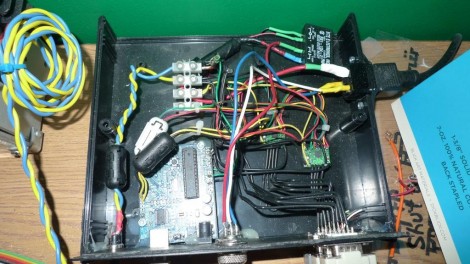
[Reza Naima] has been using an Arduino as the center of his CNC setup for quite some time now. It handles three stepper motors, limiting switches, e-stop, and spindle control. The sketch he’s using allows him to stream g-code to the popular prototyping platform, freeing him from needing a dedicated PC. It’s worked so well that he’s decided to clean up the code and develop a shield to help others get up and running. If you want to see his progress or lend a hand, check out the google group he started for the schematics, code, and forum discussions. There is already a CNC project for Arduino called Grbl but [Reza’s] approach uses the Arduino libraries in an effort to make the sketch more customizable for the average user.

LED Matrix With A Gross Of Pixels

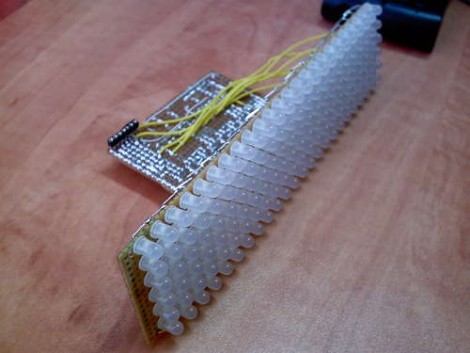
This LED matrix is arranged in a 24×6 pattern for message scrolling. There’s no etched boards here, making us wonder where [Syst3mX] found protoboard this long. He’s using an Arduino to drive the demonstration (clip after the break) but you can use any microcontroller with this setup. That’s because he’s using three shift registers for column data and a decade counter for row scanning, requiring just five control pins.

While you’re going to the trouble of ordering components, maybe you should try your hand at building a touch sensitive LED matrix too.

Continue reading “LED Matrix With A Gross Of Pixels”

Rapid Furniture Prototyping

SketchChair is a piece of software that takes the engineer out of engineering furniture. In a child’s-dream-come-true you draw the outlines you’d like to have, add some legs, and the software pops out a design ready to be laser-cut. The finishing touch of adding palm fiber and felt produces what we imagine is a moderately comfortable place to sit. Now the hard part will be convincing your spouse that you should spend the money building an industrial grade laser cutter because of all the money you’ll save on furniture.

We’re still holding out for furniture that is 3d-printed from rock to match our Flintstone’s motif.

Oh, and as always, video after the break.

Continue reading “Rapid Furniture Prototyping”

IPad Arcade Dock Has Hidden Projector

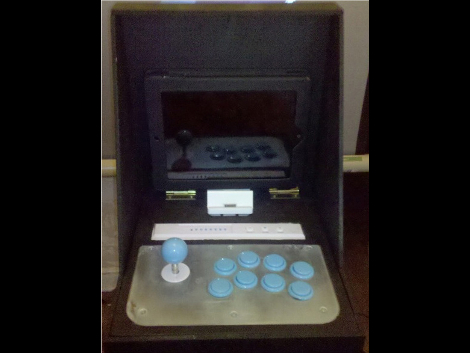
This iPad dock is a well-executed gaming accessory. [Linkreincarnate] used a Hori Wii fighting stick as the controller. In his hardware explanation he outlines several benefits of this choice including built-in support in most of the iPad emulators, as well as foregoing the need for a wired connection. Just above the controls there is a standard docking connector which holds the iPad in place and patches through the audio to some external speakers. But  that’s not all that is included in the build, the final touch is a pico projector that can be used if you want a larger gaming experience. Video of the hardware and a gaming demonstration can be found after the break.

Continue reading “IPad Arcade Dock Has Hidden Projector”

Hands-free Input

This is a concept input device that [Tech B] built for disabled users. The device uses an accelerometer along with a piezo sensor (right click) and a push button (left click) to function as a mouse. The Arduino that resides in a breadboard on the side of the hat communicates with the computer over a serial connection, using PySerial to translate the microcontroller data into cursor commands with the power and ease of the Python programming language.

During development [Tech B] made a proof-of-concept video using a Basic Stamp which you can watch after the break. He found that this input device was less complicated, more accurate, and much less resource intensive than his webcam IR tracking system.

4-player SNES And More

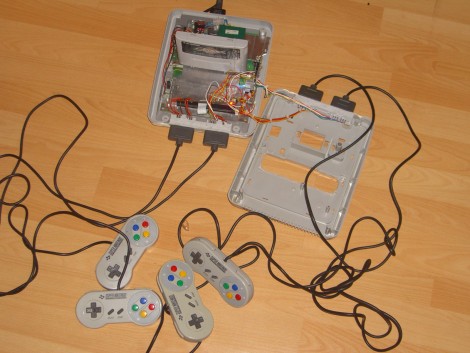
[Mr.X] added support for four controllers to his Super Nintendo (Google translated) by internalizing the multi-player adapter. In the video after the break you’ll notice that he also added some bling to the case by positioning the power LED beneath the logo and adding a two-digit display. There is a switch on the back that allows him to choose PAL or NTSC standards with the current setting shown on that display. While most people are going with emulators, [Mr.X] ended up with a custom piece of hardware with a clean finish.

Continue reading “4-player SNES And More”