Adding Remote Touch Control To The Kaoss Pad

touchosc_kaoss

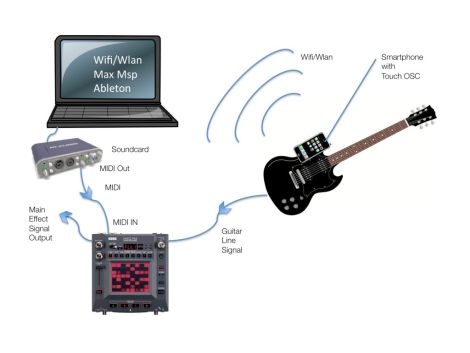
[Munki] enjoys using his Kaoss Pad MIDI controller to add a new dimension to his music while playing guitar. The only thing that bothers him about the Kaoss Pad interface is that it can be difficult to trigger or alter effects in the middle of a bitchin’ guitar solo. He started looking around to see if there was a way to control the Kaoss Pad wirelessly via a touchscreen and found that with a little tweaking, his iPhone was a perfect candidate for the job.

He grabbed a copy of TouchOSC from the AppStore and configured it to communicate with his computer. After building an interface for his iPhone, he taped it to his guitar and gave it a try. Everything seemed to work pretty well, but he didn’t stop there – he also wanted to control Ableton Live and Max MSP from his iPhone. It took a bit of research and some tinkering with the Live API, but he eventually got everything working together nicely as you can see in the video below.

If you are interested in trying this out yourself, he has several useful links throughout his article, and he has made his TouchOSC/Max MSP patch available for download as well.

Continue reading “Adding Remote Touch Control To The Kaoss Pad”

Quick Hack Disables IPod Dock Auto-standby

ipod_dock_hacking

[Aaron] wrote in to share with us a quick hack that has made his life a little easier. He bought a Rocketfish RF-HV3 portable iPod dock to listen to his music, but he wanted to utilize it as an alarm clock as well. He also found that the speakers worked quite well when he hooked up his Yaesu handheld transmitter to the dock.

The only problem he had with it was that the dock would automatically power down when there was no input for 5 minutes. That’s fine when the dock is running on batteries, but if [Aaron] was going to use it as an alarm clock or to listen to his HAM radio, that simply wouldn’t do.

He pulled the dock apart and started poking around with his DSO Nano scope. He found that if pin 16 stays low for 5 minutes, it turns off the dock even if there is a signal coming through. His fix for the problem was actually quite simple – all he did was solder the VDD pin to the pin in question, and the 5-minute timeout was disabled.

We’re glad that [Aaron] was able to solve his problem in such an easy manner – it just goes to show what you can do with a scope and a few minutes’ time.

Scout, The Autonomous Transatlantic Boat

autonomous_boat

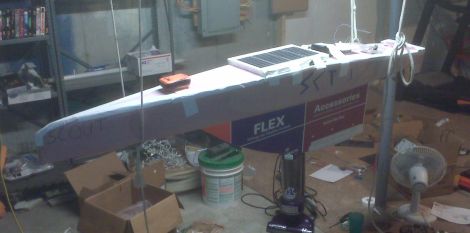
Sailing a small boat across the Atlantic ocean is quite the daunting task. As many have discovered, it is a journey often fraught with perils, typically ending in failure. A team of four college students decided the best way to get a small boat across the ocean would be to remove the human element from the process, so they set off to build an autonomous craft to take on the task.

Like most projects, this one started as a handful of wild ideas exchanged between friends [Dylan Rodriguez and Max Kramers]. As they thought about it more, they decided that turning [Max’s] sailboat into an autonomous ocean-going craft would be pretty awesome, so they got to work. Recruiting help from their friends [Brendan Prior and Ricky Lyman], the project started to quickly take shape, and Scout was born.

Scout is 8 feet long and consists of foam core covered in carbon fiber. It is filled with various electronic components such as a SPOT tracker, a battery bank that will power the boat for up to 25 hours, and the various servos and motors which will be used to pilot the craft.

It’s a rather ambitious project, though the boat is nearly complete – just in time for their launch, slated for May 29th. We’ll certainly be keeping an eye on this project as the launch date approaches – good luck guys!

Head on over to their Kickstarter page to see a promo video introducing Scout.

Continue reading “Scout, The Autonomous Transatlantic Boat”

3D Printed Strandbeests Made To Order

strandbeest

If you love Strandbeests but don’t have the patience to build your own, Dutch artist [Theo Jansen] has you covered. You might remember him from a story we ran last year, detailing his awesome beach-going strandbeest creations.

His beach walkers are typically built out of PVC conduit and plastic tubing, towering over their creator. For the time being however, he is focusing his work on a much smaller scale. [Theo] has recently teamed up with a 3D printing shop in order to offer miniature working replicas of his creations to the public. The current models can be had for $105, which seems like a pretty steep price to us. Then again, these models come fully assembled and are composed of 76 individual pieces, which is nothing to sneeze at.

That said, considering how easily a Strandbeest can be created with a stack of thick paper and some free time, we imagine that an enterprising individual could build one using readily available plastics at a fraction of the cost. Anyone out there up for giving it a shot?

Continue reading to see a video of the Strandbeest creation process.

[via Gizmodo]

Continue reading “3D Printed Strandbeests Made To Order”

Flinging Birds And Slaying Pigs With Your Thoughts

angry_birds_mind_control

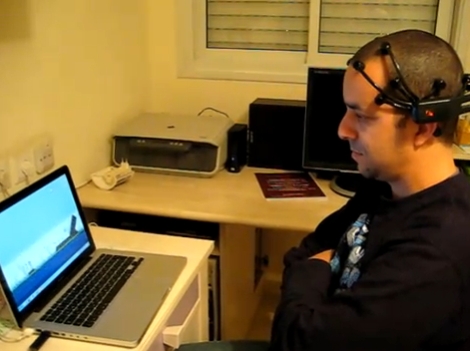
[Rafael Mizrahi and Anat Sambol] decided that Angry Birds was missing one crucial element – mind control. They grabbed a copy of the game for their netbook and [Rafael] strapped on an Emotiv EPOC headset to see if he could play it without using a mouse or keyboard. While he was able to move the cursor around with his thoughts, he found that Emotiv’s EmoKey software lacked any sort of mouse button support. Undaunted, they turned to the Internet for help and found that he could map the Emotiv’s output to his mouse via another application, GlovePie.

As you can see in the video below their efforts were successful, though we doubt [Rafael] will be completely giving up his mouse just yet. With some more refinement, we imagine [Rafael] will be blasting pigs to kingdom come in no time.

If you are interested in trying this yourself, be aware that only the SDK version of the EPOC headset can be paired with 3rd party applications, the standard consumer version is locked into using solely authorized software.

Continue reading if you would like to see a video of their Angry Birds neural interface in action.

Continue reading “Flinging Birds And Slaying Pigs With Your Thoughts”

papercraft_strandbeest

Papercraft Strandbeest Is A Great Rainy Day Project

Here in the Midwest it sometimes seems like Spring will never, well…spring. We get that “April showers bring May flowers”, but nearly all of the last month has been cold and rainy around these parts. While things are improving, we think it’s always good practice to have a few fun projects at the ready, just in case your plans with the kids get rained out.

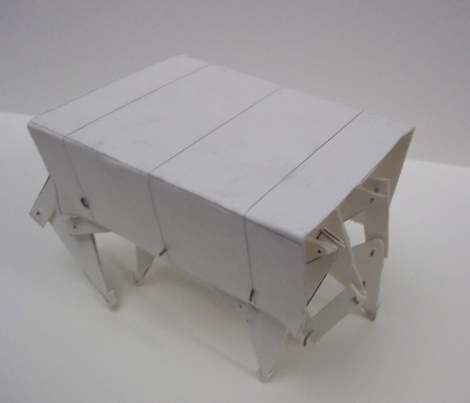
We think that Hackaday reader [Dombeef’s] papercraft strandbeest is a perfect idea for a rainy afternoon. The supply list is pretty short, requiring little more than some scissors, pliers, paperclips, and glue in addition to the thick paper that makes up the body of the strandbeest. The paper is cut into pieces according to the PDF template he includes in his Instructable, secured to one another via small pieces of paperclip.

Once the legs are all constructed, a main axis is built from one of the remaining paperclips, and everything is joined together under the main portion of the strandbeest’s body.

As you can see in the video, the legs work quite well, though the strandbeest can probably benefit from a hand crank in the short term. [Dombeef] plans on adding a small motor to his creation, which should get the strandbeest moving about quite rapidly once completed.

If you are looking for more fun projects to do with the kids, look no further than this papercraft gyroscope or these squishy circuits.

Continue reading “Papercraft Strandbeest Is A Great Rainy Day Project”

rc_car

Racing Wheel Guided R/C Car With Video Feed

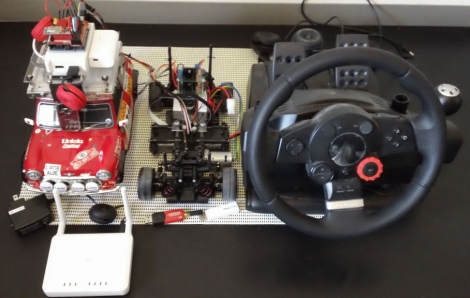
Instructables user [Kaeru no Ojisan] enjoys constructing R/C kit cars and wanted to build one that could be driven using a PC racing wheel he had on hand. Not satisfied with simply guiding it with the racing wheel, he added a web cam to the car so that he can monitor its location from the comfort of his desk chair.

The car is loaded down with all sorts of electronics to get the job done, requiring four separate battery packs to keep them online. An Arduino controls the motor and the steering servos, receiving its commands wirelessly via a Bluetooth add-on. The camera connects to a USB to Ethernet converter, which enables the car’s video feed to be transmitted via the onboard wireless router.

The racing wheel interface seems to work just fine, though we don’t doubt that the whole setup can be easily simplified, reducing both weight and battery count. While [Kaeru no Ojisan] says that the car is in its concept stages and there are a few bugs to work out, we think it’s a good start.

Stick around to see a quick video of the car in testing.

Continue reading “Racing Wheel Guided R/C Car With Video Feed”