Making A 3D Printed DSLR Camera Mount Even Better

We’d love to say that all of our projects worked perfectly on the first try, but the average Hackaday reader is a bit too experienced to buy a fib like that. The reality is, DIY projects rarely get everything right out of the gate. It takes some time to identify issues and work out all the kinks. But of course, that’s half the fun.

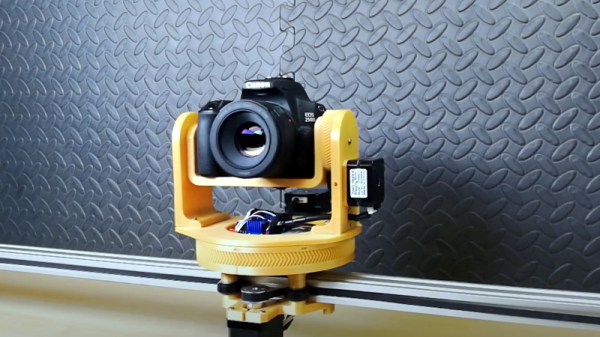
For a perfect example of this process, check out the latest update on the 3D printed DSLR camera mount that [isaac879] has been working on. When we last checked in with this project over the summer the mount was already impressive, but with the latest improvements and the addition of a whole new axis of movement, this homebrew camera motion system is an extremely compelling project for anyone who wants to take their project videos to the next level.
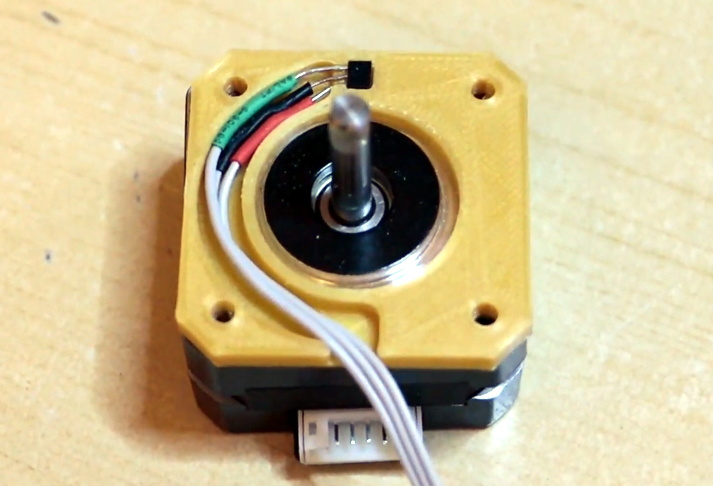
The new Hall effect sensor mounts are a very nice touch.

Back in June, the mount [isaac879] showed off was only capable of pan and tilt. But as you can see in the video after the break, he’s since mounted that to a track made of 20×40 aluminum extrusion and added another stepper motor. This allows the pan/tilt mount to move itself back and forth on the track to get those slick panning shots that all the cool kids use in their videos nowadays.

But even if you’re not interested in the slider aspect, the core pan/tilt mount has also received a number of refinements over the last few months. Perhaps the most obvious is the switch over to thinner and lighter stepper motors. Reducing mass is always an improvement with a moving system like this, and in the case of the pan motor, the shorter can prevents a potential collision with the camera itself. Obviously the smaller motors are weaker, but [isaac879] considers that a feature; the mini motors will just start skipping steps if things get bound up instead of potentially damaging your expensive camera.

He’s switched to flange bearings to help hold the frame together, improved wire routing, added a mounting point for the electronics, reprinted the pinion gears in a flexible filament to help absorb some vibrations, and switched over to TMC2208 stepper drivers. The new drivers may actually be one of the biggest usability upgrades, as they allow the entire mount to move faster and more accurately. Critically, [isaac879] also reports the new drivers have solved a troublesome vibration issue he was seeing when the camera was moving slowly.

Obviously you can throw together a simple pan and tilt mount with a couple of servos and some zip ties if you only need to use it once or twice, but a project of this caliber would rightfully become a permanent fixture in your workspace. Perfect if you’re looking to up your project photography game.

Continue reading “Making A 3D Printed DSLR Camera Mount Even Better”
Replace Your IR Remote With A Web Browser

While more and more consumer products are rushing to include WiFi and Bluetooth connectivity, the simplicity and reliability of infrared has kept it in the game in the game far longer than many might have thought. Despite being thinner and sleeker, the IR remote control that comes with your brand new smart TV isn’t fundamentally different than what we were using in the 1980s.

But that doesn’t mean IR devices can’t enjoy some modern conveniences. Sick of misplacing his remote, [Sasa Karanovic] decided to come up with a way he could emulate it to control his TV over the network. Now with nothing more exotic than a web browser on his phone or computer, he can tap away at a visual representation of a remote to control the TV from anywhere in the house. As you might expect, this project could readily be adapted to control whatever IR gadget you might have in mind.

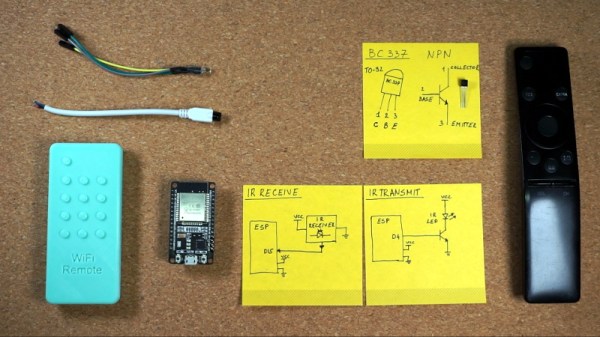
Assembling a simple IR transmitter dongle.

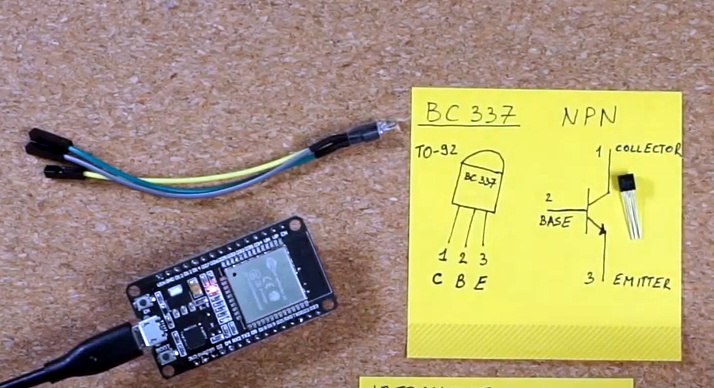
Admittedly, this isn’t exactly breaking any new ground. We’ve seen plenty of people come up with similar IR gateways in the past with varying levels of complexity. But what we really like about this project is that not only has [Sasa] shared the source code that turns an ESP32 into a network-controlled IR transmitter, but he’s put together a concise video that demonstrates how easy it is so spin up your own version. The 3D printed enclosure that looks like a traditional IR remote was a nice touch too.

The hardware for this project is little more than an ESP32 development board and an LED, but if you’re looking for something a bit more built for purpose, we recently saw a very slick open hardware IR gateway that might fit your needs.

Continue reading “Replace Your IR Remote With A Web Browser”

Bringing High Temperature 3D Printing To The Masses

Despite the impressive variety of thermoplastics that can be printed on consumer-level desktop 3D printers, the most commonly used filament is polylactic acid (PLA). That’s because it’s not only the cheapest material available, but also the easiest to work with. PLA can be extruded at temperatures as low as 180 °C, and it’s possible to get good results even without a heated bed. The downside is that objects printed in PLA tend to be somewhat brittle and have a low heat tolerance. It’s a fine plastic for prototyping and light duty projects, but it won’t take long for many users to outgrow its capabilities.

The next step up is usually polyethylene terephthalate glycol (PETG). This material isn’t much more difficult to work with than PLA, but is more durable, can handle higher temperatures, and in general is better suited for mechanical parts. If you need greater durability or higher heat tolerance than PETG offers, you could move on to something like acrylonitrile butadiene styrene (ABS), polycarbonate (PC), or nylon. But this is where things start to get tricky. Not only are the extrusion temperatures of these materials greater than 250 °C, but an enclosed print chamber is generally recommended for best results. That puts them on the upper end of what the hobbyist community is generally capable of working with.

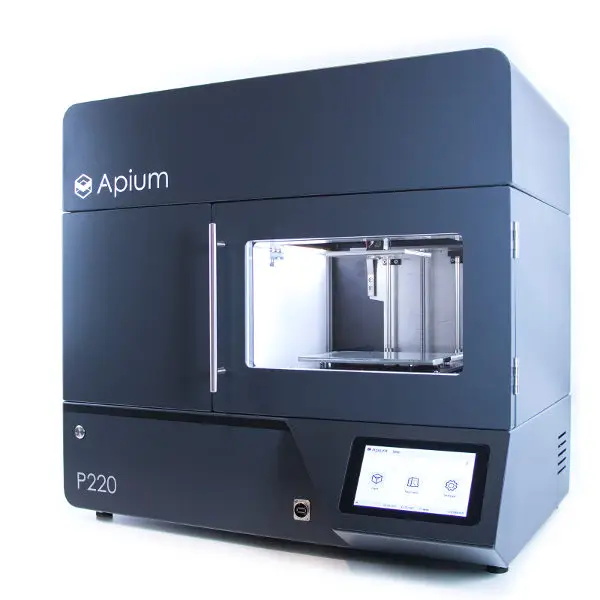
Industrial 3D printers like the Apium P220 start at $30,000.

But high-end industrial 3D printers can use even stronger plastics such as polyetherimide (PEI) or members of the polyaryletherketone family (PAEK, PEEK, PEKK). Parts made from these materials are especially desirable for aerospace applications, as they can replace metal components while being substantially lighter.

These plastics must be extruded at temperatures approaching 400 °C, and a sealed build chamber kept at >100 °C for the duration of the print is an absolute necessity. The purchase price for a commercial printer with these capabilities is in the tens of thousands even on the low end, with some models priced well into the six figure range.

Of course there was a time, not quite so long ago, where the same could have been said of 3D printers in general. Machines that were once the sole domain of exceptionally well funded R&D labs now sit on the workbenches of hackers and makers all over the world. While it’s hard to say if we’ll see the same race to the bottom for high temperature 3D printers, the first steps towards democratizing the technology are already being made.

Continue reading “Bringing High Temperature 3D Printing To The Masses”

Community Rallies Behind Youtube-dl After DMCA Takedown

At this point, you’ve likely heard that the GitHub repository for youtube-dl was recently removed in response to a DMCA takedown notice filed by the Recording Industry Association of America (RIAA). As the name implies, this popular Python program allowed users to produce local copies of audio and video that had been uploaded to YouTube and other content hosting sites. It’s a critical tool for digital archivists, people with slow or unreliable Internet connections, and more than a few Hackaday writers.

It will probably come as no surprise to hear that the DMCA takedown and subsequent removal of the youtube-dl repository has utterly failed to contain the spread of the program. In fact, you could easily argue that it’s done the opposite. The developers could never have afforded the amount of publicity the project is currently enjoying, and as the code is licensed as public domain, users are free to share it however they see fit. This is one genie that absolutely won’t be going back into its bottle.

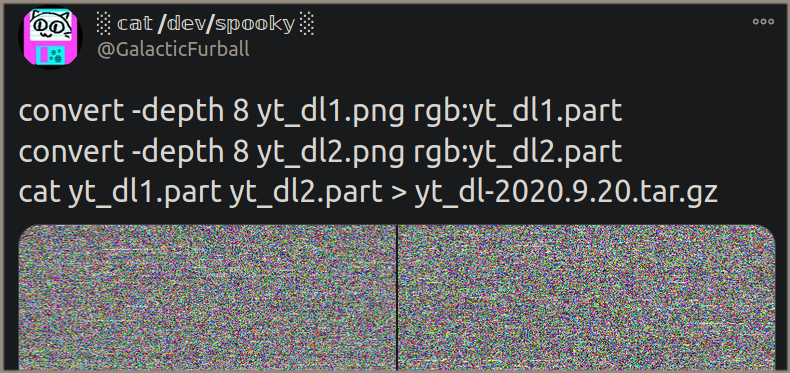
In true hacker spirit, we’ve started to see some rather inventive ways of spreading the outlawed tool. A Twitter user by the name of [GalacticFurball] came up with a way to convert the program into a pair of densely packed rainbow images that can be shared online. After downloading the PNG files, a command-line ImageMagick incantation turns the images into a compressed tarball of the source code. A similar trick was one of the ways used to distribute the DeCSS DVD decryption code back in 2000; though unfortunately, we doubt anyone is going to get the ~14,000 lines of Python code that makes up youtube-dl printed up on any t-shirts.

Screenshot of the Tweet sharing YouTube-dl repository as two images

It’s worth noting that GitHub has officially distanced themselves from the RIAA’s position. The company was forced to remove the repo when they received the DMCA takedown notice, but CEO Nat Friedman dropped into the project’s IRC channel with a promise that efforts were being made to rectify the situation as quickly as possible. In a recent interview with TorrentFreak, Friedman said the removal of youtube-dl from GitHub was at odds with the company’s own internal archival efforts and financial support for the Internet Archive.

But as it turns out, some changes will be necessary before the repository can be brought back online. While there’s certainly some debate to be had about the overall validity of the RIAA’s claim, it isn’t completely without merit. As pointed out in the DMCA notice, the project made use of several automated tests that ran the code against copyrighted works from artists such as Taylor Swift and Justin Timberlake. While these were admittedly very poor choices to use as official test cases, the RIAA’s assertion that the entire project exists solely to download copyrighted music has no basis in reality.

[Ed Note: This is only about GitHub. You can still get the code directly from the source.]

Engine Trouble Delays SpaceX’s Return To The ISS

A crewed mission to the International Space Station that was set to depart from Kennedy Space Center on Halloween has been pushed back at least several weeks as NASA and SpaceX investigate an issue with the company’s Merlin rocket engine. But the problem in question wasn’t actually discovered on the booster that’s slated to carry the four new crew members up to the orbiting outpost. This story starts back on October 2nd, when the computer aboard a Falcon 9 set to carry a next-generation GPS III satellite into orbit for the US Space Force shut down the engines with just two seconds to go before liftoff.

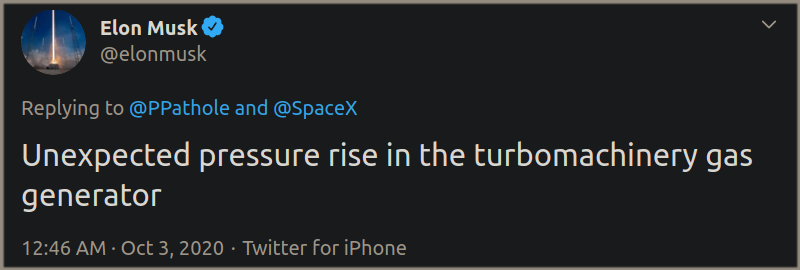
The fact that SpaceX and NASA have decided to push back the launch of a different Falcon 9 is a clear indication that the issue isn’t limited to just one specific booster, and must be a problem with the design or construction of the Merlin engine itself. While both entities have been relatively tight lipped about the current situation, a Tweet from CEO Elon Musk made just hours after the GPS III abort hinted the problem was with the engine’s gas generator:

As we’ve discussed previously, the Merlin is what’s known as an “open cycle” rocket engine. In this classical design, which dates back to the German V-2 of WWII, the exhaust from what’s essentially a smaller and less efficient rocket engine is used to spin a turbine and generate the power required to pump the propellants into the main combustion chamber. Higher than expected pressure in the gas generator could lead to a catastrophic failure of the turbine it drives, so it’s no surprise that the Falcon 9’s onboard systems determined an abort was in order.

Grounding an entire fleet of rockets because a potentially serious fault has been discovered in one of them is a rational precaution, and has been done many times before. Engineers need time to investigate the issue and determine if changes must be made on the rest of the vehicles before they can safely return to flight. But that’s where things get interesting in this case.

SpaceX hasn’t grounded their entire fleet of Falcon 9 rockets. In fact, the company has flown several of them since the October 2nd launch abort. So why are only some of these boosters stuck in their hangers, while others are continuing to fly their scheduled missions?

Continue reading “Engine Trouble Delays SpaceX’s Return To The ISS”

Jetson Emulator Gives Students A Free AI Lesson

With the Jetson Nano, NVIDIA has done a fantastic job of bringing GPU-accelerated machine learning to the masses. For less than the cost of a used graphics card, you get a turn-key Linux computer that’s ready and able to handle whatever AI code you throw at it. But if you’re trying to set up a lab for 30 students, the cost of even relatively affordable development boards can really add up.

Spoiler: These things don’t exist.

Which is why [Tea Vui Huang] has developed jetson-emulator. This Python library provides a work-alike environment to NVIDIA’s own “Hello AI World” tutorials designed for the Jetson family of devices, with one big difference: you don’t need the actual hardware. In fact, it doesn’t matter what kind of computer you’ve got; with this library, anything that can run Python 3.7.9 or better can take you through NVIDIA’s getting started tutorial.

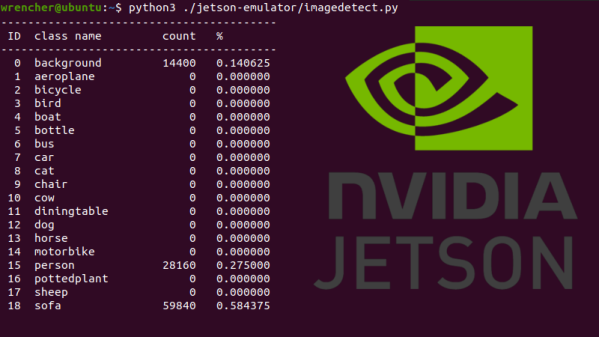
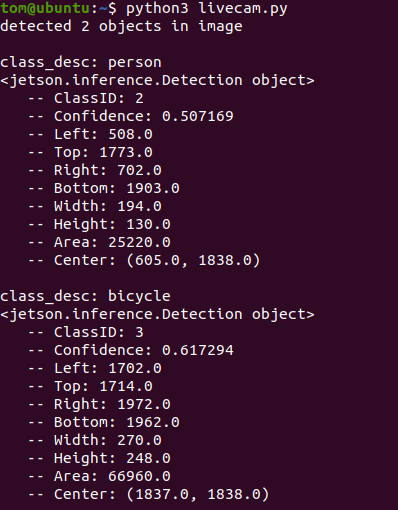
So what’s the trick? Well, if you haven’t guessed already, it’s all fake. Obviously it can’t actually run GPU-accelerated code without a GPU, so the library [Tea] has developed simply pretends. It provides virtual images and even “live” camera feeds to which randomly generated objects have been assigned.

The original NVIDIA functions have been rewritten to work with these feeds, so when you call something like net.Classify(img) against one of them you’ll get a report of what faux objects were detected. The output will look just like it would if you were running on a real Jetson, down to providing fictitious dimensions and positions for the bounding boxes.

If you’re a hacker looking to dive into machine learning and computer vision, you’d be better off getting a $59 Jetson Nano and a webcam. But if you’re putting together a workshop that shows a dozen people the basics of NVIDIA’s AI workflow, jetson-emulator will allow everyone in attendance to run code and get results back regardless of what they’ve got under the hood.

Battery Swap Gives Nissan LEAF New Lease On Life

It’s often said that one of the advantages of owning an electric vehicle is reduced maintenance costs, and for the most part, that’s true. That is, until the vehicle’s battery pack starts to show its age. Then you might be on the hook for a repair bill comparable to swapping out the engine on your old gas-burner. Depending on the age of the vehicle at that point, you might find yourself in the market for a new ride.

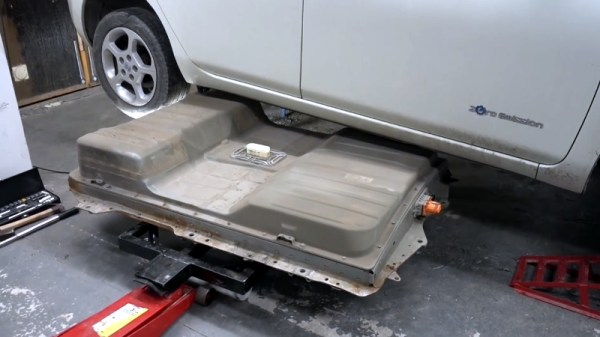
But in his latest video, [Daniel Öster] demonstrates that you can replace the battery in a modern electric vehicle without breaking the bank. While it’s not exactly an easy job, he manages to swap the pack in his 2012 Nissan LEAF from the comfort of his own garage using common tools and with the vehicle up on jack stands. The old battery wasn’t completely shot, so he was even able to recoup some of his costs by selling it; bringing the total price of the operation to approximately €2,122 ($2,500 USD).

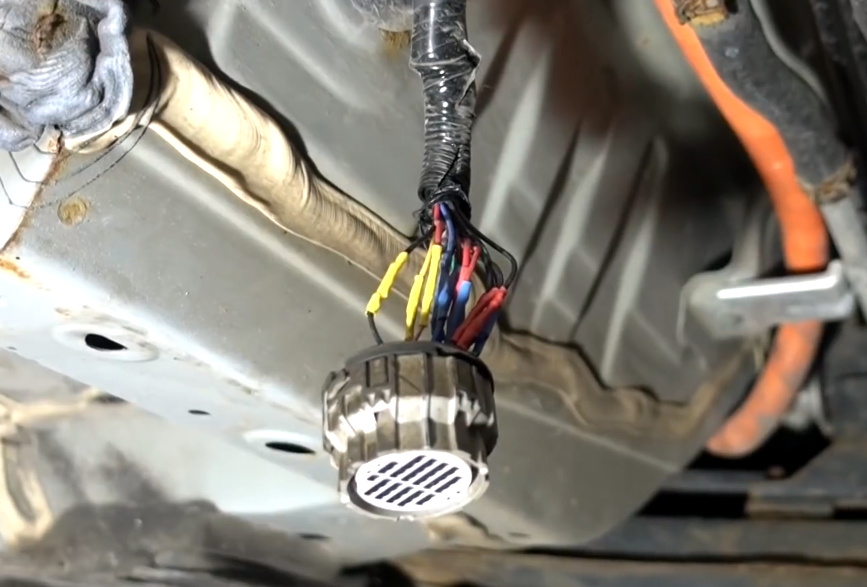
Splicing on a new diagnostic connector.

While that wouldn’t be a bad deal even for a simple swap, the operation was actually an upgrade. The car was originally sold with a 24 kWh battery, but [Daniel] has replaced it with a 30 kWh pack intended for the 2017 LEAF. His car now has a greater range than it did the day it rolled off the assembly line, though as you might expect, the installation was more complex than it would have been with a contemporary battery.

[Daniel] has produced a kit that has all the adapters required to perform your own battery upgrade, including a module that translates the diagnostic signals from the newer battery into something the older vehicle can understand. With all the electrical bits simplified, all you’ve got to worry about is drilling the new battery mounting holes in the frame.

The battery pack is truly the heart and soul of an electric car, so its no surprise that mechanics and hackers alike are eager to learn as much about them as possible. They’ll have their work cut out for them, as the technology is only going to get more advanced with time.

Continue reading “Battery Swap Gives Nissan LEAF New Lease On Life”