Watching A Boat Get Welded Together Is Workshop ASMR

If you’ve been on the Internet long enough to know about Hackaday, we’ll wager you’re familiar with the concept of autonomous sensory meridian response (ASMR) — a tingling sensation in the scalp that’s said to be triggered by certain auditory stimuli. There are countless videos on YouTube that promise to give you “the tingles” using everything from feather dusters to overly starched shirts, but for us, the tool of choice is apparently a Lincoln Electric Magnum PRO 100SG spool gun in the hands of [Bob].

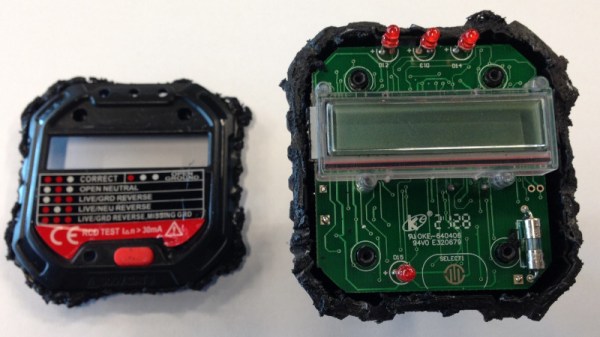
You’ll want a friend to help wrangle the panels.

Admittedly we can’t promise the latest Making Stuff video will induce a euphoric physical sensation for all viewers, but at the very least, we think you’ll agree that watching [Bob] and his brother methodically welding together the twelve foot hull of what will eventually be a custom jet boat is strangely relaxing.

While we usually associate [Bob] with scratch builds, this time he’s actually working his way through a commercial kit. Sold by Jet Stream Adventure Boats, the kit includes the pre-cut aluminum panels that make up the hull, stringers, and top deck — niceties like a windshield and seats are offered as extras. The engine and jet drive need to be salvaged from an existing personal watercraft (PWC), but that will have to wait for a future video. For now, there’s a boat-load (get it?) of tack welding to be done.

The build process looks to go pretty smoothly, except for when they attempt to put the bow of the boat together. Unable to get the two side panels to meet properly, [Bob] eventually has to contact the manufacturer. After some back and forth, it turns out that a bit must have broken on the CNC when the hull panel went through, as a key cut was made nearly 8 inches (20 cm) too short. He was able to complete the cut with a jigsaw and continue on with the build, but we’re still scratching our heads at how this wasn’t caught before it got shipped out.

It won’t be the first homemade boat we’ve covered, but given [Bob]’s attention to detail, we’re particularly excited to see how this one develops in future videos. Especially since he’s foolishly bravely asked the commenters to come up with a name for his new craft.

Continue reading “Watching A Boat Get Welded Together Is Workshop ASMR”

NASA’s Flying Telescope Is Winding Down Operations

NASA’s Hubble Space Telescope is arguably the best known and most successful observatory in history, delivering unprecedented images that have tantalized the public and astronomers alike for more than 30 years. But even so, there’s nothing particularly special about Hubble. Ultimately it’s just a large optical telescope which has the benefit of being in space rather than on Earth’s surface. In fact, it’s long been believed that Hubble is not dissimilar from contemporary spy satellites operated by the National Reconnaissance Office — it’s just pointed in a different direction.

There are however some truly unique instruments in NASA’s observational arsenal, and though they might not have the name recognition of the Hubble or James Webb Space Telescopes, they still represent incredible feats of engineering. This is perhaps best exemplified by the Stratospheric Observatory for Infrared Astronomy (SOFIA), an airborne infrared telescope built into a retired airliner that is truly one-of-a-kind.

Unfortunately this unique aerial telescope also happens to be exceptionally expensive to operate; with an annual operating cost of approximately $85 million, it’s one of the agency’s most expensive ongoing astrophysics missions. After twelve years of observations, NASA and their partners at the German Aerospace Center have decided to end the SOFIA program after its current mission concludes in September.

With the telescope so close to making its final observations, it seems a good time to look back at this incredible program and why the US and German space centers decided it was time to put SOFIA back in the hangar.

Continue reading “NASA’s Flying Telescope Is Winding Down Operations”

ESP32 Powers Fresh Take On An IoT Geiger Counter

Over the years we’ve covered many projects aimed at detecting elevated radiation levels, and a fair number of them have been Internet connected in some way. But as they are often built around the Soviet-era SBM-20 Geiger–Müller tube, these devices have generally adhered to a fairly conservative design. With the current situation in Europe heightening concerns over potential radiation exposure, [g3gg0] thought it was a good a time as any to revisit the idea of an Internet-connected Geiger counter using more modern components.

Now to be clear, even this modernized approach still makes use of that same SBM-20 tube. There’s such an incredible wealth of information floating around out there about how to work with them that you’d almost put yourself at a disadvantage to chose something else to base your design on. Put simply, it’s hard to go wrong with a classic.

An unfortunate bug was discovered in the HV circuit.

That said, [g3gg0] decided early on that the design would use as many SMD components as possible, a considerable departure from many of the SBM-20 counters we’ve seen. That meant coming up with a new high-voltage power supply capable of providing the tube with the necessary 400 V, which from the sound of things, took a few attempts to complete. The final result is perhaps the smallest and cleanest looking board we’ve ever seen play host to this particular tube.

To run the show, [g3gg0] selected the ESP32-PICO-D4. You certainly don’t need such a powerful microcontroller to read the impulses from the SBM-20 tube and publish them via MQTT, but to be fair, the chip has a number of other duties. It’s handling the WS2812 RGB LEDs that go off in response to detected particles, running the (apparently optional) 2.9 inch WaveShare electronic paper display, and also pulling data from a BME280 environmental sensor as well as a CCS811 VOC sensor — so it’s keeping fairly busy.

As impressive as this build is, we do hate that it had to be built. From certain world leaders dropping casual comments about the strength of their nuclear arsenal to foolhardy attempts to capture the Chernobyl power station, having access to a reliable Geiger counter isn’t an unreasonable precaution right now. For everyone’s sake, let’s hope the fancy RGB LEDs on this particular build remain as dark as possible.

Continue reading “ESP32 Powers Fresh Take On An IoT Geiger Counter”

Hacking The RF Protocol Of An Obscure Handheld Game

When you think old school handheld games, you probably imagine something like Nintendo’s Game Boy line or the Sega Game Gear. But outside of those now iconic systems, there was a vast subculture of oddball handheld games vying for a chunk of an adolescent’s weekly allowance. Many of these were legitimately terrible and frankly aren’t worth remembering, but a few offered unique features that were arguably ahead of their time.

One such game was Hasbro’s short-lived P-O-X. As explained by [Zachary Ennenga], the game didn’t spend much time on store shelves as its core concept of defeating undetectable alien invaders hell-bent on destroying our way of life proved to be more than a little problematic when it launched in September of 2001. But that doesn’t mean it didn’t have some cool ideas, such as a wireless ad-hoc multiplayer capability that let your game autonomously battle it out with other units that got close by.

Fascinated by this feature since his youth, [Zach] set out to study how this relatively cheap kid’s toy was able to pull this off back when even the flagship handheld consoles were still using physical link cables for multiplayer. He was aided in his quest by a particularly helpful patent, which not only gave him clues as to the frequency, data rate, modulation, and encoding of the RF signal, but even explained the game’s logic and overall structure. A lot of what was in the document seemed wishful thinking on the part of Hasbro, but reading through the marketing speak still uncovered some salient technical details.

A decoded P-O-X packet.

Armed with an RTL-SDR, GNU Radio, Inspectrum, and a bit of Python, [Zach] was able to identify the signal and begin the process of decoding it. This is where things get really interesting, as the details of his reverse engineering process are widely applicable for all sorts of unknown RF signals. Even if you’re like most people and have nearly zero interest in failed handheld games of the early 2000s, it’s well worth a read. The same techniques he uses to figure out the name and physical characteristics of the invisible foe his game is transmitting could one day help you figure out how to manipulate the data from that wireless weather station you’ve got in the backyard.

Once he figured out the major parts of the protocol, [Zach] moves on to creating his own packets and broadcasting them out in such a way that the real hardware will recognize it. He even comes up with some code that will automatically battle games which wander within range of his Yardstick One, which may come in handy during the inevitable P-O-X Renaissance.

While this might seem like a lot of effort to put into a game that most people have never even heard of, we’ll remind you that some of the greatest hacks to ever grace these pages have been born of similar pursuits. Even if you’re the only person in the world to directly benefit from your current line of research and experimentation, there’s still plenty of like-minded folks in this community that are all to happy to cheer you on from the sidelines.

Raspberry Pi Pico “Modchip” Unlocks The GameCube

In terms of units sold, it’s no secret that the GameCube was one of Nintendo’s poorest performing home consoles. You could argue increased competition meant sales of the quirky little machine were destined to fall short of the system’s legendary predecessors, but that didn’t keep the Wii from outselling it by a factor of five a few years later. Still, enough incredible games were released for the GameCube that the system still enjoys a considerable fanbase.

Now, with the release of PicoBoot by [webhdx], we suspect the GameCube is about to gain a whole new generation of fans. With just a Raspberry Pi Pico, some jumper wires, and a widely available third-party SD card adapter, this open source project bypasses the console’s original BIOS so it can boot directly into whatever homebrew application the user selects. With how cheap and easy to perform this modification is, we wouldn’t be surprised if it kicked off something of a renaissance for GameCube homebrew development.

Installation takes just five wires.

In the video after the break, [Tito] of Macho Nacho Productions provides a rundown of this new project, including a fantastic step-by-step installation guide that covers everything from soldering the jumper wires to the console’s motherboard to getting the firmware installed on the Pico. He then demonstrates booting the console into various community developed front-ends and tools, showing just how versatile the modification is. While some will see this as little more than an easier way to run bootleg games, we can’t help but be excited about what the future holds now that getting your own code to run on the system is so easy.

Alright, maybe it’s not so easy. To solder on the five wires that will eventually snake their way to the GPIO pins of the Pi Pico, you’ll need to strip the console all the way down to the main board. That wouldn’t be too bad itself, but unfortunately to reach two of the connections you’ll need to remove the system’s massive heatsink — which means you’ll need to clean up the old sticky thermal pads and apply new ones if you don’t want your GameCube to turn into a GameCrisp. It’s nothing that would scare off the average Hackaday reader, but it might give pause to those less handy with an iron.

The release of PicoBoot comes hot on the heels of the revelation that the Raspberry Pi Pico can be used not only as an N64 flash cart but as a supercharged PlayStation Memory Card. These projects would all be significantly improved with a custom RP2040 board, and no doubt that’s the direction they’ll eventually head, but it’s hard not to be impressed by what the low-cost microcontroller development board is capable of in its native form. Especially now that it comes in WiFi flavor.

Continue reading “Raspberry Pi Pico “Modchip” Unlocks The GameCube”

Unraveling The Hackaday Podcast Hidden Message

When Elliot and I record the raw audio for the weekly podcast, it’s not unusual for us to spend the better part of two hours meandering from topic to topic. During one of these extended gab sessions, we wondered if it would be possible to embed a digital signal into the podcast in such a way that it could be decoded by the listener. Of course, storing and transmitting data via sound is nothing new — but the podcast format itself introduced some level of uncertainty.

Would the encoded sound survive the compression into MP3? Would the syndication service that distributes the file, or the various clients listeners will use to play it back, muddy the waters even further? Was it possible that the whole episode would get flagged somewhere along the line as malicious? After a bit of wild speculation, the conversation moved on to some other topic, and the idea was left to stew on one of our infinite number of back burners.

That is, until Elliot went on vacation a couple weeks back. In place of a regular episode, we agreed that I’d try my hand at putting together a special edition that consisted of pre-recorded segments from several of the Hackaday contributors. We reasoned this simplified approach would make it easier for me to edit, or to look at it another way, harder for me to screw up. For the first time, this gave me the chance to personally oversee the recording, production, and distribution of an episode. That, and the fact that my boss was out of town, made it the perfect opportunity to try and craft a hidden message for the Hackaday community to discover.

I’m now happy to announce that, eleven days after the EMF Camp Special Edition episode was released, ferryman became the first to figure out all the steps and get to the final message. As you read this, a coveted Hackaday Podcast t-shirt is already being dispatched to their location.

As there’s no longer any competition to see who gets there first, I thought it would be a good time to go over how the message was prepared, and document some interesting observations I made during the experiment.

Continue reading “Unraveling The Hackaday Podcast Hidden Message”

ESP32 Camera Slider Build Keeps Things In Perspective

We’ve seen a lot of camera slider builds here at Hackaday, and for good reason: having one really lets you take your project documentation, especially videos, to the next level. It’s one of those force multiplier builds — after you’ve completed it, it can help you make all your future projects just that much better. But we’re also no strangers to seeing these projects become overly complex, which can often make it difficult for others to replicate.

But that’s not the case here. The motorized camera slider that [Sasa Karanovic] recently sent our way does exactly what you’d expect, and little else. That’s not meant as a dig — sometimes the best approach is to keep it simple. Unless you’re a professional photographer or videographer, it’s unlikely you need a complicated motion rig. This design is perfect for the hacker or maker who wants to spruce up their project videos, but doesn’t want to spend months fiddling with the design. Continue reading “ESP32 Camera Slider Build Keeps Things In Perspective”