Open Source: Free As The Air You Breathe

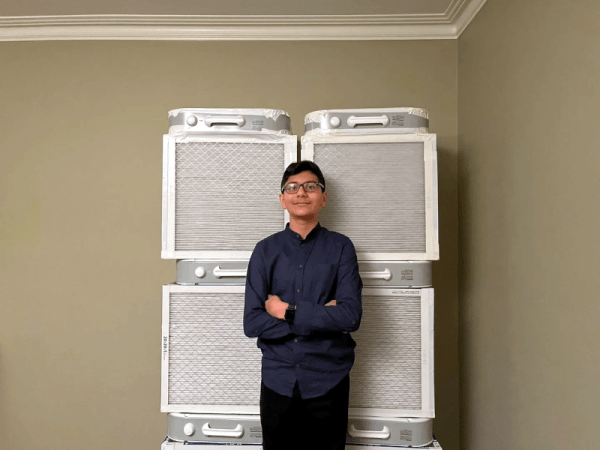
[Carolyn Barber] recently interviewed a 15-year-old who has been making Corsi-Rosenthal boxes for people in his community that are at risk for COVID. Not only is it great that a teenager has such community spirit, but it is also encouraging that [Richard Corsi] and [Jim Rosenthal] made an open-source design that can help people at a greatly reduced cost.

If you haven’t seen one of these boxes, it is essentially a box fan inside a cardboard box with MERV-13 filters on all sides. While these high-quality filters aren’t as efficient as HEPA filters, the box makes up for it by moving a prodigious amount of air and by being much less expensive. The article says you can build a unit for $60 to $100, which is considerably cheaper than other filters with similar performance.

There’s been at least one research paper on the efficacy of the filters and the results were generally quite positive. Schools are taking a great interest in these boxes because they are inexpensive and effective. Of course, the filters don’t last forever, but one of the creators estimates in a classroom with 25 students, a three-year run of the box would run about $4.46 per student per year. Not a lot to pay for clean air.

We love hearing about tech helping people and especially open source that makes big impacts. Usually, when we think of air filtering, we are thinking about laser cutters or 3D printers. However, we have seen inexpensive HEPA filters, too.

IGY: The Year We All Got Along

If you are a Steely Dan fan, you might know the Donald Fagen song, “IGY.” In it, Fagen sings about a rosy future with high-speed undersea rail, solar power, giant computers making life better, and spandex jackets. Since that song was on the 1982 album Nightfly, it is already too old for some people to remember, but the title goes back even further: the International Geophysical Year which was actually a little longer than a year in 1957 and 1958. The year was a concerted effort by 67 countries to further mankind’s knowledge of the Earth. It was successful,  and was big news in its day, although not much remembered now.

The real origin dates back to even earlier. In 1882 and 1932 there were International Polar Years dedicated to researching the polar regions of the Earth. In a way, it makes sense to do this. Why should 60 or more countries each mount difficult, dangerous, and expensive expeditions to such a hostile environment? However, instead of a third polar year, James Van Allen (who has a famous belt) and some other scientists felt that advances in many fields made it the right time to study geophysics. From the scientific point of view, the IGY coincided with the solar activity cycle maximum. But there were other forces at play, too.

Continue reading “IGY: The Year We All Got Along”

Glass 3D Printing Via Laser

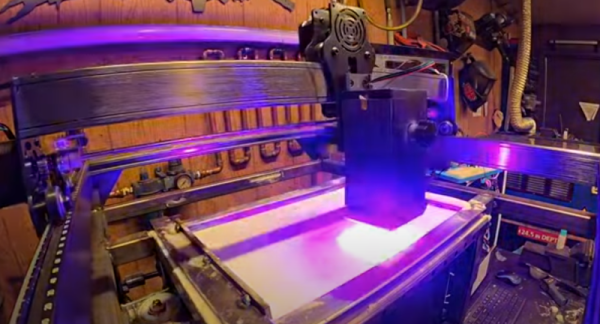
If you haven’t noticed, diode laser engraver/cutters have been getting more powerful lately. [Cranktown City] was playing with an Atomstack 20 watt laser and wondered if it would sinter sand into glass. His early experiments were not too promising, but with some work, he was able to make a crude form of glass with the laser as the source of power. However, using glass beads was more effective, so he decided to build his own glass 3D printer using the laser.

This isn’t for the faint of heart. Surfaces need to be flat and there’s aluminum casting and plasma cutting involved, although some of it may not have been necessary for the final construction. The idea was to make a system that would leave a layer of sand and then put down a new layer on command. This turned out to be surprisingly difficult.

Continue reading “Glass 3D Printing Via Laser”

Retrotechtacular: The Original Robot Arm

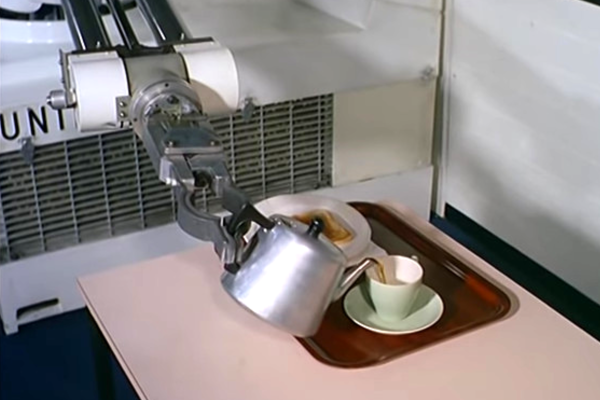
Do you know the name [George Devol]? Probably not. In 1961 he received a patent for “Programmed Article Transfer.” We’d call his invention the first robot arm, and its name was the Unimate. Unlike some inventors, this wasn’t some unrealized dream. [Devol’s] arm went to work in New Jersey at a GM plant. The 4,000 pound arm cost $25,000 and stacked hot metal parts. With tubes and hydraulics, we imagine it was a lot of work to keep it working. On the other hand, about 450 of the arms eventually went to work somewhere.

The Unimate became a celebrity with an appearance in at least one newsreel — see below — and the Johnny Carson show. Predictably, the robot in the newsreel was pouring drinks.

Continue reading “Retrotechtacular: The Original Robot Arm”

As Europe Goes To LEDs, Scientists Worry

There was a time when street lighting means someone had to go light the lamps. Electricity changed that, but street and outdoor lighting has been quietly going through a new revolution: LEDs. The problem, though, is that LEDs provide what scientists call “broad white” light and there are concerns about the impact the unnatural lighting will have on ecosystems, including people and animals.

Of course, the first step in worrying about something is to measure it. You would think that satellites would have a bird’s-eye view of the nighttime lighting landscape, and, of course, they do. But most of the imagery isn’t suitable for looking at the spectrum of wavelength data scientists need to quantify what they call ALAN — Artificial Light at Night.

The ISS imaging is, however, sufficient. Using special data techniques, they were able to track the adoption of LEDs over sodium lights and other technologies between 2012-2013 and 2014-2020 across Europe. For example, in the title image, you can see Belgium with an orange tint indicating low-pressure sodium lights. The Netherlands, France, and the UK have a more yellow hue, indicating high-pressure sodium lamps. Germany is more of a blue color due to fluorescent and mercury vapor bulbs.

Continue reading “As Europe Goes To LEDs, Scientists Worry”

Solar Flare Quiets A Quarter Of The Globe

In the “old” days, people were used to the idea that radio communication isn’t always perfect. AM radio had cracks and pops and if you had to make a call with a radiophone, you expected it to be unreliable and maybe even impossible at a given time. Modern technology,  satellites, and a host of other things have changed and now radio is usually super reliable and high-fidelity. Usually. However, a magnitude 7.9 solar flare this week reminded radio users in Africa and the Middle East that radio isn’t always going to get through. At least for about an hour.

It happened at around 10 AM GMT when that part of the world was facing the sun. Apparently, a coronal mass ejection accompanied the flare, so more electromagnetic disruption may be on its way.

The culprit seems to be an unusually active sunspot which is expected to die down soon. Interestingly, there is also a coronal hole in the sun where the solar wind blows at a higher than usual rate. Want to keep abreast of the solar weather? There’s a website for that.

We’ve pointed out before that we are ill-prepared for technology blackouts due to solar activity, even on the power grid. The last time it happened, we didn’t rely so much on radio.

Continue reading “Solar Flare Quiets A Quarter Of The Globe”

TRS-80 Model II Lives Again

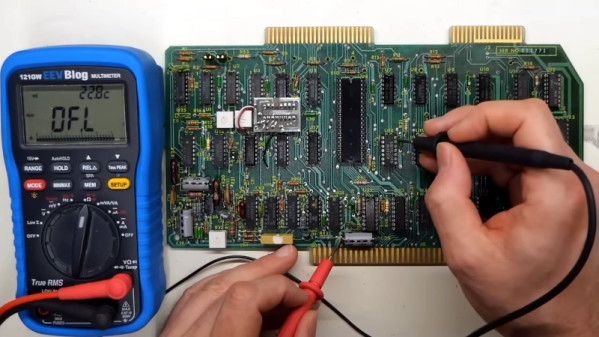
A lot of people had a Radio Shack TRS-80 Model I. This was a “home computer” built into a keyboard that needed an external monitor or TV set. Later, Radio Shack would update the computer to a model III which was a popular “all in one” option with a monitor and even space for — gasp — floppy disks. But the Model II was not nearly as common. The reason? It was aimed at businesses and priced accordingly. [Adrian] got a Model II that was in terrible shape and has been bringing it back to life. You can see the video of how he’s done with it, below.

The Model II was similar to the older “Trash 80” which had been used — to Radio Shack’s surprise — quite often by businesses. But it had more sophisticated features including a 4MHz CPU — blistering speed for those days. It also had an 80×25 text display and a 500K 8-inch floppy drive. There were also serial and printer ports standard.

There were a few interesting features. The floppy drive’s spindle ran on AC power and if the computer was on, the disk was spinning. In addition, there was bank switching so you could go beyond 64K and also you didn’t have to share your running memory with the video display. In theory, the machine could go beyond 64K since half the memory was bank switchable. In practice, the early models didn’t have enough expansion space to handle more than 64K physically.

Continue reading “TRS-80 Model II Lives Again”