BASH Template Promises Safer Scripts

Many bash scripts start out as something quick and dirty but then become so useful that they live for years, indeed sometimes seeing more use than our traditional programs. Now that you can even run bash well under Windows (although, you’ve always been able to run it there if you tried), there are even more opportunities for your five-minute bash script to proliferate. [Maciej] decided he was tired of always having to patch up his quick and dirty scripts to be more robust, so he created (and shared) his boilerplate template for scripts.

Probably most of us have at least some basic template we start with, even if it just our last script project. What’s nice about [Maciej’s] template is that he documents what’s going on with each part of it. It is also relatively short without a lot of excess stuff. Of course, you’ll probably customize it, but it is a great place to start.


Continue reading “BASH Template Promises Safer Scripts”

Learn Compilers Online From Cornell

It sounds like the start of a joke, but what’s the difference between taking Cornell’s CS6120 online and in-person? The instructor, [Adrian Samspon] notes that the real class has deadlines, an end-of-semester project, and a discussion board that is only open to real-life students. He also notes that you only earn “imagination credits.”

Still, this is a great opportunity to essentially audit a PhD-level computer science class on a fascinating topic. The course consists of videos, papers, and open source projects using LLVM and a custom internal representation based on JSON that is made for the class. It is all open source, too. You do however need access to the papers, some of which are behind paywalls. Your local library can help if you can’t otherwise find copies of the papers.

Continue reading “Learn Compilers Online From Cornell”

Russian Doomsday Radios Go Missing

Normally we like hearing about old military gear going on the surplus market. But if you encounter some late-model Russian radio and crypto equipment for sale you might want to make sure it isn’t hot (English translation). If you prefer not picking through the machine translation to English, the BBC also has a good write-up.

The Russians maintain four large planes set up as flying command and control bunkers in case of nuclear war — so-called “doomsday planes.” Like the U.S. ABNBC (better known as Looking Glass) fleet, the planes can provide the President or other senior leaders a complete command capability while in flight. As you might expect, the radios and gear on the plane are highly classified.

Continue reading “Russian Doomsday Radios Go Missing”

15 Volts To 110,000 Volts

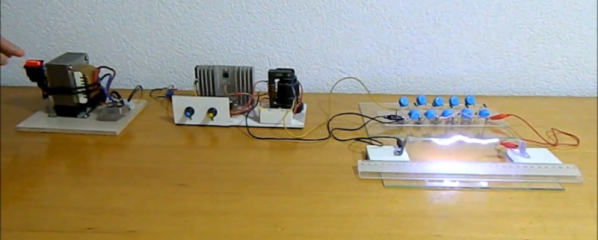
There’s something satisfying about creating high voltages. Sure, there are practical uses like neon signs or doing certain experiments, but be honest — you really just want to see some giant arcs lighting up your dark mad scientist lair. [Mircemk] has just the prescription for what ails you. Using a two-stage approach, he shows a simple setup that generates about 110KV from a pretty tame 15V supply.

From the 15V, there is a stage that uses a flyback transformer and a switch to generate a reasonably high voltage. The final stage is a Cockroft-Walton voltage multiplier that can produce quite a bit of voltage. You can see the impressive arcs in the video below.

The multiplier circuit found fame with experiments by Cockroft and Walton, obviously, but was actually originated in the early 1900s with a physicist named Greinacher. The circuit uses diodes as switches and charges a bank of capacitors in parallel. The discharge, however, puts the capacitors in series. Neglecting losses and loads, the output voltage is equal to the peak-to-peak input voltage times the number of stages present. Real-world considerations mean you won’t quite get that voltage out of it, but it can still provide a potent punch. Click through the break for a video of the circuit in action!

Continue reading “15 Volts To 110,000 Volts”

Creality WiFi Takes On Octoprint

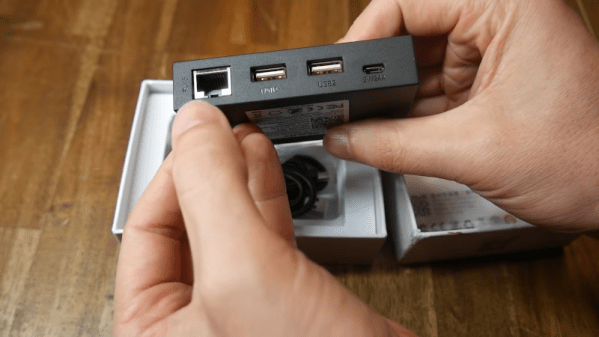
A very common hack to a 3D printer is to connect a Raspberry Pi to your printer and then load Octoprint or a similar program and send your files to the printer via the network. [Teaching Tech] noticed that Creality now has an inexpensive WiFi interface that promises to replace Octoprint and decided to give it a quick review.

You might wonder why you’d want this system when Octoprint exists? Mainly, the value proposition is the price. You can buy the Creality box for about $20. A Raspberry Pi with a similar case would be at least twice that price. In addition, the box integrates with a Thingiverse-like library and does cloud slicing, which is attractive when you have a very small computer connected to your printer.

However, [Teaching Tech] found some issues. The box was pretty picky about connecting to printers and there were many other problems. The 3D model library wasn’t very comprehensive, although that could change if the thing got very popular. Worse, the slicer didn’t really produce stellar results.

We have to admit, an attractive network interface for $20 would be of interest. But it is hard to see how this would be a better value than Octoprint unless you were very short on cash and had no Raspberry Pi surplus laying around. You still need an SD card and a power supply, so those extras are a wash.

On the other hand, if Creality fixes the problems and expands the 3D model library, we’d buy one. But it remains to be seen if either of those things will happen, much less both of them. We do wish [Teaching Tech] had opened the thing up for us. Maybe next time.

Continue reading “Creality WiFi Takes On Octoprint”

Surfing The Web With 7400 Logic

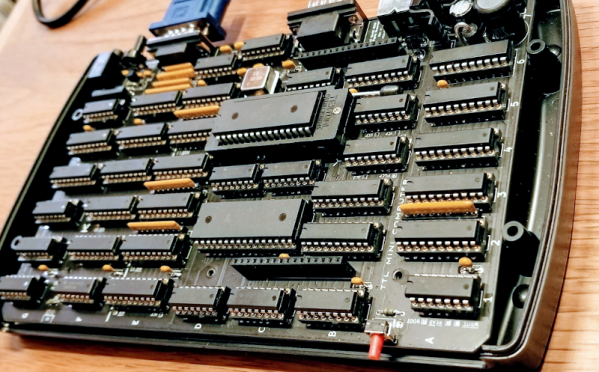
We see more computers built from logic gates than you might expect. However, most of them are really more demonstration computers and can’t do much of what you’d consider essential today. No so with [Alastair Hewitt’s] Novasaur. Although built using 34 TLL chips (and a few memory and analog chips, too, along with one PAL), it boasts some impressive features:

  • Dual Processor CPU/GPU (Harvard Architecture).
  • 33 MHz dot clock, 16.5 MHz data path, 8.25 MHz per processor (~3.5 CPU MIPs)
  • 256k ROM: 96k ALU, 64k native program, 64k cold storage, 32k fonts.
  • 128/512k RAM: 1-7 banks of 64k user, 60k display, 4k system.
  • 76 ALU functions including multiply/divide, system, and math functions.
  • Bitmapped Graphics: Hi-res mode up to 416×240 with 8 colors and 4 dithering patterns. Lo-res mode up to 208×160 with 256 colors, double-buffered.
  • Text Mode: 8 colors FG/BG, 256 line buffer, up to 104×60 using 8×8 glyphs, 80×36, and 64×48 rows using  8×16 glyphs.
  • Audio: 4 voice wavetable synthesis, ADSR, 8-bit DAC, 8Hz-4.8kHz.
  • PS2 Keyboard: Native interface built-in.
  • RS232 Serial Port: Full duplex, RTS/CTS flow control, 9600 baud.
  • Expansion Port: 7 addressable 8-bit register ports, 4 interrupt flags

Continue reading “Surfing The Web With 7400 Logic”

A Thousand Feet Under The Sea

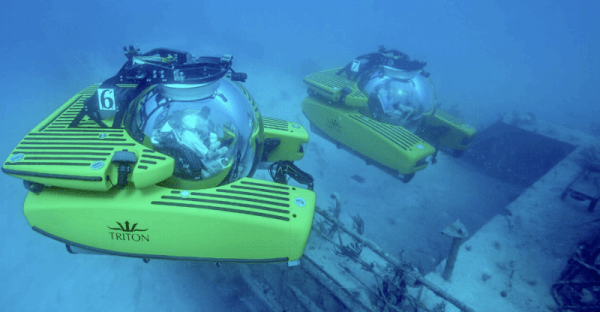
If you were to plumb the depth of the oceans, you could only get so far with a snorkel or a SCUBA tank. We don’t know the price, but if you have enough money, you might consider the Triton 3300/6 — a six-person submersible that can go down to 3,300 feet (hence the name–get it–3300/6). Billed as “diving for the entire family,” we aren’t sure we can load grandma and the kids in something like this, but that doesn’t mean we wouldn’t like to try.

The machine can carry up to 1,760 pounds and can make 3 knots which isn’t going to set any speed records. At around 24,000 pounds, the two main thrusters are lucky to make that speed. The view bubble is apparently optically perfect acrylic made by a German company and the company claims the 100-inch diameter bubble is the world’s largest spherical acrylic pressure hull.

Continue reading “A Thousand Feet Under The Sea”