Voice Chess Uses Phone, Arduino, And An Electromagnet

[Diyguypt] may be an altruist to provide the means for people who can’t manipulate chess pieces to play the game. Or he may just have his hands too busy with food and drink to play. Either way, his voice command chessboard appears to work, although it has a lot of moving parts both figuratively and literally. You can check out the video below to see how it works.

The speech part is handled by an Android phone and uses Google’s voice services, so if you don’t want Google listening to your latest opening gambit, you’ll want to pass this one up. The phone uses an app that talks to the Arduino via Bluetooth, which means the Arduino needs a Bluetooth module.

Continue reading “Voice Chess Uses Phone, Arduino, And An Electromagnet”

Arduino On MBed

Sometimes it seems like Arduino is everywhere. However, with a new glut of IoT processors, it must be quite a task to keep the Arduino core on all of them. Writing on the Arduino blog, [Martino Facchin], Arduino’s chief of firmware development, talks about the problem they faced supporting two new boards from Nordic.

The boards, the Nano 33 BLE and Nano 33 BLE Sense are based on an ARM Cortex M4 CPU from Nordic. The obvious answer, of course, is to port the Arduino core over from scratch. However, the team didn’t want to spend the time for just a couple of boards. They considered using the Nordic libraries to interact with the hardware, but since that is closed source, it didn’t really fit with Arduino’s sensitivities. However, in the end, they took a third approach which could be a very interesting development: they ported the Arduino core to the Mbed OS. There’s even an example of loading a sketch on top of Mbed available from [Jan Jongboom].

Continue reading “Arduino On MBed”

This Heads Up Display Is All Wet

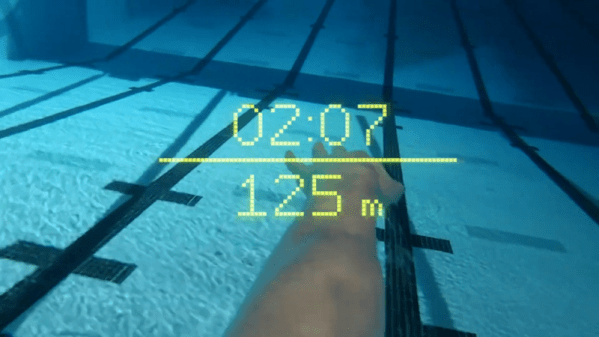
Athletes have a long history of using whatever they can find to enhance their performance or improve their training. While fitness tracker watches are nothing new, swimmers have used them to track their split times, distance, and other parameters. The problem with fitness trackers though is that you have to look at a watch. FORM has swim goggles that promise to address this, their smart goggles present the swimmer with a heads-up display of metrics. You can see a slick video about them below.

The screen is only on one eye, although you can switch it from left to right. The device has an inertial navigation system and is — of course — waterproof. It supposedly can withstand depths up to 32 feet and lasts 16 hours on a charge. It can use Bluetooth to send your data to your phone in addition to the display.

Continue reading “This Heads Up Display Is All Wet”

Impractical Clock Uses Tuning Fork

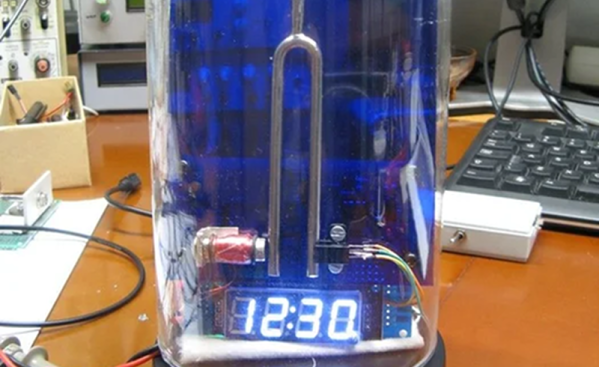
Clock projects are so common that they are almost a cliche. After all, microcontrollers have some clock source and are good at counting, so it stands to reason that a clock is an obvious project. [WilkoL’s] clock though has a most unusual clock source: a 440 Hz tuning fork.

A cheap plastic dome really shows off the fork and contributes to this good-looking build. An ATTiny13 divides the input frequency down, handles the display, and obeys the adjustment buttons. It does require a little metalworking, as the tuning fork needed filing and threading, although we bet you could figure out other ways to mount it.

Continue reading “Impractical Clock Uses Tuning Fork”

How The Power Gets To The Outlet

[Practical Engineering] is ready to explain how power substations get electricity to you in his latest video, which you can see below.  One of the things we always notice when talking to people either in our community or outside it is that most people have no idea how most of the modern world works.

Ask your non-technical friend to explain how a cell phone works or how a hard drive stores data and you aren’t likely to get a very good answer. However, even most of us are only focused on some particular aspect of electronics. There are a lot of people who hack on robots or radios. The AC power grid,though isn’t something a lot of people work with as a hobby. Do you know exactly what goes on in that substation you pass every day on your commute? If you don’t, you’ll learn something in the video.

Continue reading “How The Power Gets To The Outlet”

New Cray Will Reach 1.5 ExaFLOPS

It wasn’t that long ago when hard drives that boasted a terabyte of capacity were novel. But impressive though the tera- prefix is, beyond that is peta and even further is exa — as in petabyte and exabyte. A common i7 CPU currently clocks in at about 60 gigaflops (floating point operations per second). Respectable, but today’s supercomputers routinely turn in sustained rates in the petaflop range, with some even faster. The Department of Energy announced they were turning to Cray to provide three exascale computers — that is, computers that can reach an exaflop or more. The latest of these, El Capitan, is slated to reach 1.5 exaFLOPS and will reside at Lawrence Livermore National Laboratories.

The $600 million price tag for El Capitan seems pretty reasonable for a supercomputer. After all, a Cray I could only do 160 megaflops and cost nearly $8 million in 1977, or about $33 million in today’s money. So about 20 times the cost gets them over 9,000 times the compute power.

Continue reading “New Cray Will Reach 1.5 ExaFLOPS”

Quantum Radar Hides In Plain Sight

Radar was a great invention that made air travel much safer and weather prediction more accurate, indeed it is even credited with winning the Battle of Britain. However, it carries a little problem with it during times of war. Painting a target with radar (or even sonar) is equivalent to standing up and wildly waving a red flag in front of your enemy, which is why for example submarines often run silent and only listen, or why fighter aircraft often rely on guidance from another aircraft. However, researchers in Italy, the UK, the US, and Austria have built a proof-of-concept radar that is very difficult to detect which relies upon quantum entanglement.

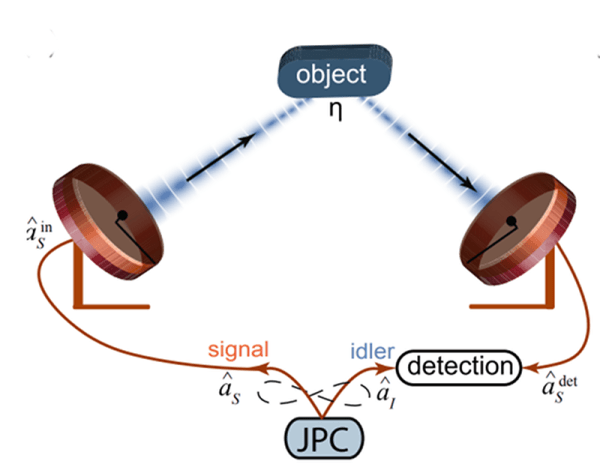
Despite quantum physics being hard to follow, the concept for the radar is pretty easy to understand. First, they generate an entangled pair of microwave photons, a task they perform with a Josephson phase converter. Then they store an “idle” photon while sending the “signal” photon out into the world. Detecting a single photon coming back is prone to noise, but in this case detecting the signal photon disturbs the idle photon and is reasonably easy to detect. It is likely that the entanglement will no longer be intact by the time of the return, but the correlation between the two photons remains detectable.

Continue reading “Quantum Radar Hides In Plain Sight”