Uber Has An Autonomous Fatality

You have doubtlessly heard the news. A robotic Uber car in Arizona struck and killed [Elaine Herzberg] as she crossed the street. Details are sketchy, but preliminary reports indicate that the accident was unavoidable as the woman crossed the street suddenly from the shadows at night.

If and when more technical details emerge, we’ll cover them. But you can bet this is going to spark a lot of conversation about autonomous vehicles. Given that Hackaday readers are at the top of the technical ladder, it is likely that your thoughts on the matter will influence your friends, coworkers, and even your politicians. So what do you think?

Continue reading “Uber Has An Autonomous Fatality”

All Your IPhone Are Belong To Us

Apple’s commitment to customer privacy took the acid test after the San Bernadino shooting incident. Law enforcement demanded that Apple unlock the shooter’s phone, and Apple refused. Court cases ensued. Some people think that the need to protect the public outweighs the need for privacy. Some people think that once they can unlock one iPhone, it won’t stop there and that will be bad for everyone. This post isn’t about either of those positions. The FBI dropped their lawsuit against Apple. Why? They found an Israeli firm that would unlock the phone for about $5,000. In addition, Malwarebytes — a company that makes security software — reports that law enforcement can now buy a device that unlocks iPhones from a different company.

Little is known about how the device — from a company called Grayshift — works. However, Malwarebytes has some unverified data from an unnamed source. Of course, the exploit used to break the iPhone security is secret because if Apple knew about it, they’d fix it. That’s happened before with a device called IP-box that was widely used for nefarious purposes.

Continue reading “All Your IPhone Are Belong To Us”

CUDA Is Like Owning A Supercomputer

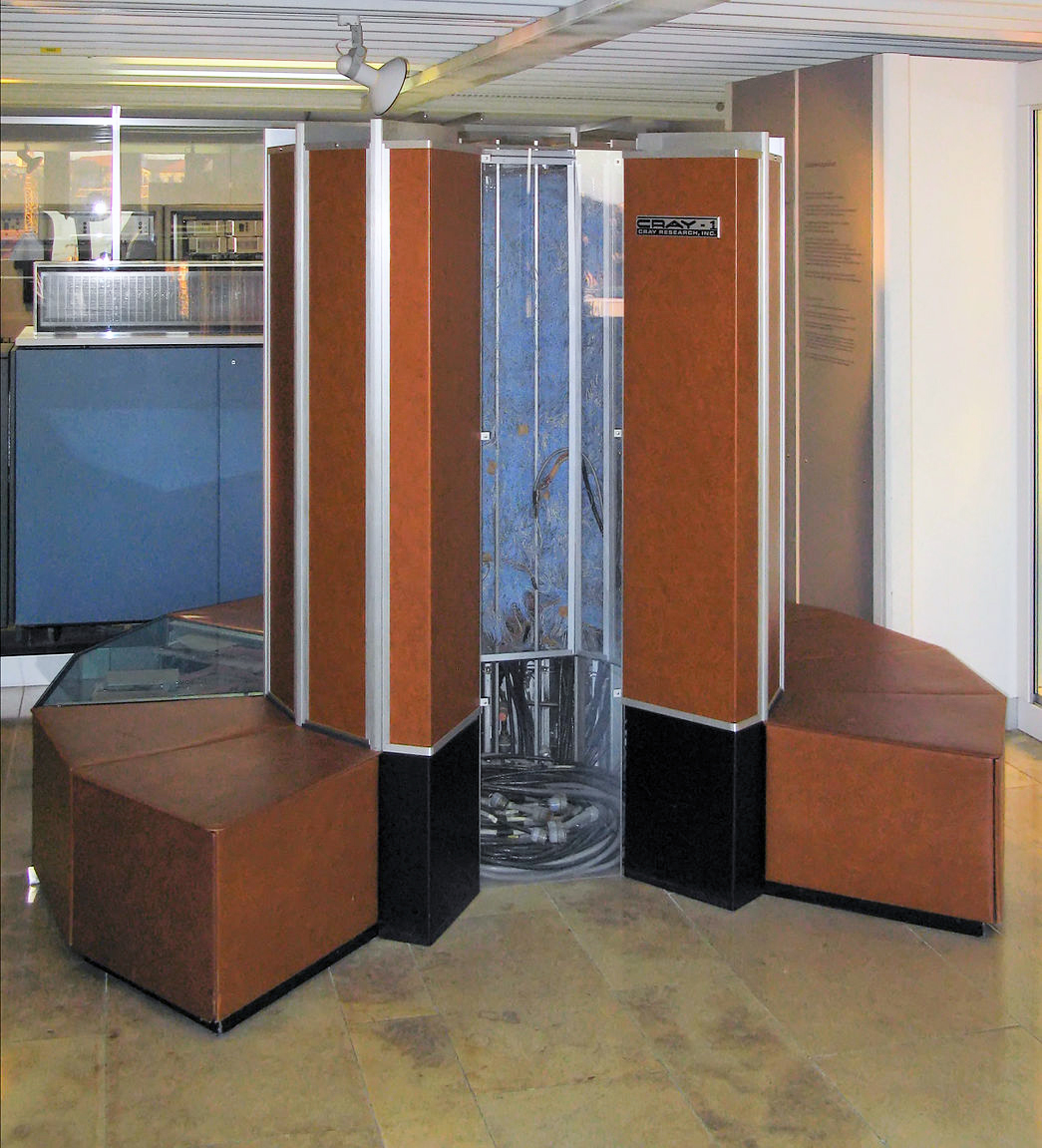
The word supercomputer gets thrown around quite a bit. The original Cray-1, for example, operated at about 150 MIPS and had about eight megabytes of memory. A modern Intel i7 CPU can hit almost 250,000 MIPS and is unlikely to have less than eight gigabytes of memory, and probably has quite a bit more. Sure, MIPS isn’t a great performance number, but clearly, a top-end PC is way more powerful than the old Cray. The problem is, it’s never enough.

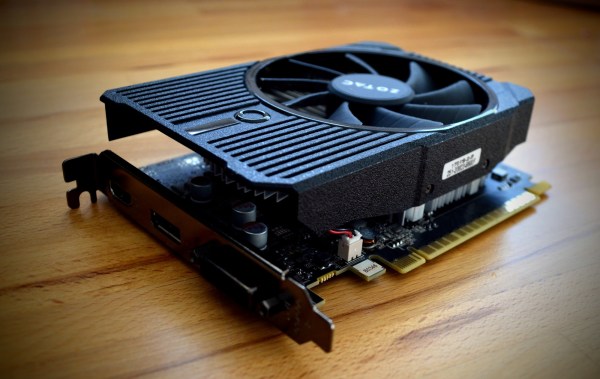
Today’s computers have to processes huge numbers of pixels, video data, audio data, neural networks, and long key encryption. Because of this, video cards have become what in the old days would have been called vector processors. That is, they are optimized to do operations on multiple data items in parallel. There are a few standards for using the video card processing for computation and today I’m going to show you how simple it is to use CUDA — the NVIDIA proprietary library for this task. You can also use OpenCL which works with many different kinds of hardware, but I’ll show you that it is a bit more verbose.
Continue reading “CUDA Is Like Owning A Supercomputer”

3D Printer Halts And Catches Fire — Analysis Finds A Surprising Culprit

Let’s build a robot that gets hot. Really hot — like three times hotter than McDonald’s coffee. Then make it move around. And let’s get the cost in at around $100. Sounds crazy? Not really, since that describes the cheap 3D printers we all have been buying. [John] found out the hard way that you really need to be careful with hot moving parts.

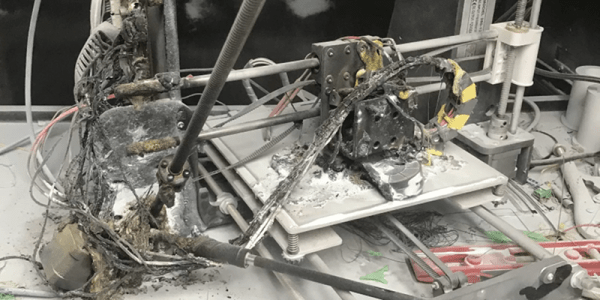
The short story is that [John’s] Anet A8 caught on fire — significantly caught on fire. Common wisdom says that cheap printers often don’t have connectors for the heated bed that can handle the current. There have been several well-publicized cases of those connectors melting, especially on early production models of several printers. However, this printer had an add-on heater with a relay, so that shouldn’t be the problem. Of course, a cheap power supply could do it, too, but the evidence pointed to it being none of those things.

Continue reading “3D Printer Halts And Catches Fire — Analysis Finds A Surprising Culprit”

3D Printed Antenna Is Broadband

Antennas are a tricky thing, most of them have a fairly narrow range of frequencies where they work well. But there are a few designs that can be very broadband, such as the discone antenna. If you haven’t seen one before, the antenna looks like — well — a disk and a cone. There are lots of ways to make one, but [mkarliner] used a 3D printer and some aluminum tape to create one and was nice enough to share the plans with the Internet.

As built, the antenna works from 400 MHz and up, so it can cover some ham bands and ADS-B frequencies. The plastic parts act as an anchor and allow for coax routing. In addition, the printed parts can hold a one-inch mast for mounting.

Continue reading “3D Printed Antenna Is Broadband”

Are You Dying To Upload Your Brain?

Cryonics — freezing humans for later revival — has been a staple of science fiction for ages. Maybe you want to be cured of something presently incurable or you just want to see the future. Of course, ignoring the problem of why anyone wants to thaw out a 500-year-old person, no one has a proven technology for thawing out one of these corpsicles. You are essentially betting that science will figure that out sometime before your freezer breaks down. A new startup called Nectome funded by Y Combinator wants to change your thinking about preservation. Instead of freezing they will pump you full of preservatives that preserve your brain including fine structures that scientists currently believe contain your memories.

Nectome’s strategy isn’t to have you revived like in conventional cryonics. They think the technology to do high definition scans of your preserved brain will exist soon. Those scans might allow future scientists to recreate your brain in a simulation. That isn’t really the same as coming back to life, though. At least we don’t imagine it is.

Continue reading “Are You Dying To Upload Your Brain?”

Linux Fu: File Aliases, Links, And Mappings

Have you heard it said that everything in Linux is a file? That is largely true, and that’s why the ability to manipulate files is crucial to mastering Linux Fu.

One thing that makes a Linux filesystem so versatile is the ability for a file to be many places at once. It boils down to keeping the file in one place but using it in another. This is handy to keep disk access snappy, to modify a running system, or merely to keep things organized in a way that suits your needs.

There are several key features that lend to this versatility: links, bind mounts, and user space file systems immediately come to mind. Let’s take a look at how these work and how you’ll often see them used.

Continue reading “Linux Fu: File Aliases, Links, And Mappings”