Point And Click To An IoT Button

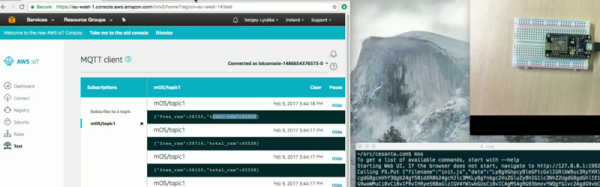
The availability of cheap WiFi boards like the ESP8266 and others means you can inexpensively put projects on the network. But there is still the problem of how to connect these devices to other places reliably. An Open Source project that attempts to make that whole effort point and click is Mongoose OS. The open source system works with the ESP8266, ESP32, and several other platforms. It is well integrated with Amazon’s IoT backend, but it isn’t locked to it.

Everyone wants to be your IoT broker and we see products appear (and disappear) regularly aimed at capturing that market. One common way to send and receive messages from a tiny device to a remote server is MQTT, an ISO standard made with resource-limited devices in mind. Many IoT services speak this protocol, including Amazon’s IoT offering. You can see how quick it is to flash an ESP8266 to make an Amazon IoT button in the video below. Although the video example uses Amazon, you can configure the system to talk to any public or private MQTT broker.


Continue reading “Point And Click To An IoT Button”

Better Linux Through Coloring

Cyber security is on everyone’s minds these days. Embedded devices like cameras have been used by bad guys to launch attacks on the Internet. People worry about data leaking from voice command devices or home automation systems. And this goes for the roll-your-own systems we build and deploy.

Many network-aware systems use Linux somewhere — one big example is pretty much every Raspberry Pi based project. How much do you think about security when you deploy a Pi? There is a superior security system available for Linux (including most versions you’d use on the Pi) called SELinux. The added letters on the front are for “Security-Enhanced” and this project was originally started by the NSA and RedHat. RedHat actually has — no kidding — a coloring book that helps explain some of the basic concepts.

We aren’t so sure the coloring book format is really the right approach here, but it is a light and informative read (we didn’t stay in the lines very well, though). Our one complaint is that it doesn’t really show you anything in practice, it just explains the ideas behind the different kind of protections available in SELinux. If you want to actually set it up on Pi, there’s a page on the Pi site that will help. If you have an hour, you can get a good overview of using SELinux in the video below.

Continue reading “Better Linux Through Coloring”

Saved By The Bel — Understanding Decibels

If you’ve hung around electronics for any length of time, you’ve surely heard of the decibel (often abbreviated dB). The decibel is a measure of a power ratio. Actually, the real measure is a bel, but you almost never see that in practice. If you are versed in metric, you won’t be surprised to learn a decibel is 1/10 of a bel. Sometimes in electronics, we deal with really large ratios, so the decibel is logarithmic to cope with this. Doubling the number of decibels doesn’t double the ratio, as you will soon see. It’s all about logarithms, and this ends up being extremely useful when measuring something like antenna or amplifier gain.

Besides antennas, decibels are often used to measure sound and light. The reason is that human ears and eyes have a logarithmic response to those quantities. Your ear, for example, has a huge dynamic range. That is to say, you can hear a whisper or a space shuttle launch. That ratio is about 1 trillion to 1, but that’s only 120 dB. This is also why potentiometers made for volume controls have a logarithmic taper. A linear pot would seem off because, for example, a tenth of a turn at one extreme will affect the apparent volume much more than a tenth of a turn at the other extreme. This holds true whether or not those knobs go up to eleven.

Continue reading “Saved By The Bel — Understanding Decibels”

Vintage COSMAC Elf Is Pretty Close To Original

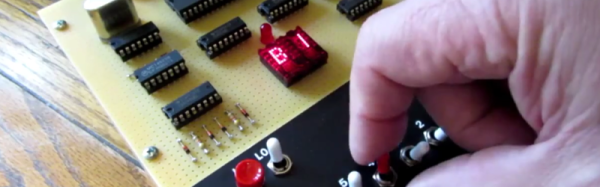
Popular Electronics was famous for the article introducing the Altair 8800 back in 1975 (well, the cover date was 1975; it really came out in late 1974). That was so popular (no pun intended), that they ran more computer construction articles, including the SWTPC 680 late in 1975. But in 1976 a very popular article ran on building a very simple computer called the COSMAC ELF. [Youtubba] had an Altair, but always wanted a “cute” COSMAC ELF. Now, forty-something years later, he finally got around to it. He made the very detailed video about his experience, below.

Surprisingly, he didn’t have to look very hard for too many of the components as most of them were available from Digikey. He had to get compatible RAM chips, the 1802 CPU and LED displays. He also couldn’t find a look-alike crystal, so he used a fake one and a hidden oscillator. The result looks awfully close to the original. He even did a nice front panel using Front Panel Express.

Continue reading “Vintage COSMAC Elf Is Pretty Close To Original”

200KV Capacitor Uses Cake Pan And Bowl

[PhysicsGirl] posts videos that would be good to use in a classroom or homeschool environment. She recently showed a 200KV capacitor made from a cake pan, a bowl, and some other common items (see video, below).

One of the most interesting things about the project was how they charged the capacitor. A PVC pipe and some common hardware made a wand that they’d charge by rubbing a foam sleeve up and down against the dome formed by a metal bowl. We might have used a cat, but there’s probably some law against that.

To discharge, they used the end of the wand and were able to get a 10 cm spark. Based on the dielectric constant for air, they estimated that equated to a 200KV charge. They also discharged it through someone’s finger, which didn’t seem like a great idea.

We’ve talked about [PhysicsGirl’s] videos before. Granted, a lot of this won’t help the experienced hacker, but if you work with kids, they are a great way to make physics interesting and approachable. We wish she’d spent more time on the actual construction (you’ll need to slow it down to see all the details), though. If you really want a capacitor for your high voltage mad science, you might find these more practical. We’ve seen many homemade capacitors for high voltage.

Continue reading “200KV Capacitor Uses Cake Pan And Bowl”

Solid State Battery From The Man Who Brought Us Lithium Ion

Who is [John Goodenough]? He’s 94, so he’s been around long enough that you ought to know him. He was one of the co-inventors of the lithium-ion battery. Think about how much that battery has changed electronics. [Goodenough] along with [Maria Helena Braga] may have come up with that battery’s successor: the solid state battery. There’s a paper available that is free, but requires registration. If you don’t want to register, you can read the news release from the University of Texas with no trouble.

Keywords used to describe the new battery are low-cost, noncombustible, long cycle life, high energy density, and fast charge and discharge rates. The pair is also claiming three times the energy density of a current lithium-ion battery. They also claim that the batteries recharge in minutes instead of hours. You can see a video from [Transport Evolved] that discusses the invention, below.

Continue reading “Solid State Battery From The Man Who Brought Us Lithium Ion”

Stop Printing Air With A Filament Sensor

If you have had a 3D printer for awhile, you know the heartbreak of coming in to check on an 8-hour print only to find that in hour 7 you ran out of filament (or the filament broke) and your printer has been dutifully moving around for no reason. [Chuck Hellebuyck] knows and he decided to make a filament sensor he found on Thingiverse.

Finding a part on Thingiverse and printing it probably doesn’t warrant much attention. But if you watch the video, below, it is a good example of how things from Thingiverse don’t always meet your needs. The microswitch [Chuck] had was bigger than the design used. So he loaded the STL file into TinkerCAD and fixed it. He shows you exactly how he did it. That’s a useful skill because you never know when you’ll need to modify some part you’ve found on the Internet.

Continue reading “Stop Printing Air With A Filament Sensor”