MIDI To CV The DIY Way

MIDI has been a remarkably popular interface since its inception way back in 1983. Based on existing serial interfaces, and with a broad enough set of features, it remains the defacto standard for communication between musical gear. However, older gear and many modular synths simply don’t grok digital data, instead using analog control voltages to get the job done. Never fear, though – you can convert from one to the other with the goMIDI2CV.

It’s a simple device, hewn from an ATTINY microcontroller. MIDI signals are received at TTL voltage levels, and converted to output voltages by the ATTINY via use of the PWM hardware. A lowpass filter is added to remove the high-frequency content from the output signal.  A 6N138 optocoupler completes the project, to comply with the MIDI standard and ensure the device is not subject to any dangerous voltages from the hardware plugged in.

It’s a simple way to control older non-MIDI compliant hardware, and might make an old modular rig just that much more useful in the studio of today. We’ve seen similar builds before, like this combined CV and Gate converter. 
Custom LoRa Pager Designed With Care

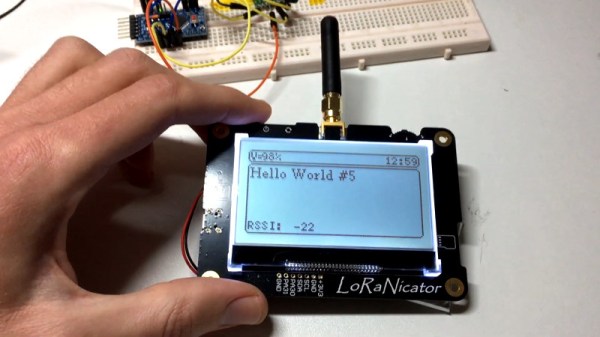
LoRa is a useful technology if you need to send data a long way at low power levels. Leveraging this, [5Volt-Junkie] decided to build a small pager named the LoRaNicator.

Those who love a detailed build log will enjoy this. The pager features everything up to and including the kitchen sink. A Cortex M0+ runs the show, flashed with an Arduino compatible bootloader, while a RFM95W module handles the LoRa communications. There’s a pager vibrator and piezo buzzer for notifications, along with a LiPo charger to make keeping the battery topped up easy. There’s even an RTC and soft-power button module.

Even if the LoRa side of things isn’t relevant to your interests, it’s a great example of how to build a useful tool rather than just a proof-of-concept. Things like an easy-to-use interface and simple battery charging go a long way to making something usable in the field. [5Volt-Junkie] even goes so far as to point out that even solder mask matters – if you’re using an infrared oven, your black boards will need a different profile to the usual green PCBs.

All the hard work has paid off, creating an attractive end product that we’d be proud to pack with the rest of our ham gear. LoRa is a useful platform, and as we’ve seen, it can be useful for everything from viticulture to meterology. Video after the break.

Continue reading “Custom LoRa Pager Designed With Care” →

Reverse Engineering A Telephonic Relay Device

The Plain Old Telephone Service, or POTS, doesn’t get a lot of love from the average person anymore. Perhaps once in a while a payphone will be of use when a phone battery has died, but by and large many people simply don’t have hardwired phones anymore. However, that doesn’t mean that the old landline can’t be put to good use. As [Felix Vollmer] shows us, it’s still possible to get useful hardware running over the phone line.

The YC-KZ02DN is a simple device which hooks up to a standard phone line. It’s capable of answering calls and responding to commands by switching its various relays on or off. [Felix] wasn’t quite happy with the stock functionality, however. Investigation showed the onboard STC15W202S microcontroller can be repogrammed over serial via an unpopulated header. Thus opened the door to hacking the device.

[Felix]’s alternative firmware has a couple of key features that make it valuable. Longer PINs are supported, decreasing the likelihood that malicious actors can gain access to the system. Additionally, the device is set to restore the last relay state after a power loss event. This makes the device far more useful for situations where it’s important to ensure consistent operation. It’s no use if an intermittent power loss stops your livestock’s water trough from filling, for example.

In this day and age of the Internet of Things, an old school telephony hack warms the cockles of our hearts. We’re suckers for anything that recalls the days of rotary dialing and speaking with the operator, after all.

Game Boy Recreated In Verilog

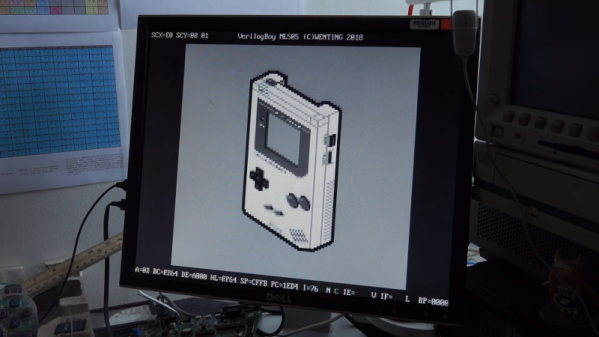
With the wide availability of Raspberry Pi hardware and pre-baked Linux distros with emulators ready to go, making a retro handheld is easier than ever. Emulation isn’t the only way to go about playing old games however. [Wenting Zhang] decided to instead recreate the Nintendo Game Boy in Verilog, and has documented the effort.

The project runs on a Spartan 6 FPGA. [Wenting] first developed the hardware to use a DualShock controller for input, and output video to a regular LCD monitor. However, work is now underway to produce a handheld VerilogBoy. This will feature a 320×320 LCD screen, with pixels being quadrupled from the original Game Boy 160×144 resolution, with some pixels to spare. [Wenting] is also looking at porting the code to some Pano Logic units, which we’ve discussed before. The thin clients pack FPGA hardware and lots of IO ports that make them perfect for such a project.

Code is available on Github for the curious tinkerers out there. While there are easier ways to play old handheld games, the amount of learning value of such a project should not be underestimated. We’ve seen FPGAs used for other Nintendo hijinx, too – like this NES cart that packs some serious muscle. Video after the break.

Continue reading “Game Boy Recreated In Verilog” →

Automated Cat Feeder Handles Wet Food With Aplomb

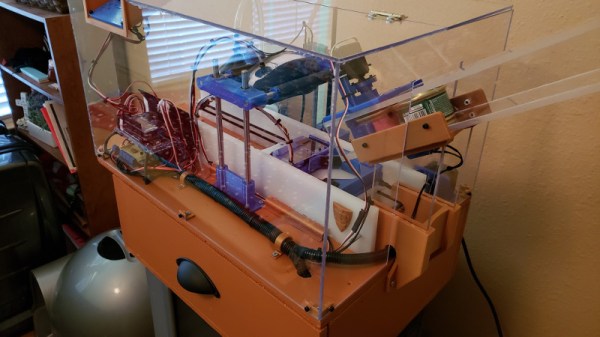
A feline’s appetite is rarely sated, and cat owners around the world are routinely treated to an early morning wake up call to remind them of this fact. To solve this problem, many turn to automated feeders. However, such devices usually handle only dry foods, with a simple hopper system. [Vikram Hao] instead went above and beyond, building a fully automated wet food cat feeder.

The device is a great example of effective automation. It’s fully capable of dispensing a single can of cat food, as well as opening the can, serving the food and disposing of the waste in an integrated bin. Currently, it has a maximum capacity of 9 cans, though this can be increased by simple alterations to the hopper and trash bin. Unsurprisingly, all manner of steppers, servos and brushed motors work in concert to achieve this feat. An Arduino Mega 2560 serves as the brains, providing plenty of IO to run everything as easily as possible.

[Vikram] reports that both the owner and the cat are overjoyed with the invention. We’ve seen a few builds before, with some even featuring armor plating. Video after the break.

Continue reading “Automated Cat Feeder Handles Wet Food With Aplomb” →

Kid Rover Is Six Wheels Of Awesome

There are plenty of ways to go about learning to TIG weld. Most involve a series of practice parts making butt joints and welding together various sections of pipe. [Kris Temmerman] decided to go a little bit farther, however. The result is a kid rover that’s sure to be the envy of every neighbourhood child for a few zipcodes around.

The chassis is an all-aluminium affair, making TIG welding the perfect choice for the job. Of course, [Kris] wasn’t content to simply build a basic go-kart or buggy. This sweet ride is inspired by the rocker-bogie designs of NASA’s Mars rovers, giving it the ride height and flexibility to roam over serious obstacles. Naturally, there’s six-wheel drive and four-wheel steering to complete the dynamic package. It should also be noted that yellow wheels are a stunning design choice that we just don’t see enough of.

It’s a beautifully crafted vehicle, and a testament to [Kris]’s machining and design skills. We can’t wait to see it given a shakedown run on the muddy fields of Belgium. If you’re eager to start your own rocker-bogie build, NASA’s got the open source designs to get you started. Video after the break.

Continue reading “Kid Rover Is Six Wheels Of Awesome” →

Robot Telephone Operator Handles Social Media For You

Social media has become pervasive in modern life. It can be impossible to get so much as an invite to a party without offering up your personal data at the altar of the various tech companies. [David] wanted to avoid the pressures of seeing countless photos of people climbing mountains and eating tacos, but also didn’t want to ostracize himself by avoiding social media altogether. Naturally, automation was the answer.

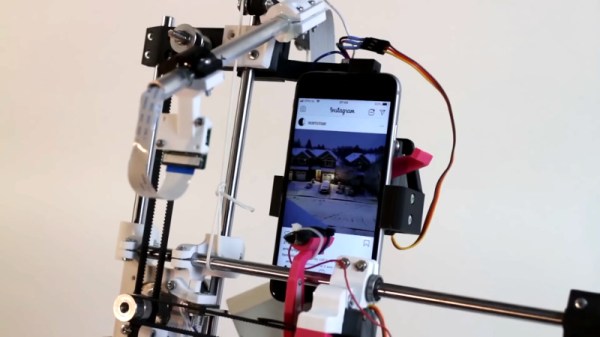
[David] aptly named his robot Telephone Operator, and that’s precisely what it does. Stepper motors and a servo allow the robot’s capacitive appendage to interact with the touch screen on [David]’s iPhone. A camera is fitted, and combined with OpenCV, the robot is capable of a great many important tasks.

Liking Instagram posts? Done. Reposting inane tweets? Easy. Asking your pal Mike what’s up? Yep, Telephone Operator has it covered. Given the low quality of human interaction on such platforms, it’s entirely possible [David] has the Turing Test beat without even trying. The robot even has that lazy continuous Sunday morning scroll down pat. It’s spooky stuff.

Of course, if you’re too in love with social media to trust an automaton, you might instead prefer to wear your likes on your sleeve. Video after the break.

[Thanks to dechemist for the tip!]

Continue reading “Robot Telephone Operator Handles Social Media For You” →