Glowing Eyes For Regular Guys

Cosplayers continually push the boundary of what’s possible in live costuming, often taking effects from the silver screen and creating them in real life. [KyleofAsgard] is no exception, bringing Thor’s glowing eyes to life in this impressive build.

The helmet is a 3D printed piece from Thingiverse, painted and distressed by hand.

The build relies on special contact lenses, which [Kyle] suggests are best sourced by searching for “electric blue contact lenses”. These glow in the presence of UV light, which here is provided by a strip of UV LEDs embedded into Thor’s helmet from the recent Marvel movies.

The concept is simple, but the attention to detail is what makes this project a winner. Not content with an earlier build that was a tangle of wires and uncomfortable to use, [KyleofAsgard] made some smart upgrades. The battery for the LEDs and all circuitry is built into the helmet, making it easy to take on and off on those long convention days. For a more impressive effect, a relay is used to turn the LEDs on by remote control with a 433MHz module. This allows [Kyle] or an assistant to trigger the effect covertly, adding plenty of drama when the eyes suddenly begin to shine. It’s all done with off-the-shelf parts that even a novice could put together.

Giving credit where it’s due, [Kyle] notes that his work was inspired by that of Instagram cosplayer [missxboof], who executed a similar concept earlier this year. It’s great to see the cosplay community coming together and sharing tips and techniques online. Of course, if your tastes are more Metroid than Marvel, you might prefer this arm cannon build. Video after the break.

[Thanks to NZSmartie for the tip!]

Continue reading “Glowing Eyes For Regular Guys” →

Welcome Our New Insect Overlords With Arduino-Powered Ant Bot

Walking robots come in many forms, and each presents their own unique challenges. Bipedal style locomotion is considered particularly difficult to do well, however designs with more legs offer certain advantages. Hexapods offer the possibility of keeping several legs on the ground while others move, providing a useful degree of stability. [How To Mechatronics] developed this ant robot, which is an excellent example of the form.

The hexapod has as the name suggests, six legs, each of which consist of 3 joints. This necessitates 3 servos per leg, for 18 servos total just for locomotion. Further servos are then used to control the abdomen, head, and mandibles. This gives the robot strong ant credentials, above and beyond being simply a 3D printed lookalike.

Brains come courtesy of an Arduino Mega, chosen for its ability to control a large number of servos. A custom PCB is printed as a shield to ease the connection of all the necessary hardware. An HC-05 Bluetooth module is used for communication with an Android app, which controls the ant. The piece de resistance is the ultrasonic sensors in the head, which allow the ant to automatically defend itself against predators that get too close.

It’s an involved build, requiring plenty of 3D printing and over 200 fasteners. Fundamentally though, it’s a fully working and tested hexapod build with full plans available for download, ready to toil in your underground sugar caves.

If your hexapod tastes skew more anime than insectoid, check out this Ghost in the Shell build. Video after the break.

[Thanks to Baldpower for the tip!]

Continue reading “Welcome Our New Insect Overlords With Arduino-Powered Ant Bot” →

ULTIMATE – A Useful Tool For File System Hacking

Whether you’re at the hobbyist level or a professional, if you’re working on code for operating systems or file systems, tools can make or break the job. [Ben Lunt] is an enthusiast hacker himself, and found that over time, a series of useful utilities had proliferated beyond reasonable management. It was time to solve the problem – enter ULTIMATE.

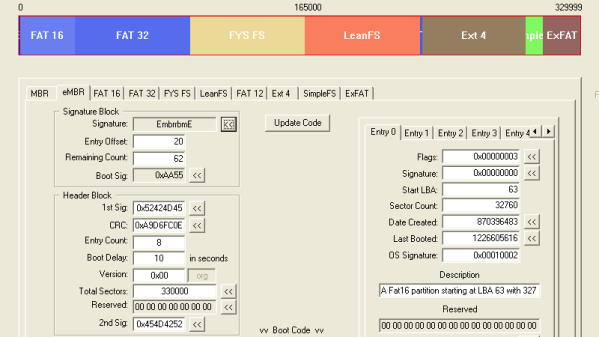
ULTIMATE is a combination of a wide swathe of file system hacking tools that [Ben] had developed over the preceding years. Capable of dealing with most FAT variants, Ext4, ISO, [Ben]’s own FYS FS as well as other Linux ephemera, it enables a wide variety of common tasks to be executed from within a single program.

Capabilities of the tool are wide ranging. Files can be inserted into and removed from image files, boot records can be altered, and there’s even the ability to tinker with GPTs for UEFI-based systems. [Ben] has also experimented with the concept of the eMBR – an extended Master Boot Record with greater functionality for larger, modern hard drives.

ULTIMATE is a testament to [Ben]’s broad file system knowledge, and could likely serve useful to many hackers in the file system and OS community. Just be cautious, though – the software is still in an early stage of development. If you’re just getting started in this particular realm of tinkering, take our primer on file system forensics.


‘Bit’ Installation Combines Art, Markov Chains

A Markov chain is a mathematical concept of a sequence of events, in which each future event depends only on the state of the previous events. Like most mathematical concepts, it has wide-ranging applications from gambling to the stock market, but in this case, [Jonghong Park] has applied it to art.

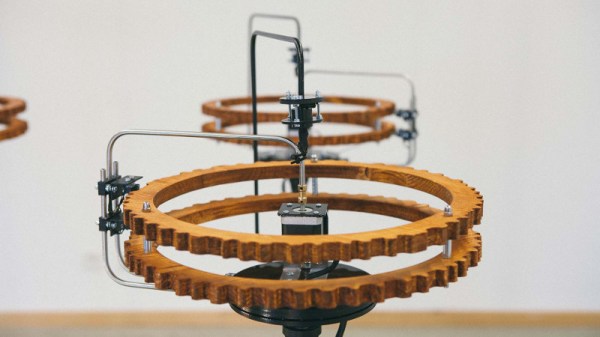
The installation, known simply as ‘bit’, consists of four machines. Each machine has two microswitches, which are moved around two wooden discs by a stepper motor. The microswitches read bumps on the surface of the disc as either a 0 or 1, and the two bits from the microswitches represent the machine’s “state”.

When a machine is called, the stepper motor rotates 1/240th of a revolution, and then the microswitches read the machine’s current state. Based on this state and the Markov Chain algorithm coded into the machines, a machine with the corresponding state is then called, which in turn moves, continuing the chain.

The piece is intended to reflect the idea of a deterministic universe, one in which the current state can be used to predict all future states. As an art piece, it combines its message with a visually attractive presentation of understated black metal and neatly finished wood.

We love a good art installation here at Hackaday – like this amazing snowflake install from a couple years back. Video after the break.

Continue reading “‘Bit’ Installation Combines Art, Markov Chains” →

Artificial Intelligence Composes New Christmas Songs

One of the most common uses of neural networks is the generation of new content, given certain constraints. A neural network is created, then trained on source content – ideally with as much reference material as possible. Then, the model is asked to generate original content in the same vein. This generally has mixed, but occasionally amusing, results. The team at [Made by AI] had a go at generating Christmas songs using this very technique.

The team decided that the easiest way to train their model would be to use note data from MIDI files. MIDI versions of Christmas songs are readily available and provide a broad base with which to train the model. For a neural network, the team chose to use a Long-short Term Memory (LSTM) architecture. This is a model which is contextually sensitive, which is important when dealing with structured formats like music or language.

The neural network generated five tunes which you can listen to on the Made by AI Soundcloud page. The team notes their time was limited, and we think that with some further work and more adherence to musical concepts such as structure and repetition, it might be possible to generate something a little more catchy.

There are other applications for AI in music, too – like these intelligent musical prostheses.

Brushless Motor Thrust Stand Provides Useful Data

When designing model aircraft of any shape or size, it’s useful to know the performance you can expect from the components chosen. For motors and propellers, this can be difficult. It’s always best to test them in combination. However, with the numbers of propeller and motor combinations possible, such data can be tough to come by. [Nikus] decided it would be easier to just do the testing in-house, and built a rig to do so.

The key component in this build is the strain gauge, which comes already laced up with an Arduino-compatible analog-digital converter module. Sourced for under $10 from Banggood, we can’t help but think that we’ve got it easy in 2018. A sturdy frame secures motor and propeller combination to the strain gauge assembly. An ATMEGA328 handles sending commands to the motor controller, reading the strain gauge results, and spitting out data to the LCD.

It’s a cheap and effective build that solves a tricky problem and would be a useful addition to the workshop for any serious modeler. We’ve seen other approaches in this area too, for those eager to graph their motor performance data. Video after the break.

[Thanks to Baldpower for the tip!]

Continue reading “Brushless Motor Thrust Stand Provides Useful Data” →

Bust A Move Doesn’t Have To Be Such A Grind

PC gamers have the benefit of the mouse and keyboard, which are highly flexible when it comes to input devices for gaming. What’s more, the freedom of the platform means that it’s easy to whip up whatever mad controller you can dream of to best suit the games you’re playing. Enter [Tom Tilley] with the aptly-named Hipster Game Controller.

Yes, this is a controller made out of a coffee grinder. The hand-crank setup makes it perfect for imitating the game board in that puzzle classic, Bust-A-Move. [Tom] interfaces the controller in a perfectly hacky way – the scroll wheel from a mouse is removed from the case and zip tied to the shaft of the grinder, allowing the rotation of the grinder to turn the wheel. The mouse wheel is then mapped as the aim control in the game – it really is that simple. An arcade button is also fitted into a mug and wired into the left mouse button to act as the trigger.

[Tom] notes that while you can fill the grinder up while you play, it makes playing the game very hard work. It’s a hacky build to show that sometimes, you don’t need a microcontroller and lines of code – just a mouse, some wire, and a healthy dose of ingenuity.

And, as it turns out, [Tom]’s been quite the Bust-a-Move fan for a few years now. Video after the break.

Continue reading “Bust A Move Doesn’t Have To Be Such A Grind” →