Reflex Trainer Puts Athletes To The Test

Being a top athlete in this modern age is a full-time job. No longer do athletes simply practice at their nominated sport of choice. They undergo strength training, full nutritional programs, cardio, and even reflex training.

Reflex training involves a series of nodes that an athlete must identify when lit up, and touch them to switch them off. By triggering them in a fast sequence, the athlete must work hard to both identify the lit node and then move to switch it off. TrainerLights is just such a system, built around the NodeMCU platform.

The system consists of a minimum of four lights – one acting as a server, the others as nodes. The lights each contain a nodeMCU board which communicates over WiFi, while the server has an additional board – acting as a WiFi hotspot that controls the system.

With the lights switched on, the coach connects to the server with a smartphone, and configures the lighting sequence and timings depending on the desired excercise regime. The server then communicates with the lighting nodes, which light their LEDs  at specified intervals. The athlete must clear the lights by swiping at the nodes, which detect the athlete’s hand via an ultrasonic proximity sensor. The sensitivity is configurable, to allow the system to trigger from a distant wave or a direct touch from the athlete. This allows a variety of training uses, from tennis to taekwondo.

With a 3D printed case and parts readily available from any good maker supplier, it’s a project you could tackle in a weekend to add to your own training regime.

We see plenty of athletic hacks in these parts – like this line-following robot for training sprinters. Video after the break.

[Thanks to Baldpower for the tip!]

Continue reading “Reflex Trainer Puts Athletes To The Test” →

Let’s Look At Some Cool Old LEDs

LEDs are now a mature technology, with all manner of colors and flavors available. However, back in the 1970s, it was early days for this fledgling display tech, and things looked very different. [IMSAI Guy] happened to work at the optoelectronics division of Hewlett-Packard during their development of LED displays, and has a handful of prototypes from those heady days.

The video is a great look at not only vintage display hardware, but also rarely seen prototypes that seldom left the HP offices. Matrix, 7-segment and even 16-segment devices are all in attendance here. There’s great macro photography of the packages, including the now-forgotten bubble displays as well as hermetically sealed glass packages. The parts all have a uniquely 1970s look, drenched in gold plating and otherwise just looking very expensive.

The followup video breaks out the microscope and powers up the displays. [IMSAI Guy] shares some useful tips on how to best tinker with unknown LED parts, as well as knowledge about the chemical compounds and manufacturing processes involved in LED production. If you don’t know your III-V compounds from your II-VI compounds, prepare to learn.

It’s always interesting to take a look back, and even better to get a peek at the experiments of engineers of the past.

If you’re wondering about applications of this hardware, we’ve seen messageboards and watches before. Video after the break.

Continue reading “Let’s Look At Some Cool Old LEDs” →

How To Make A Pilotron, The Forgotten Tube

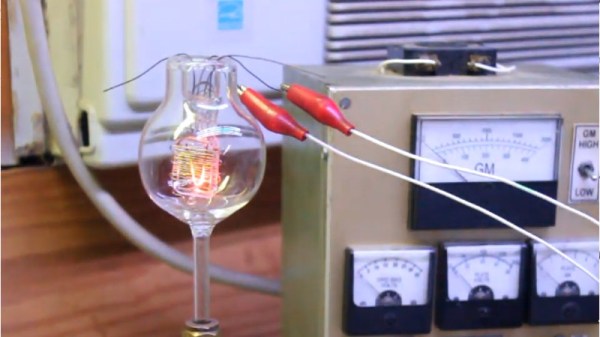
The vacuum tube is largely ignored in modern electronic design, save for a few audio applications such as guitar and headphone amps. The transistor is smaller, cheaper, and inordinately easier to manufacture. By comparison, showing us just how much goes into the manufacture of a tube, [glasslinger] decided to make a wire-element pilotron – from scratch!

To say this is an involved build is an understatement. Simply creating the glass tube itself takes significant time and skill. [glasslinger] shows off the skills of a master, however – steadily working through the initial construction, before showing off advanced techniques necessary to seal in electrodes, produce the delicate wire grid, and finally pull vacuum and seal the tube completely.

The project video is an hour long, and no detail is skipped. From 2% thoriated tungsten wire to annealing torches and grades of glass, it’s all there. It’s enough that an amateur could reproduce the results, given enough attempts and a complete shop of glassworking equipment.

The pilotron may be a forgotten design, but in 2018 it once again gets its day in the sun. Overall, it’s a testament to [glasslinger]’s skill and ability to be able to produce such a device that not only looks the part, but is fully functional on an electronic level, as well.

There’s a few people out there still building valves the old fashioned way, and we’d love to see more – tip ’em if you got ’em. Video after the break.

[Thanks to Morris for the tip!]

Continue reading “How To Make A Pilotron, The Forgotten Tube” →

The Battle Between Robot Harmonica And Machine Finger Rages On

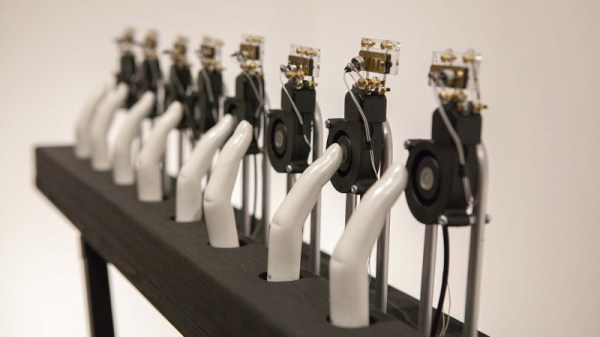
When asking the question “Do humans dream of machines?”, it’s natural to think of the feverish excitement ahead of an iPhone or Playstation launch, followed by lines around the block of enthusiastic campers, eager to get their hands on the latest hardware as soon as is humanly possible. However, it’s also the title of an art piece by [Jonghong Park], and is deserving of further contemplation. (Video after the break.)

The art piece consists of a series of eight tiny harmonicas, which are in turn, played by eight fans, which appear to have been cribbed from a low-power graphics card design. Each harmonica in turn has a microphone fitted, which, when it picks up a loud enough signal, causes an Arduino Nano to actuate a mechanical finger which slows the fan down until the noise stops. It’s the mechanical equivalent of a stern look from a parent to a noisy child. Then, the cycle begins again.

The build is very much of the type we see in the art world – put together as simply as possible, with eight Arduinos running the eight harmonicas, whereas an engineering approach may focus more on efficiency and cost. Between the squeaks from the toy harmonicas and the noise from the servos entrusted to quiet them, the machine makes quite the mechanical racket. [Jonghong] indicates that the piece speaks to the interaction of machine (robot harmonica) and humanity (the finger which quells the noise).

It’s a tidily executed build which would be at home in any modern art gallery. It recalls memories of another such installation, which combines fans and lasers into a musical machine. Continue reading “The Battle Between Robot Harmonica And Machine Finger Rages On” →

Stovetop Milk Steamer Is Beautiful, Effective

The Moka pot is an industrial design classic, hailing from Italy in the early part of the 20th century. To this day, it remains an excellent way to brew top quality coffee at home with affordable equipment. However, if your tastes for coffee lie more towards lattes than espresso, you’re out of luck – unless you’ve got one of these.

[Create] started with a classic Moka pot for this project, and set out to build a stovetop milk steamer. The top reservoir is quickly cut away, and a tap fitted atop the lower water reservoir. This allows the flow of steam from the lower reservoir to be controlled. A steel pipe is then fitted to the tap, which is bent, crushed, and soldered to form a nozzle for steaming the milk. It’s then finished off with beautiful wooden handles for a nice aesthetic touch.

While we’re not sure the soldering process or tap used are food grade, there are workarounds for that, and it’s a project that could easily be pulled off in a weekend. What’s more, you can celebrate your new creation with a delicious hot cappuccino. What could be better? Now all you need is your own special roast. Video after the break.

[Thanks to Baldpower for the tip!]
Continue reading “Stovetop Milk Steamer Is Beautiful, Effective” →

Soft Rotating Pneumatic Actuators

When we think of pneumatic actuators, we typically consider the standard varieties of pneumatic cylinder, capable of linear motion. These can be referred to as “hard” actuators, made of rigid components and capable of great accuracy and force delivery. However, “soft” actuators have their own complementary abilities – such as being able to handle more delicate tasks and being less likely to injure human operators when used in collaborative operations. The Whitesides Research Group at Harvard University has undertaken significant research in this field, and released a paper covering a novel type of soft pneumatic actuator.

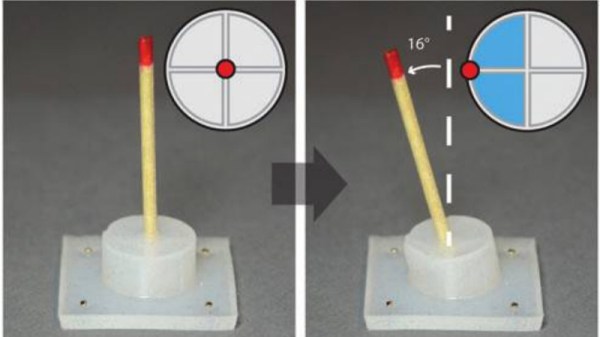
The actuator consists of a series of soft, flexible sealed chambers which surround a wooden dowel in the center. By applying vacuum to these various chambers, the dowel in the center can be pulled into up to eight different positions. It’s a unique concept, and one we can imagine could have applications in various material processing scenarios.

The actuator was built by moulding elastomers around 3D printed components, so this is a build that could theoretically be tackled by the DIYer. The paper goes into great detail to quantify the performance of the actuator, and workshops several potential applications. Testing is done on a fluid delivery and stirring system, and a tethered robotic walker was built. The team uses the term cVAMS – cyclical vacuum actuated machine – to describe the actuator technology.

The world of soft robotics is a hot bed of development, and we look forward to further work in this field. It’s not just Harvard, either – we’ve seen interesting work from Yale and from the Hackaday community too!


Improving Depth Of Field With Only 5 Phones

The hottest new trend in photography is manipulating Depth of Field, or DOF. It’s how you get those wonderful portraits with the subject in focus and the background ever so artfully blurred out. In years past, it was achieved with intelligent use of lenses and settings on an SLR film camera, but now, it’s all in the software.

The franken-camera rig, consisting of five Pixel 3 smartphones. The cameras are synchronised over WiFi.

For the Pixel 2 smartphone, Google had used some tricky phase-detection autofocus (PDAF) tricks to compute depth data in images, and used this to decide which parts of images to blur. Distant areas would be blurred more, while the subject in the foreground would be left sharp.

This was good, but for the Pixel 3, further development was in order. A 3D-printed phone case was developed to hold five phones in one giant brick. The idea was to take five photos of the same scene at the same time, from slightly different perspectives. This was then used to generate depth data which was fed into a neural network. This neural network was trained on how the individual photos relate to the real-world depth of the scene.

With a trained neural network, this could then be used to generate more realistic depth data from photos taken with a single camera. Now, machine learning is being used to help your phone decide which parts of an image to blur to make your beautiful subjects pop out from the background.

Comparison images show significant improvement of the “learned” depth data versus just the stereo-PDAF generated depth data. It’s yet another shot fired in the smartphone camera arms race, that shows no signs of abating. We just wonder when the Geiger counter mods are going to ship from factory.

[via AndroidPolice]