Recreating Early Apple Mice For The Modern Era

At a time when practical graphical user interfaces were only just becoming a reality on desktop computers, Apple took a leap of faith and released one of the first commercially available mice back in 1983. It was criticized as being little more than a toy back then, but we all know how that particular story ends.

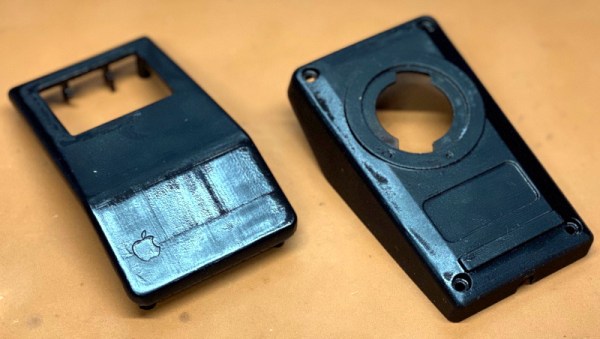
While the Apple G5431 isn’t that first mouse, it’s not too far removed. So much so that [Stephen Arsenault] believed it was worthy of historic preservation. Whether you want to print out a new case to replace a damaged original or try your hand at updating the classic design with modern electronics, his CAD model of this early computer peripheral is available under the Creative Commons license for anyone who wants it.
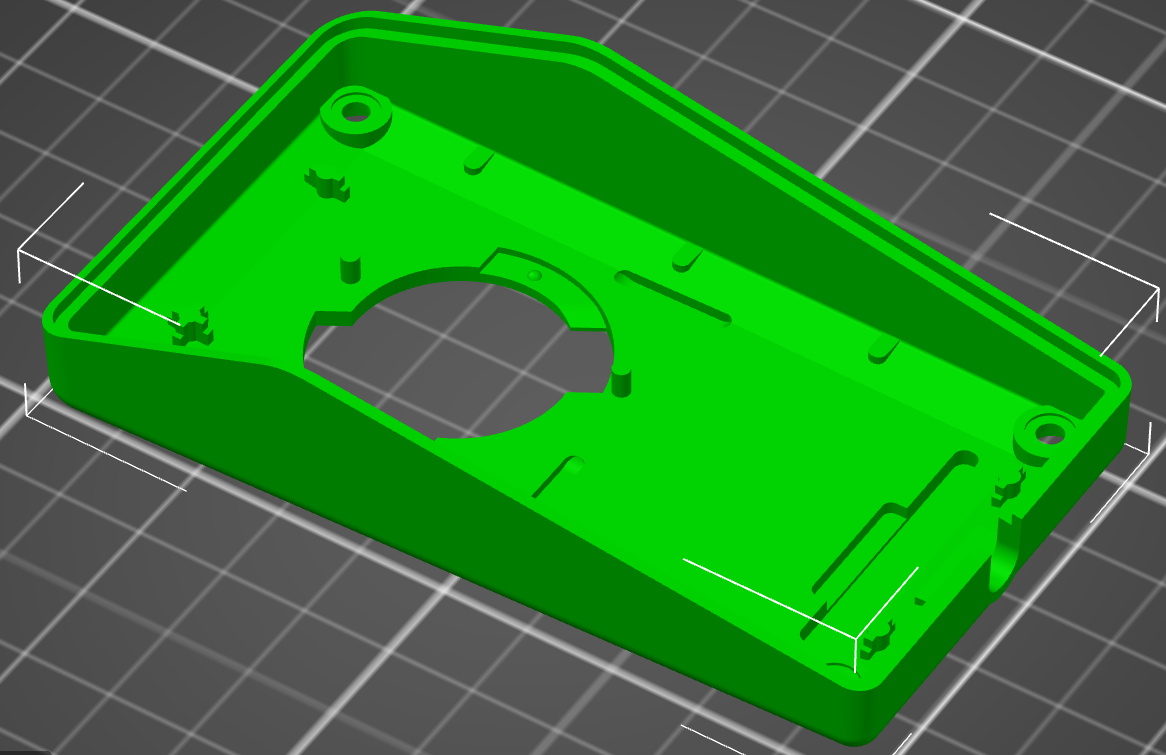
The model is exceptionally well detailed.

[Stephen] tells us that he was inspired to take on this project after he saw new manufactured cases for the G5431 popping up online, including a variant made out of translucent plastic. Realizing that a product from 1986 is old enough that Apple (probably) isn’t worried about people cloning it, he set out to produce this definitive digital version of the original case components for community use.

With these 3D models available, [Stephen] hopes that others will be inspired to try and modify the iconic design of the G5431. Perhaps by creating a Bluetooth version, or adding the ability to right-click. Considering we’ve already seen custom PCBs for mice, it’s hardly a stretch. We’d love to see somebody take him up on the offer, but even if not, the digital preservation of computer history is always welcome.
OAK Vision Modules Help You See The Forest And The Trees

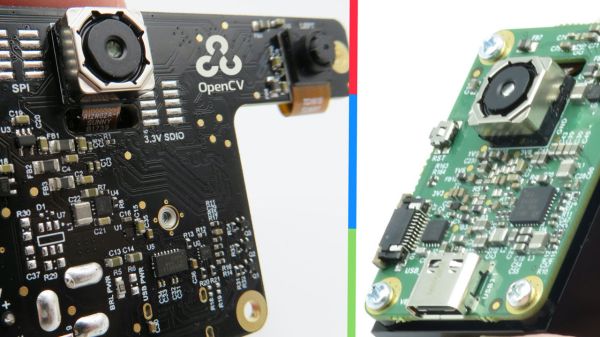
OpenCV is an open source library of computer vision algorithms, its power and flexibility made many machine vision projects possible. But even with code highly optimized for maximum performance, we always wish for more. Which is why our ears perk up whenever we hear about a hardware accelerated vision module, and the latest buzz is coming out of the OpenCV AI Kit (OAK) Kickstarter campaign.

There are two vision modules launched with this campaign. The OAK-1 with a single color camera for two dimensional vision applications, and the OAK-D which adds stereo cameras for that third dimension. The onboard brain is a Movidius Myriad X processor which, according to team members who have dug through its datasheet, have been massively underutilized in other products. They believe OAK modules will help the chip fulfill its potential for vision applications, delivering high performance while consuming low power in a small form factor. Reading over the spec sheet, we think it’s fair to call these “Ultimate Myriad X Dev Boards” but we must concede “OpenCV AI Kit” sounds better. It does not provide hardware acceleration for the entire OpenCV library (likely an impossible task) but it does cover the highly demanding subset suitable for Myriad X acceleration.

Since the campaign launched a few weeks ago, some additional information have been released to help assure backers that this project has real substance. It turns out OAK is an evolution of a project we’ve covered almost exactly one year ago that became a real product DepthAI, so at least this is not their first rodeo. It is also encouraging that their invitation to the open hardware community has already borne fruit. Check out this thread discussing OAK for robot vision, where a question was met with an honest “we don’t have expertise there” from the OAK team, but then ArduCam pitched in with their camera module experience to help.

We wish them success for their planned December 2020 delivery. They have already far surpassed their funding goals, they’ve shipped hardware before, and we see a good start to a development community. We look forward to the OAK-1 and OAK-D joining the ranks of other hacking friendly vision modules like OpenMV, JeVois, StereoPi, and AIY Vision.

Tune Into The Bonnaroo That No One Gets To Go To

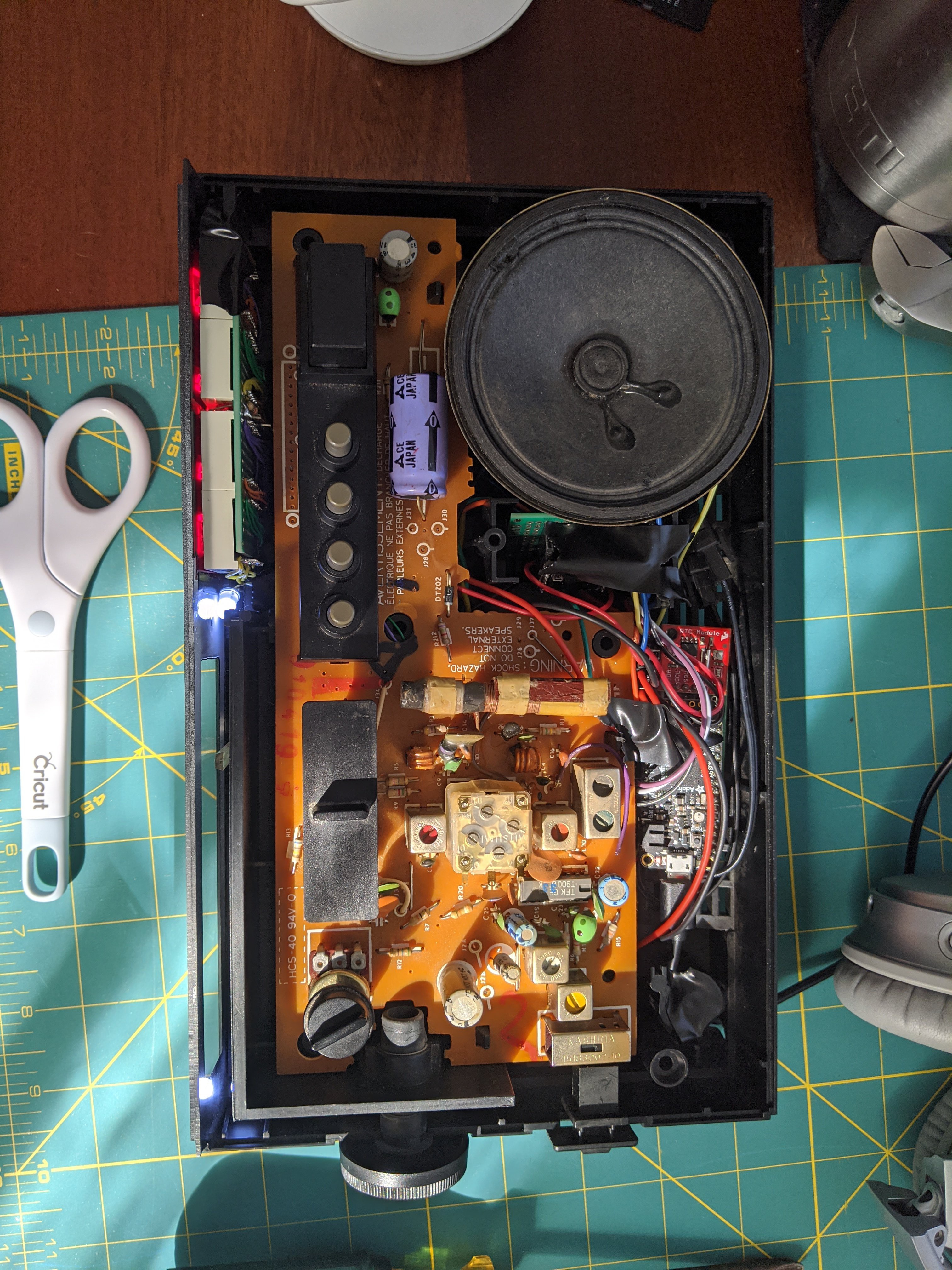
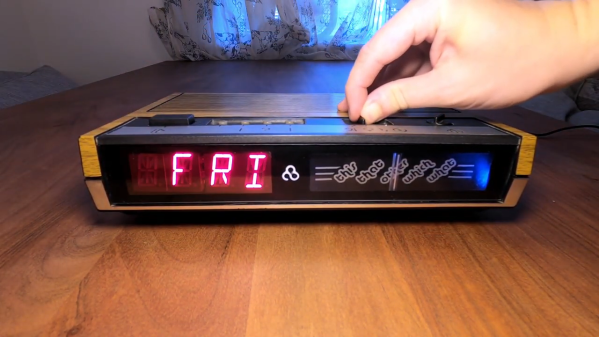
Just like everything else in 2020, the four-day, multi-stage festival of music and art known as Bonnaroo has been cancelled. This would have been [Guy Dupont]’s fifth year making the journey to Tennessee with his friend. Since they couldn’t go, [Guy] decided to build an interactive Bonnaroo mix tape into an 80s clock radio as a birthday present.

[Guy] was able to re-purpose all the original buttons and dials to navigate through the schedule of acts that would have performed across four days and five stages. The conveniently four-way function slider is used to choose the day, and the radio tuning dial selects the stage, complete with delightful static between the positions. The rest of the buttons move back and forth through the scheduled set times, and one will scroll the track and artist name across the 16-segment displays. The snooze button has the honor of being the play/pause button.

All the inputs are controlled with a Feather M4 express, and the music comes through a DFPlayer Mini. We love that [Guy] was able to repurpose the analog tuning dial by coupling it to a slide potentiometer that fit perfectly in a slot on the underside of the plastic. Stay tuned for a great video that starts with an explanation and demo and then goes into the build.

Though the utility of the clock radio may have been supplanted by cell phone alarms and doomscrolling, that just means that there are theoretically more of them to gut and turn into other things, like this Fallout-inspired luggable Pip-Boy.

Continue reading “Tune Into The Bonnaroo That No One Gets To Go To”

Animal Crossing IRL With Nova Lights To Mark The Passage Of Time

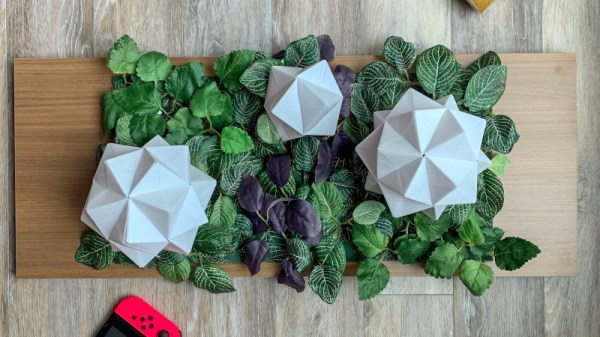
We feature a lot of clocks here at Hackaday, but it’s not often that one comes along and makes us stop in our tracks and reconsider the fundamental question: just what is a clock? [Charlyn] has managed it though, with her Nova Light clock, which doesn’t so much measure the passing of time, but mark it.

The clock itself is a set of origami pieces in the shape of the Nova lights and a star fragment from the popular Animal Crossing New Horizons game, and each has a multicolour LED underneath. The star fragment pulses, while the two Nova lights imperceptibly slowly change colour, one over the course of the day and the other over the course of the week. Except for Fridays, when in celebration of the end of the work week they pulsate with different colours. Under the hood is an Adafruit Feather with a real-time clock module, and since all the code is there for your enjoyment you can have a go at making your own. Below the break is a video showing the clock in action.

[Charlyn] is no stranger to these pages, in fact we’ve featured her exquisite use of origami before. It’s probably her rideable rocking horse that’s the most memorable among her projects though.

Continue reading “Animal Crossing IRL With Nova Lights To Mark The Passage Of Time”

Print With Plasma!

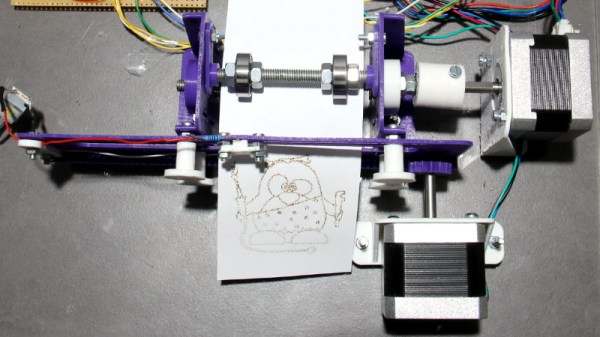
Over the years there have been a variety of methods for a computer to commit its thoughts to paper. Be it a daisy wheel, a dot matrix, a laser, or an inkjet, we’ve all cursed at a recalcitrant printer. There’s another type of printer that maybe we don’t think of quite as often but is workhorse in a million cash registers and parking ticket machines: the thermal printer. These mechanisms can be readily found as surplus items and have made their way into more than one project here over the years. [HomoFaciens] has taken thermal printing a step further by building a plasma printer from scratch that makes use of the thermal paper.

A thermal printer does its job as its name suggests, by burning the image into the paper. It may not deliver the best quality print, but scores on not needing ink ribbons, cartridges, or toner. This DIY version uses an off-the-shelf battery-powered plasma lighter to do the job, mounted on a 3D printed XY printer mechanism driven by two stepper motors. Behind the scenes is an Arduino Uno, which receives its instructions via USB from a command-line program on a Linux box. It’s admitted that this is hardly the pinnacle of printing technology, but it does at least make for a fascinating project. You can see it in action in the video below the break.

This isn’t [HomoFaciens]’ first printer, we’re instantly reminded of this ink drop printer from a few years ago.

Continue reading “Print With Plasma!”

Wood-Fired Hot Tub For The End Of The World

It’s one of the idyls of our age, to imagine oneself lounging in a hot tub watching a golden sunset, glass of wine in hand and the love of your life at your side. Along the way though it’s one that’s become diverted from the original, instead of a Scandinavian style wood fired tub in the forest we’re more likely to be thinking of an electric whirlpool spa made from fibreglass, as much a status symbol as a leisure item. It’s refreshing then to see [sirClogg]’s home made hot tub, a simple wooden tub with associated wood stove to heat its water. We can’t wait to step in!

The tub is simplicity itself, being made from softwood planks held together under tension by some steel cables. He admits though that he made a mistake using green wood, as it has now contracted leaving the tub with some gaps. But it’s a simple enough build that he can contemplate dismantling and rebuilding it to correct for that oversight.

Heat meanwhile is provided by a pipe that circulates water from the bottom of the tub through a heat exchanger coil inside a brick-built wood stove adjacent to the tub. The fabrication of the heat exchanger is detailed in the video below, we enjoyed seeing the copper piping filled with salt to ensure it doesn’t collapse when being bent around a five-gallon bucket. It doesn’t get much simpler than this, and the reward of a hot tub must be a sweet one indeed.

For hot tub enthusiast hackers, it’s always worth remembering that the excellent Danish hacker camp BornHack has a hot tub as part of its wellness area.

Continue reading “Wood-Fired Hot Tub For The End Of The World”

Vintage Gauges Turned Classy Weather Display

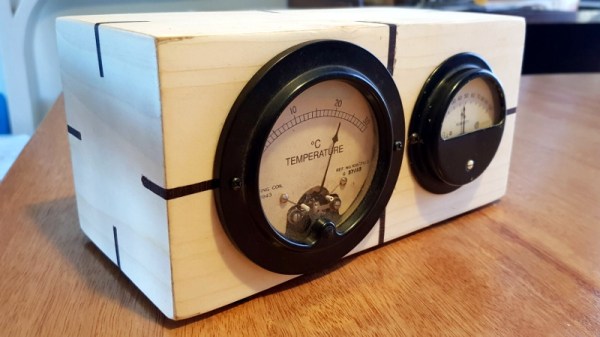
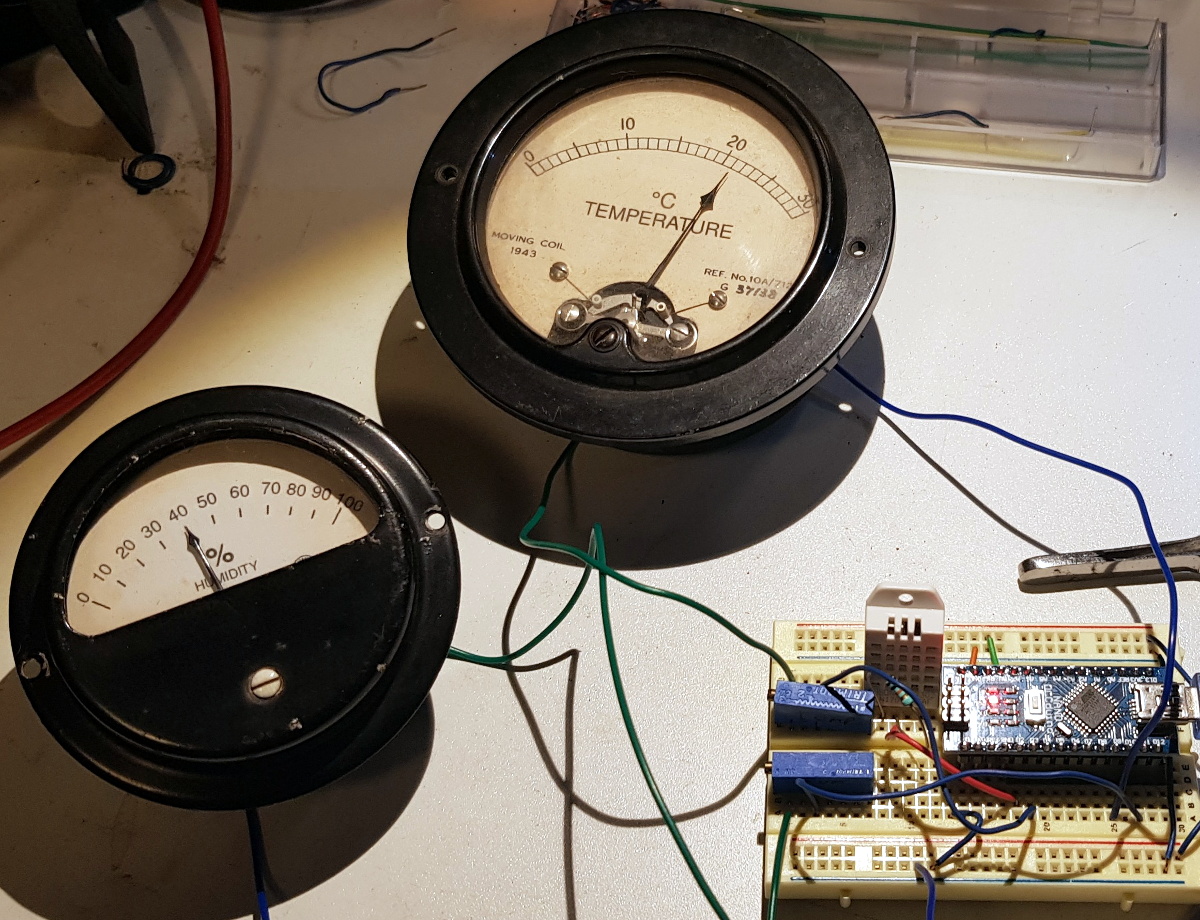
It’s always good to see old hardware saved from the junk pile, especially when the end result is as impressive as this analog gauge weather display put together by [Build Comics]. It ended up being a truly multidisciplinary project, combing not only restoration work and modern microcontroller trickery, but a dash of woodworking for good measure.

Naturally, the gauges themselves are the real stars of the show. They started out with rusted internals and broken glass, but parts from a sacrificial donor and some TLC from [Build Comics] got them back in working order. We especially like the effort that was put into making the scale markings look authentic, with scans of the originals modified in GIMP to indicate temperature and humidity while retaining the period appropriate details.

To drive the 1940s era indicators, [Build Comics] is using an Arduino Nano and a DHT22 sensor that can detect temperature and humidity. A couple of trimmer pots are included for fine tuning the gauges, and everything is mounted to a small scrap of perfboard hidden inside of the custom-made pine enclosure.

This is hardly the first time we’ve seen analog gauges hooked up to modern electronics, but most of the projects are just that: modern. While the end look might be somewhat polarizing, we think maintaining the hardware’s classic style was the right call.