Robotic Open Source Puppy Needs A Home

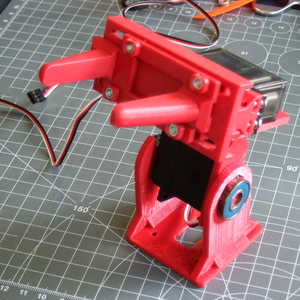
Personally, I am a fan of the real thing, but dogs aren’t an option for all. Plus, robotic dogs are easier to train and don’t pee on your couch. If you are looking to adopt a robotic companion, Stanford Pupper might be a good place to start. It’s a new open source project from the Stanford Robotics Student group,  a group of robotic hackers from Stanford University. This simple robotic quadruped looks pretty simple to build, but also looks like a great into to four-legged robots.

This is the first version of the design, but it looks pretty complete, built around a carbon fiber and 3D printed frame. The carbon fiber parts have to be cut out on a router, but you can order them pre-cut here, and you might be able to adapt it to easier materials. The Pupper is driven by twelve servos powered from a 5200 mAh 2S LiPo battery and a custom PCB that distributes the power. That means it could run autonomously.

Continue reading “Robotic Open Source Puppy Needs A Home”

Dr. Anthony Fauci, Infectious Disease Slayer

In the two months since the harsh realities of SARS-CoV-2 and COVID-19 have come into sharp focus, Americans have become increasingly familiar with a man who has been quietly serving the people since the days when Ronald Reagan was up for re-election. For many, Dr. Anthony Fauci is the national voice of reason in a sea of dubious information. He has arguably become the most trustworthy person the government has to offer in the face of this pandemic.

Officially, Dr. Fauci is the Director of the National Institute of Allergy and Infectious Diseases (NIAID), a position he was appointed to in 1984. He has worked under six presidents, advising them on every outbreak from the HIV/AIDS epidemic up through Zika and Ebola. Now, he is part of the White House’s coronavirus task force.

At 79 years old, he still works 18-hour days, sticking it to infectious diseases with one hand, and smoothing the feathers of the American people with the other. Dr. Fauci certainly feels like the right person at the right time. So how did he get to this point?

Continue reading “Dr. Anthony Fauci, Infectious Disease Slayer”

Original Zork MDL Source Code Has Been Released

Though mostly known for its releases on countless 8-bit personal computers from the 1970s and 1980s, the game of Zork began its life on a PDP-10 mainframe. Recently, MIT released the original source code for this version of Zork. As we covered a while ago, the history of Zork is a long and lustrous one, a history that is based on this initial version written in MDL.

To recap, MDL is a LISP-derived language that excels at natural language processing. It was developed and used at MIT’s AI and LCS (now CSAIL) departments for a number of projects, and of course to develop games with. The use of MDL gave Zork as a text-based adventure a level of interaction that was far ahead of its time.

What MIT has made available is the source code from Zork as it existed around 1977, at a time when it was being distributed to universities around the US. For purely educational purposes, obviously. This means that it’s a version of Zork before it was commercialized (~1979), showing a rare glimpse of the game as it was still busily being expanded.

Running the game will take a bit of effort, however. These files were retrieved from an original MIT backup tape that was used with their PDP-10 machines. Ideally one would use a 1970s-era PDP-10 mainframe with an MDL compiler, but in a pinch one could run a PDP-10 emulator as well.

Let us know whether you got it to run. Screenshots (ASCII or not) are highly encouraged.

Understanding A Bit About Noise Can Help You Go A Long Way

There are many ways in which one’s youth can be misspent, most of which people wish they’d done when they get older and look back on their own relatively boring formative years. I misspent my youth pulling TV sets out of dumpsters and fixing them or using their parts in my projects. I recognise with hindsight that there might have been a few things I could have done with more street cred, but for me, it was broken TVs. Continue reading “Understanding A Bit About Noise Can Help You Go A Long Way”

Neat And Tidy USB-C Conversions For Legacy Devices

USB-C has been on the market for a good few years now, and it’s finally starting to take over. Many new laptops only come with the newer port, making it difficult to use legacy USB-A devices. [Matt] doesn’t like mucking about with dongles and hubs, so set about converting some older hardware to the new standard. (Video, embedded below.)

[Matt] first set about hacking a Logitech wireless mouse dongle, peeling apart the original USB A connector to gain access to the PCB inside. A USB C breakout board is then sourced, and the relevant pins in the USB-C connector are soldered to the original USB-A connector pads. Unfortunately, the breakout board is configured as a host device, unsuitable for peripherals. Replacing a pull-up resistor with a pull-down on the VCONN and CC1 pins rectifies this. With the mod done, the mouse enumerates and is fully functional over USB-C. A little Sugru is then used to wrap everything up neatly.

[Matt] then progresses through several other similar mods to other hardware, sharing useful tips on how to make things as neat and useful as possible. It’s a tidy hack that could make your user experience with a new laptop much less painful. USB-C mods are becoming more common, and we’ve seen plenty done to soldering irons thanks to the Power Delivery spec.
Continue reading “Neat And Tidy USB-C Conversions For Legacy Devices”

Open Source Raman Spectrometer Is Cheaper, But Not Cheap

Raman spectrography uses the Raman scattering of photons from a laser or other coherent light beam to measure the vibrational state of molecules. In chemistry, this is useful for identifying molecules and studying chemical bonds. Don’t have a Raman spectroscope? Cheer up! Open Raman will give you the means to build one.

The “starter edition” replaces the initial breadboard version which used Lego construction, although the plans for that are still on the site, as well. [Luc] is planning a performance edition, soon, that will have better performance and, presumably, a greater cost.

Continue reading “Open Source Raman Spectrometer Is Cheaper, But Not Cheap”

Alexa, Shoot Me Some Chocolate

[Harrison] has been busy finding the sweeter side of quarantine by building a voice-controlled, face-tracking M&M launcher. Not only does this carefully-designed candy launcher have control over the angle, direction, and velocity of its ammunition, it also locates and locks on to targets by itself.

Here comes the science: [Harrison] tricked Alexa into thinking the Raspberry Pi inside the machine is a smart TV named [Chocolate]. He just tells an Echo to increase the volume by however many candy-colored projectiles he wants launched at his face. Simply knowing the secret language isn’t enough, though. Thanks to a little face-based security, you pretty much have to be [Harrison] or his doppelgänger to get any candy.

The Pi takes a picture, looks for faces, and rotates the turret base in that direction using three servos driven by Arduino Nanos. Then the Pi does facial landmark detection to find the target’s mouth hole before calculating the perfect parabola and firing. As [Harrison] notes in the excellent build video below, this machine uses a flywheel driven by a DC motor instead of being spring-loaded. M&Ms travel a short distance from the chute and hit a flexible, spinning disc that flings them like a pitching machine.

We would understand if you didn’t want your face involved in a build with Alexa. It’s okay — you can still have a voice-controlled candy cannon.

Continue reading “Alexa, Shoot Me Some Chocolate”