Hackaday Prize Entry: Crop Data For Improved Yields

As the world’s population continues to increase, more food will be needed for all the extra mouths to feed. Unfortunately, there’s not a whole lot of untapped available farmland. To produce extra food, crop yields need to increase. [Vignesh Ravichandran] is tackling this with the Farmcorder – a device for detecting crop nutrition levels.

The device centers around using spectroscopy to measure the chlorophyll content of leaves. This information can then be used to make educated decisions on the fertilizer required to maximize plant yield. In the past, this has been achieved with expensive bespoke devices, or, at the other end of the spectrum, simple paper color charts.

[Vignesh]’s project takes this to the next level, integrating a spectroscopy package with a GPS and logging over the GSM mobile network. This would allow farmers to easily take measurements out in the field and log them by location, allowing fertilizer application to be dialed in on a per-location basis.  The leaf sensor package is particularly impressive. Relying on a TSL2561 sensor IC, the samples are lit with 650nm and 940nm LEDs. The sensor readings can then be used to calculate the chlorophyll levels in the leaves.

It’s a project that sets out to tackle a serious world problem and uses off-the-shelf parts and some hacker know-how to do so. We hope to see this hardware on farms across the world in the near future!


Retrotechtacular: London Bus Overhaul

If you have ever visited London as a tourist, what memories did you take away as iconic of the British capital city? The sound of Big Ben sounding the hour in the Elizabeth Tower of the Palace of Westminster perhaps, the Yeoman Warders at the Tower of London, or maybe the guardsmen at Buckingham Palace. Or how about the red double-decker buses? They’re something that, while not unique to the city, have certainly become part of its public image in a way that perhaps the public transport of other capitals hasn’t.

A city the size of London has many thousands of buses in the fleet required to provide transport to its sprawling suburbs. Until a few years ago the majority of these machines were built to a series of standard designs under the London Transport banner, so a Londoner with an eye for buses could have seen near-identical vehicles in any corner of the city. Each of these buses would have carried millions of passengers over hundreds of thousands of miles in a typical year, so many in fact that every few years they would have required a complete overhaul. For that task, London Transport maintained a dedicated factory capable of overhauling hundreds of buses simultaneously, and this factory is our subject today.

The overhaul works at Aldenham was the subject of a 1957 British Transport Films picture, Overhaul, in which we follow a bus in its journey through the system from tired-out to brand-new. We see the bus given a thorough inspection before being stripped of its upholstery and then having its body separated from its chassis and cleaned, then we see each part being refurbished. Along the way we gain a fascinating insight into the construction of a mid-century passenger transport vehicle, with its wooden frame and aluminium exterior panels being refurbished and rebuilt where necessary, before the camera. Meanwhile we see the chassis, with its separate gearbox in the centre of the vehicle, before it is painted to resist more years of road grime and reunited with a bus body. The completed vehicle is then taken for a test run before being sent to the paint shop for a coat of that iconic London Transport red. Enjoy the film in its entirety below the break.

The buses in the film are the AEC/London Transport “RT” vehicles, which entered service in the late 1930s and last ran in the 1970s. Their replacement, the visually similar “Routemaster” had only started to appear the previous year, and continued in regular service until 2005. Meanwhile the Aldenham bus overhaul works survived until its closure in 1986 due to the appearance of a range of new buses in the capital that did not conform to the standard design that it had been designed to serve.

Continue reading “Retrotechtacular: London Bus Overhaul”

Shed Pounds And Inches While Binge Watching Netflix

Feel like breaking out of your streaming-induced vegetative state but can’t seem to break the binge-watching cycle? Maybe you’re a candidate for this exercise bike that controls how much Netflix you watch.

The concept behind [Roboro]’s anti-couch potato build is simple — just keep pedaling and you get to keep watching. The details are pretty simple too and start with an Arduino monitoring the signal coming from a jack thoughtfully provided by the manufacturer of his exercise bike. The frequency of the square wave is translated into a speed which a Python script on a PC reads over USB. Once a Netflix stream is started, dropping below the user-defined speed pauses the movie. The video below shows it doing its thing.

Improvements readily spring to mind, like adding a speed buffer so that pedaling faster lets you bank some streaming time and earn a rest. Maybe it could somehow integrate with these Netflix-enabled socks, or even with the Netflix and Chill button. But those sort of defeat the purpose a bit.

Continue reading “Shed Pounds And Inches While Binge Watching Netflix”

Automate The Freight: The Robotic Garbage Man

When I started the Automate the Freight series, my argument was that long before the vaunted day when we’ll be able to kick back and read the news or play a video game while our fully autonomous car whisks us to work, economic forces will dictate that automation will have already penetrated the supply chain. There’s much more money to be saved by carriers like FedEx and UPS cutting humans out of the loop while delivering parcels to homes and businesses than there is for car companies to make by peddling the comfort and convenience of driverless commuting.

But the other end of the supply chain is ripe for automation, too. For every smile-adorned Amazon package delivered, a whole bunch of waste needs to be toted away. Bag after bag of garbage needs to go somewhere else, and at least in the USA, municipalities are usually on the hook for the often nasty job, sometimes maintaining fleets of purpose-built trucks and employing squads of workers to make weekly pickups, or perhaps farming the work out to local contractors.

Either way you slice it, the costs for trash removal fall on the taxpayers, and as cities and towns look for ways to stretch those levies even further, there’s little doubt that automation of the waste stream will start to become more and more attractive. But what will it take to fully automate the waste removal process? And how long before the “garbage man” becomes the “garbage ‘bot”?

Continue reading “Automate The Freight: The Robotic Garbage Man”

Mindstorms Morse Key Writes To Drawbot

[Jason Allemann] built a Mindstorms Telegraph Machine that packs so many cool details that HaD is about to have a fit.

First off, It’s a drawbot able to write letters, a difficult feat given a lack of native stepper motors and the limited gear options for Mindstorms.  Trying to draw letters with servos typically makes for some ugly letters. And how does the drawbot know what to write? You code them in with Morse code. The second video after the break shows [Jason]’s setup. He has a Mindstorms touch sensor with a LEGO Morse key attached to it. He simply taps on the key and the EV3 Intelligent Brick interprets his dots and dashes and translates them into letters.

Next off, [Jason]’s printer is built using one EV3 set. It’s one thing to build a cool Mindstorms robot with whatever you have in your parts bin, but the gold standard is to make a project that can be built with only one EV3 set. That way, anyone with the set can build the project. Precious few really cool projects can be built with just one set–[David Gilday]’s MindCub3r Rubik’s cube solver comes to mind. Dude, this is another one.

Last off, [Jason] breaks down how to build it, providing full LDraw building steps and EV3 code on his site. Even better, he shows how to supersize the project by adding a second EV3 brick, which can connect to the drawbot’s EV3 brick via bluetooth and serve as a standalone CW key. He shows off this part in the second video.

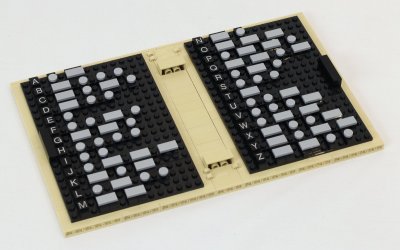
Icing on the cake, [Jason] even built a Morse reference book, done appropriately in 100% LEGO.

Hackaday loves innovative LEGO projects, like this game-playing robot and this LEGO exoskeleton.

Continue reading “Mindstorms Morse Key Writes To Drawbot”

A Bright Idea For Reflow Soldering

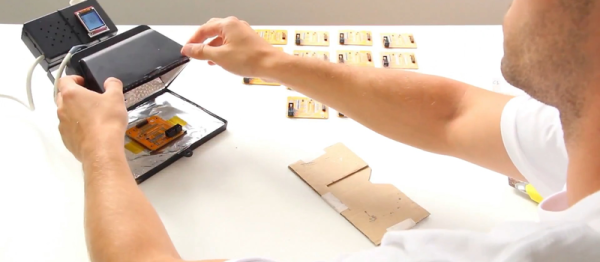
There are almost as many ways to reflow a surface-mount circuit board as there are hackers. Today, we add another method to the list. [Dasaki] converted a halogen floodlight into an SMT oven, and did so with all the bells and whistles. Check the video below the break.

We’ve actually seen the low-tech version of this hack before, but it’s nothing we would want to use on a daily basis. [Dasaki] needed to get 100 boards done, so it was worth the effort to get it right.

Continue reading “A Bright Idea For Reflow Soldering”

ESP8266 Dev Board Sports Flying Squirrel PCB Art

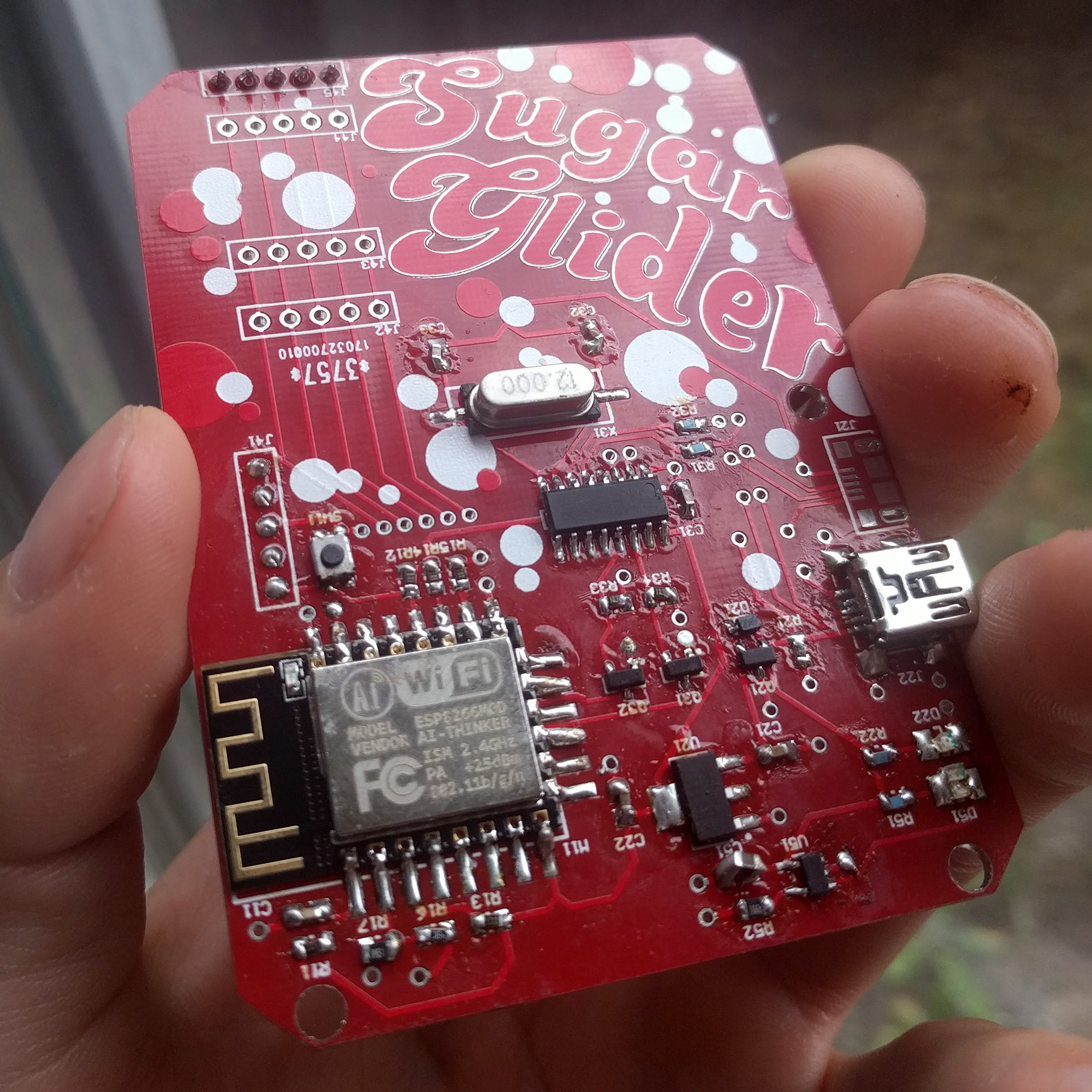
[Jarrett] has a box of Nokia phone batteries and decided to use them in a project. He designed and built WiFi throwies— these consist of ESP8266 WiFi chips attached to custom PCBs and powered by Nokia phone batteries. The board charges LiPoly/Li-Ion batteries over USB with the help of a MCP73831 charger chip and has USB-serial on-board. It’s much more of a powered ESP8266 dev board than a throwie, but we’ll give [Jarrett] the benefit of the doubt.

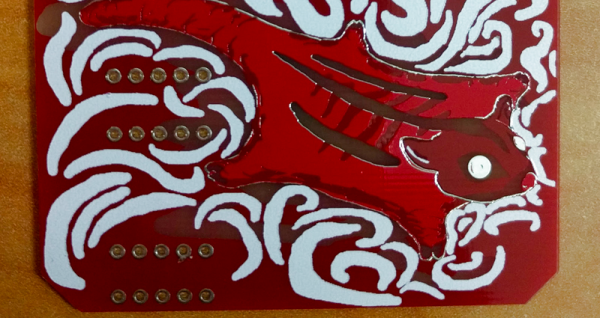
The PCB ended up larger than [Jarrett] would have liked, because of the size requirements of the phone battery connected to it. However, this gave him the canvas to create some fun PCB art. After designing the board he imported the Gerbers into Adobe Photoshop and converted each layer into a monocolor image based on the material of that layer—purple for OSHPark’s stencil mask, beige for DirtyPCB’s FR4, and so on. One challenge [Jarrett] encountered was how to get the art back into Altium Circuit Maker, his layout program of choice. After playing around with different methods for a few days, he wrote a tutorial sharing what he found out.

HaD has covered WiFi throwies before. We also appreciate a beautiful circuit board. Check out our posts on turning PCBs into art and making lapel pins out of circuit board fiberglass.