
Gluing 8192 MCUs Together To Make A GPU

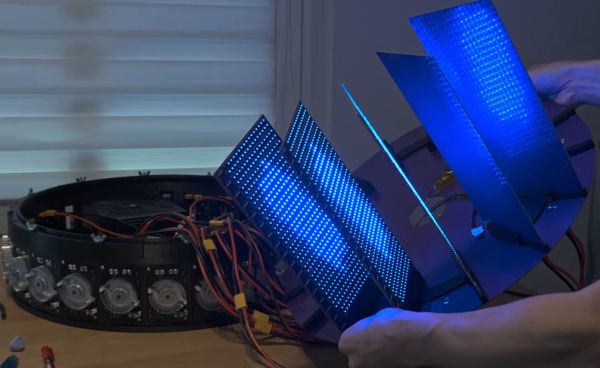
What do you get when you take 8,192 CH570 MCUs, put them on custom PCBs, and write firmware for this interconnected gaggle of cores? In the case of [bitluni]’s project, you get something that’s decidedly cluster-shaped.

These cheap MCUs feature a QingKe 32-bit RISC-V core that’s clocked at a maximum of 100 MHz, with an RV32IMBC instruction set. This means that they support integers, integer multiplication and division, bit manipulation, and compressed instructions, but no atomic, vector, or floating-point instructions.

The basic concept was to use a single MCU per pixel, but once you start scaling up a measly 10 mA and ~$0.10 per MCU to literally tens of thousands of them, you’re suddenly talking about thousands of dollars in hardware as well as a cool 655.36A at 3.3V – or 2 kW –  for something close to QVGA resolution at 320×200. Clearly this would be a rather crazy project to implement, which is why each MCU also got its own RGB LED to immediately create the pixel.
Continue reading “Gluing 8192 MCUs Together To Make A GPU”

He Comes To Bury Segmented Memory, Not To Praise It

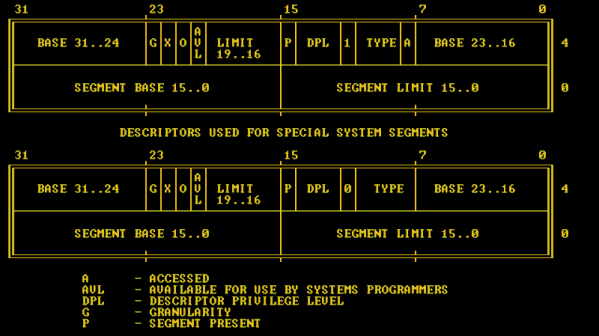
[BillPg] has been designing a fantasy 1980s-era home computer. As part of the exercise, he’s reevaluating all the assumptions that have grown organically over time in the small computer landscape. Hindsight is, so they say, 20/20, but sometimes hindsight can also be colored by modern thinking. Sometimes an idea that seems stupid today made sense in the context of its time. In particular, [Bill] has thoughts on the much-maligned 8086 memory segments.

If you haven’t run into it before, the 8086/8088 had a problem. It wanted to be more or less conceptually software compatible with the 8080 and Z80 computers, which had 16-bit addresses, leading to a limit of 64K of memory. When Intel was designing the next generation of chips, it knew that 64K had to go, but telling developers that code would require huge reengineering was a non-starter. So the idea was to provide multiple 64K spaces broken up into segments.

Continue reading “He Comes To Bury Segmented Memory, Not To Praise It”

Extract Fumes In Midcentury Style With Nixie Tubes And Military Surplus

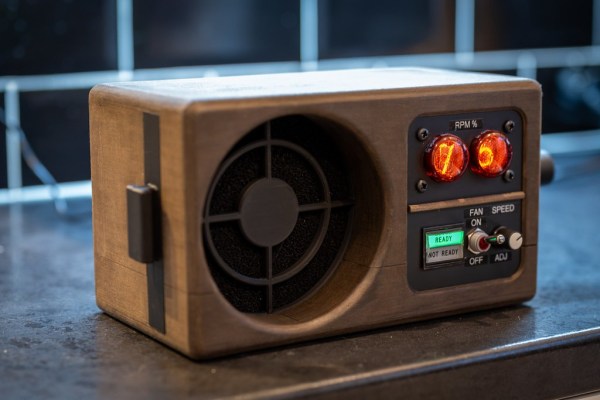
Nobody wants to breathe solder fumes; that’s a given. For most of us, an industrial-looking fan-and-filter made in China and picked up cheap feels like more than enough to keep our lungs clear. Other people, people like [George Conneely], have more refined tastes. Why have a fume extractor when you can have a work of art?

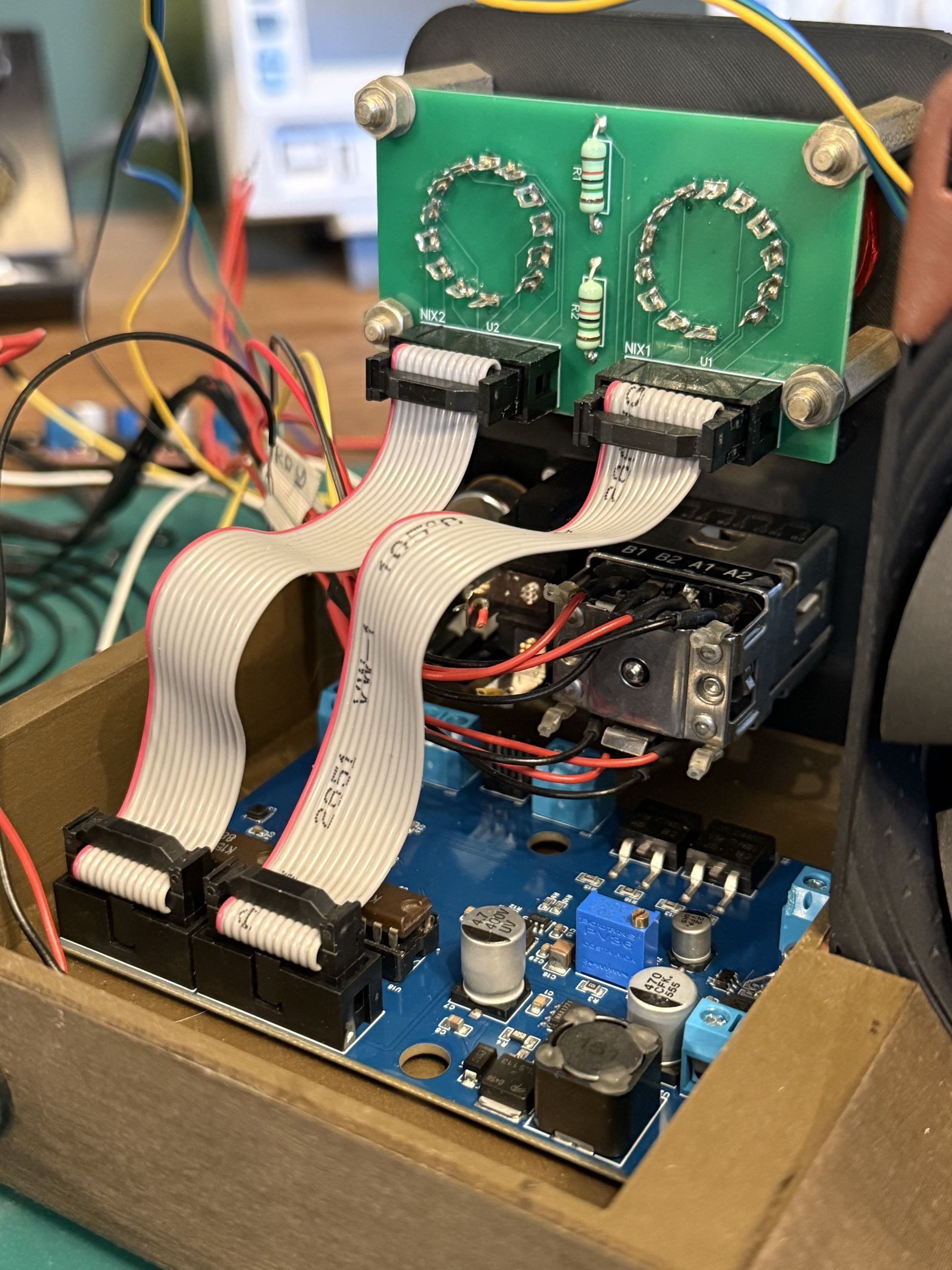
The insides aren’t quite as pretty as the outside, but it’s a clean build.

This is one of those projects where the images really speak for themselves, because the whole point is to be beautiful. Sure, the wooden case is lovingly sculpted by a—wait, it’s 3D-printed!? Yes, with the right stain and care applying it, it seems Wood PLA can fool the eye, or at least the camera. Inside that PLA case there’s a custom PCB with an ATMega microcontroller and some MOSFETS to drive the Nixie tubes. The two digits represent the fan’s set RPM as a percentage of maximum, as is clearly labeled. Using a READY/NOT READY indicator pulled from a Panvia Tornado to show whether the fan has actually spun up to its set speed is an amazing touch.

The only problem with this build is that it is too nice. We’d almost rather see it on Don Draper’s desk than risk dirtying it on a lab bench. Evidently, [George] ascribes to the philosophy that one should surround oneself with beauty whenever possible. Your tastes may differ, but to many, nixie tubes certainly qualify– whether on a desk clock or in a car’s dashboard, there’s just something about that incandescent glow.

Thanks to [George] for the tip.

The Coolest Hat At The Hacker Camp

People in hotter parts of the world may permit themselves a grin at this, but Europeans have recently been suffering under an unseasonal June heatwave. Most of us have been cowering inside with our air conditioners, but not [Making Stuff With Mike]. He’s adapting a safety helmet with a Noctua fan for only slightly uncool on-the-go cooling.

Continue reading “The Coolest Hat At The Hacker Camp”

Hackaday Links Column Banner

Hackaday Links: July 5, 2026

Happy belated July 4th to all the readers from the United States — hopefully you aren’t reading this from a hospital bed after losing a hand or burning off your eyebrows. While we suspect amateur firework shows and their related injuries will be around for many years to come, we did note that many major cities switched over to drone shows this year.

At least on paper, the appeal is obvious. Beyond the fact that drones are safer and quieter than pyrotechnics, they’re also capable of far more complex displays. Good luck trying to draw George Washington’s face in the sky with exploding rockets. But even if it’s a little more than nostalgia, there’s still something about the sights and sounds of fireworks that enthrall audiences. For many, the whole “rockets’ red glare” thing is a bit more meaningful than the “drones’ red LEDs.”

Earlier this week, we brought you news that Sony would stop producing physical PlayStation discs in January 2028. Many gamers are understandably concerned about the long-term implications such a move will have for software ownership, and while the negative reactions online haven’t bothered Sony enough to get them to amend their plans, they have clarified the situation with developers by explaining that games published before the cutoff date aren’t impacted. So if a developer has a hit title that drops in the summer of 2027 and they want to keep cranking out discs, additional orders can still be placed. Not much of a reprieve, but it will give the community a little more time to figure out what comes next.

Continue reading “Hackaday Links: July 5, 2026”

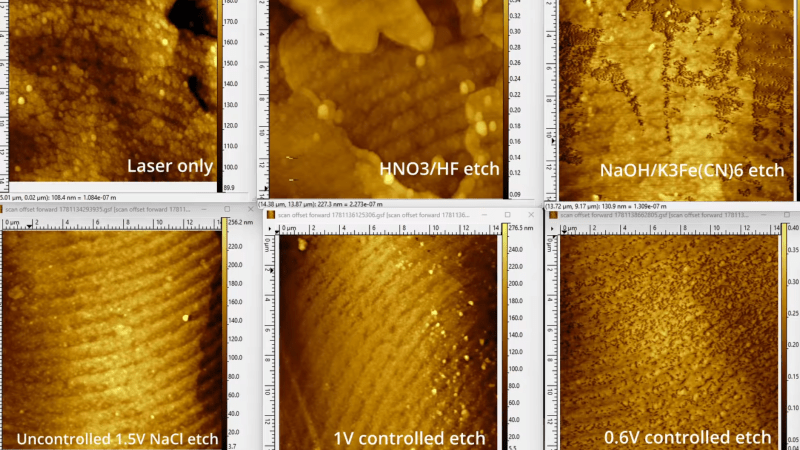
A series of six sepia-tinted micrographs is shown. The images show the surface of a piece of steel after various etching treatments.

Seeing Bacteria, Nanoprisms, And More With An Atomic Force Microscope

Unlike almost every other kind of microscope, atomic-force microscopes (AFMs) don’t use any kind of optical beam to image their subjects. Instead, they physically detect the subject’s surface with a tiny probe, repeating this thousands of times to build up a height map of the subject, sometimes with a resolution below a single nanometer. [Ben Krasnow] got to use an AFM in an investigation of one of his projects, and shared some unusual uses of it in his latest video.

Continue reading “Seeing Bacteria, Nanoprisms, And More With An Atomic Force Microscope”

Demonstrating LFP Battery Safety In Case Of BMS Failure

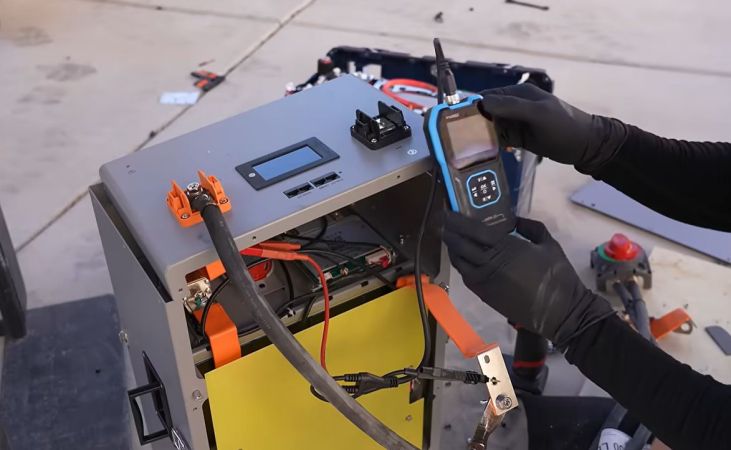
Generally, LiFePO4 (LFP) batteries are quite safe and stable, but it’s still possible for something to go wrong, even something catastrophic, like the battery management system (BMS) developing a direct short. This is one of the tests required to be certified for the UL 2054 standard that targets household and portable battery safety. In a recent series of videos, [Will Prowse] demonstrates how a series of commercial batteries pass these tests, and how some still fail.

Continue reading “Demonstrating LFP Battery Safety In Case Of BMS Failure”