Settling The Debate On Soldered Versus Crimped High-Current Connectors

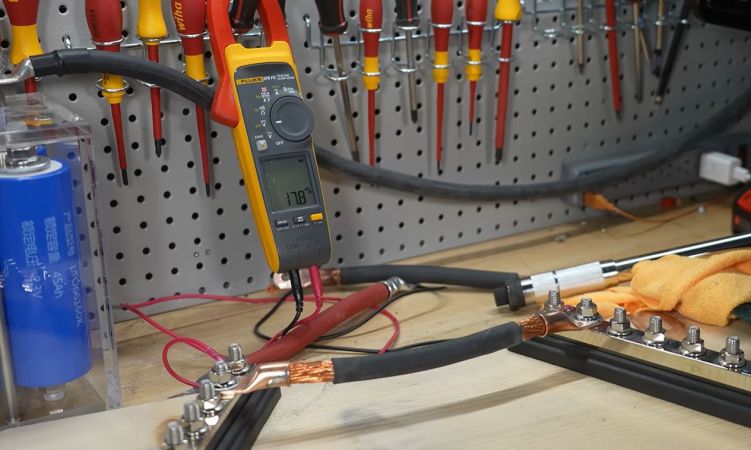
For some reason there’s heated debate around the topic of whether high current carrying wiring ought to use crimped or soldered connections, even though the industry standard is to crimp everything. As a practical demonstration of why this is the case, [Will Prowse] set up a test involving a rig capable of dispensing a few hundred amps through both a crimped and a soldered copper cable.
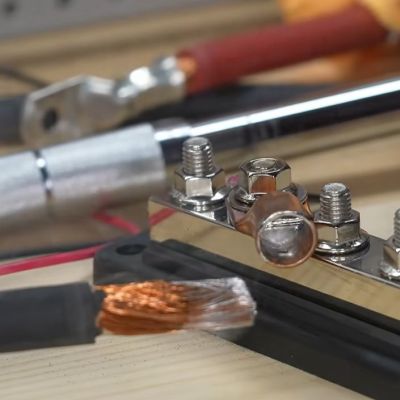
Prior to making things go spicy, [Will] made sure to check the resistance of the two cables, noting that the soldered version had significantly lower resistance than the crimped connectors. This could be one metric that proponents of soldered connectors can point to as a benefit.

Of course, the main benefit of crimping is that you create a cold weld if crimped properly, which is a sold-state welding process that effectively blends two metal surfaces together. This is also why wire wrap is generally considered to be so very reliable, as it creates a gas-free, solid connection that does not rely on a softer, dissimilar material like solder to hold things together. Of note here is also that the cold weld process tends to continue for a while, so this kind of connection is likely to get better over time.

In the subsequent testing this difference is demonstrated quite well, especially when both cables are subjected to the sort of mechanical abuse that would be expected in an installation, such as vibrations and direct impacts. Here the soldered connections quickly begin to fail, resulting in one soldered connector even unsoldering itself due to heat development. Ultimately cold welding is simply superior over relying on a flimsy and capricious interface of intermetallic compounds.

Continue reading “Settling The Debate On Soldered Versus Crimped High-Current Connectors”

Hackaday Podcast Episode 376: Modern Retro Projects, Retro Modern Projects, And The Teen Years For 3D Printing

Hackaday’s Elliot Williams and Al Williams were in a retro mood this week. There was a new ‘486 computer, a new mechanical TV, and a USB stick with a magnetic personality. Can you watch YouTube on a Game Boy? Maybe.

For the can’t miss articles, this week, Elliot and Al reflected on the awkward phase of 3D printers when they transformed from being expensive commercial machines, to where they are now. Meanwhile, Al was interested in how airplanes know how fast they are going. Along the way, there were musical hacks, precision machine tools, and a quantum 8 ball.

Check out the links if you want to follow along, and as always, tell us what you think about this episode in the comments! Or write or record something for our mailbag segment.

Direct download in authentic retro DRM-free MP3.

Continue reading “Hackaday Podcast Episode 376: Modern Retro Projects, Retro Modern Projects, And The Teen Years For 3D Printing”

The Organ That Forgot To Use Transistors

When we think of 1960s synthesizers it’s usual to imagine instruments with vast arrays of controls and patch cables for configuring their many filters, oscillators, and other parameters. They created the templates for much of what we know today as electronic music.

In all the rush to look at full-blown synths though, it’s easy to forget their more mundane cousin, the electric organ. These instruments graced many a ’60s suburban home or church hall, and [Emma Repairs] has an interesting one. It’s a Philips Philicordia, and it’s sent us here at Hackaday down one of those rabbit holes when we should really be writing.

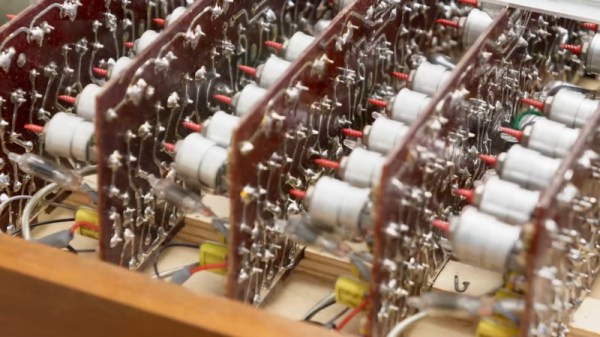
The instrument is a relatively straightforward single voice electric organ on the outside, but under the hood it’s a different matter. In an age when the transistor was revolutionizing electronic music, the folks in Eindhoven designed this one using tubes. There are a set of conventional enough tubes performing the role of amplifiers and oscillators, but the real party piece of this unit is the array of neon tube dividers. A neon bulb can be used as a switching element, and in those days when affordable digital logic chips were several years away, it made sense to use them in digital circuits.

The inside of the Philicordia is a feast of vintage Philips parts that will be instantly familiar to anyone who’s worked on Western European electronics of this era. The exterior design of the instrument screams understated early-1960s cool, and after she’s introduced it you can hear her playing it in the video below. Further down that rabbit hole we found that one of these instruments provided the distinctive organ sound on Chris Montez’s 1962 hit Let’s Dance, so they weren’t all uncool.

Continue reading “The Organ That Forgot To Use Transistors”

This Week In Security: Windows 10 Gets Another Year, SmartTV Botnets, Hiding Payloads, And LastPass Customer Leak

Unsurprisingly to many of us, app stores for smart televisions are also trash. Perhaps even more full of trash than other app stores due to the smaller ecosystem and fewer reviewers.

Spur analyzed the LG smart TV app store, and found that almost half of the apps available contain proxy software, turning your TV into a node in their proxy network. Are these apps malware? Many of the analyzed apps provided a thin veneer of user consent: they offer you the tradeoff of seeing an ad every 15 seconds, or allowing their “occasional web indexing” to run permanently in the background. Watch the fishtank app for five minutes, join their proxy network for life.

Spur notes that the proxy SDK in use appears to block connections to private network ranges (internal IP ranges like 192.168.x.x and 10.x.x.x), but that the SDK restricting access to those ranges is the only protection against accessing whatever network the TV is connected to.

Amazon and Roku ban proxy apps on their devices. Samsung and LG do not.

Win 10 Security Updates Extended

Microsoft has added another year of security updates to Windows 10. Despite trying to kill the platform, so many users remain on Windows 10 that Microsoft likely has no choice.

The extended support program was previously due to end in October 2026 but has now been pushed to October 2027. The security updates will be available for free in the UI, but users in other regions must activate OneDrive and sync system settings, or pay 1000 Microsoft credits (about $30).

The death of Windows 10 is near, but for those unwilling or unable to let go, it shuffles along.

Signal Phishing Attempts

Bleeping Computer has an article about increased phishing attempts from hacker groups in Russia targeting Signal users.

The phishing messages target politicians, government officials, military, and other high-profile intelligence targets, and claim that Signal is introducing mandatory two-factor authentication, before prompting the target to enable remote Signal backups. A second follow-up phishing attempt then prompts the user to copy the backup authentication tokens from Signal and provide them to the attacker.

Signal remote backups are a relatively recent addition to the messenger, making a backup on the Signal servers of a users messages and images, encrypted with a key known only to the user. While convenient, and likely fundamentally secure given the track record of the Signal team, this phishing campaign highlights a major weakness: once private content is accessible somewhere else, an attacker simply needs to obtain the keys to access it, which is significantly simpler than obtaining the message content directly from the victims phone.

Continue reading “This Week In Security: Windows 10 Gets Another Year, SmartTV Botnets, Hiding Payloads, And LastPass Customer Leak”

Godot’s New Contributing Policy Adds Barriers For AI Slop

Like so many large and popular open source projects these days, the Godot game engine struggles with an influx of pull requests. The situation has become increasingly dire due to the advent of AI-generated code. More specifically, the issue involves the inverse relationship between PR code quality and the number of PRs, which wastes a lot of time on the side of a limited number of (volunteer) reviewers. This has now forced the project to update its contribution policy.

An interesting point raised in the announcement article is that of the demoralizing effect of AI-generated PRs on reviewers. Often the human behind such a PR isn’t interested in being educated, or may even be an automated agent which isn’t capable of productive discussion on pros and cons of certain coding approaches — never mind in becoming a more permanent maintainer for the project.

This problem has led to new rules being instated, which include a ban on autonomous AI agents and vibe coding, a ban on substantial AI generating of code, and a ban on AI-generated text in human-to-human communication. It also codifies the requirement that all PRs are to be reviewed and approved by a human being before merging.

In many ways this new policy is similar to that of the Mesa project, which demands code comprehension on the side of the submitter, although it doesn’t go as far as NetBSD, which just outright treats LLM-generated code as ‘tainted’ due to potential licensing and other concerns. Other projects like the Linux kernel opt to make the human submitter responsible for any AI tool usage by forcing them to declare it.

Meanwhile there are also indications that such ‘AI tool’ usage is reducing useful interactions with open source projects. What the future will bring here remains to be seen, but at least as far as open source projects go these tools are clearly increasingly being banished.

Modern E-Ink Dashboards, Kindle And Otherwise

People have been attempting to turn Kindles into more than e-readers since the first devices came out nearly two decades ago. The e-ink displays are low-power and great for displaying information that doesn’t refresh too often, and with Amazon continuing their trend of bricking their older devices there will be more of these devices available. [Hemant] built a weather dashboard with one of his, but since then had requests for other types of e-reader dashboards and has a guide for making more general-purpose use of an old Kindle.

The first approaches outlined here involve the installation of a dashboard client on the Kindle and pointing it at a server that hosts a PNG image of whatever information needs to be displayed. The client simply displays that image and refreshes it at predetermined intervals. There are a number of options for creating that server as well, including using Home Assistant for those who already have a home automation system deployed. The benefit of using Home Assistant is that it’s much more straightforward to gather data for the dashboards from sensors and other peripherals that are already installed.

Installing a client like this might seem straightforward, and it can be, provided that the Kindle involved is jailbroken or capable of being jailbroken. An Amazon update recently broke many modern devices’ ability to execute the jailbreak, so not every Kindle can do this anymore. But [Hemant] goes into detail about this and also outlines some methods for using generic e-ink displays instead, and also dives into the hardware and software behind building a server to host the dashboard images for those without Home Assistant already running. It’s a great overview for those who have always wanted something like this but never knew where to start.

Porting The Legend Of Zelda: Twilight Princess To The 3DS

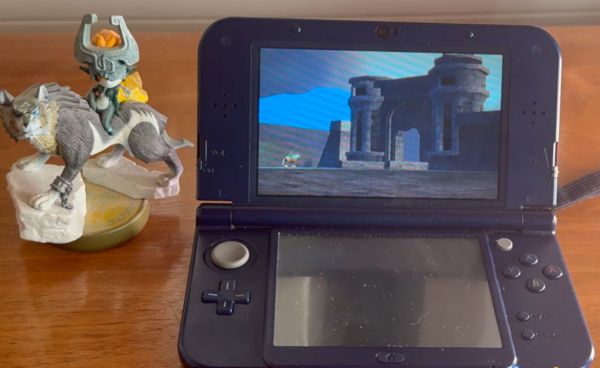
After the Nintendo 3DS saw various Nintendo 64-era titles like Super Mario 64Ocarina of Time and Majora’s Mask ported to it, there was a lot of speculation that the GameCube/Wii title of Twilight Princess might soon make its way to this handheld gaming system too. Unfortunately no official release happened, but with the recently decompiled source code of the game in hand, [Tobi] set out to see whether such a port was realistic.

Compared to the somewhat scruffy Nintendo DS and DSi handhelds, the 3DS hardware is decidedly more beefy, both in the processor department as well as in terms of RAM with 128 MB of FCRAM (Fast Cycle DRAM). This puts it within batting distance of the game’s original two consoles.

In the video the current status of the porting effort is demonstrated, with the game actually running surprisingly well despite the early state of the porting project. Even with the rather impressive graphical glitches and overall instability that one would expect at this early stage, the game is essentially already playable.

As noted by [Tobi], the next steps will involve fixing these bugs and above all actually optimizing the so far quick-and-sloppy port. Along with the possibility of actually having Twilight Princess rendered in 3D, this is a rather exciting development that demonstrates that an official version of the game for the 3DS would have been easily possible.

Continue reading “Porting The Legend Of Zelda: Twilight Princess To The 3DS”