A MiniDisc Walkman, a MiniDisc and a pair of BlueTooth earphones

Wireless MiniDisc Walkman Has Bluetooth Inside

For most people, MiniDisc is just one of countless media formats that became obsolete when music went online. Not so for MiniDisc enthusiasts, many of whom still use a MiniDisc deck at home and a MiniDisc Walkman on the go. Unfortunately, high-end headphones these days often come with Bluetooth connectivity only, necessitating the use of clunky signal converters that ruin the tidy compactness of those portable players. [Daniel Rojas] cleverly solved this problem by directly adding Bluetooth functionality to a Sony MZ-R500 MiniDisc Walkman.

MiniDisc Walkmen are famously compact devices, so adding a full circuit board to one wasn’t easy. [Daniel] managed to squeeze the PCB from a Schosche wireless audio transmitter inside the front of the Walkman, next to the control buttons. He connected the audio signal to the transmitter’s input and rewired the little-used “End Search” button to become the “Pair” button. Sadly, the recording head and some associated hardware had to be removed in order to make space for the new component, turning the Walkman into a playback-only device.

A MiniDisc Walkman, opened up and showing a BlueTooth module inside
Lots of flying wires and Kapton tape, but it all fits.

The project’s GitHub page contains a detailed walk-through of the modification process that should enable anyone to reproduce the end result. [Daniel] didn’t arrive at the optimal solution in one go however, and he describes the three major revisions of his project in separate sections. In the first iteration for example, the Bluetooth module caused interference on the audio signal, which [Daniel] solved by adding isolation transformers in version two. He also includes a page full of technical information he collected during his project, which will come in handy if you ever want to perform other modifications on your MiniDisc Walkman.

We’ve seen several impressive projects where Bluetooth interfaces were added to pre-Bluetooth gadgets, ranging from tube radios to 8-track players. Some, like the iPod Nano, are even more space-constrained than a MiniDisc Walkman. Continue reading “Wireless MiniDisc Walkman Has Bluetooth Inside”

Opening A Safe With A Stepper Motor And DIY Auto-Dialer

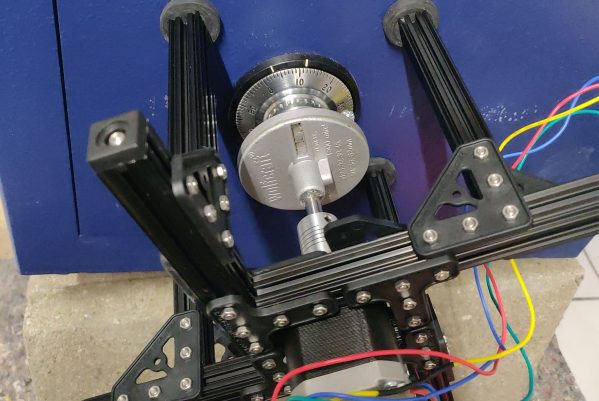
What do you do when you happen to come into possession of a safe of which the combination is lost to the sands of time? If you’re someone like [eNBeWe], you grab a stepper motor with driver module you had lying around gathering dust, an ESP8266 for the brains and a few other pieces to build your very own auto-dialer to crack that safe combination. The software has been made available on GitHub for those interested.

While other auto-dialers used with the fun hobby of safe cracking can generally find the combination in a matter of hours if not less, it took [eNBeWe]’s contraption two days to crack the combination. Much of this was due to the hacked together nature of the structure, with the glue joints among other weak points that’d probably not take too kindly to a lot of abuse. Since there was no particular rush to get into the safe, this worked out fine.

As an impromptu auto-dialer thrown together with parts that were lying around it seemed to perform just fine for the task, and we presume that this is the beginning of a beautiful new lock- and safe-picking hobby.

Continue reading “Opening A Safe With A Stepper Motor And DIY Auto-Dialer”

A montage of a "death stranding" lamp in two different color modes, purple on the left and blue on the right

Illuminate Your Benched Things With This Death Stranding Lamp

[Pinkman] creates a smart RGB table lamp based off of the “Odradek device” robot arm from the video game “Death Stranding”.

[Pinkman] adds a XIAO BLE nRF52840 Sense device, with Bluetooth support, microphone and TinyML capability. The nRF52840 is used to push data to the five WS2812 strips, one for each “blade” of the lamp, and also connects to a TTP223 capacitive touch controller to add touch input detection. The TinyML portion of the nRF52840 allows for custom keyword training to turn on the lamp with voice commands ([Pinkman] uses “Bling Bling”). [Pinkman] has also provided Bluetooth control, allowing the color and pattern to be changed from a phone application.

The lamp is 3D printed with the build being based off of [Nils Kal]’s Printables files. Each of the five blades has a white 3D-printed diffusor plate to help ease out the hot spots for the LED strip. The lamp is fully adjustable in addition to having cavities, channels and access points for “invisible” wiring. [Pinkman] has also upgraded the original 3D files to allow for the three wires needed to drive the WS2812, instead of the two wires that [Nils] had allotted in the original.

[Pinkman] has all of the code, STL files and training data available for download, so be sure to check it out. Lamps are a favorite of ours and we’ve featured our fair share, including 3D printed Shoji lamps and RGB wall lamps.

Video after the break!

Continue reading “Illuminate Your Benched Things With This Death Stranding Lamp”

The Voice Of ChatGPT Is Now On The Air

AIs can now apparently carry on a passable conversation, depending on what you classify as passable conversation. The quality of your local pub’s banter aside, an AI stuck in a text box doesn’t have much of a living quality. human. An AI that holds a conversation aloud, though, is another thing entirely. [William Franzin] has whipped up just that on amateur radio.  (Video, embedded below.)

The concept is straightforward, if convoluted. A DSTAR digital voice transmission is received, which is then transcoded to regular digital audio. The audio then goes through a voice recognition engine, and that is used as a question for a ChatGPT AI. The AI’s output is then fed to a text-to-speech engine, and it speaks back with its own voice over the airwaves.

[William] demonstrates the system, keying up a transmitter to ask the AI how to get an amateur radio licence. He gets a pretty comprehensive reply in return.

The result is that radio amateurs can call in to ChatGPT with questions, and can receive actual spoken responses from the AI. We can imagine within the next month, AIs will be chatting it up all over the airwaves with similar setups. After all, a few robots could only add more diversity to the already rich and varied ham radio community. Video after the break.

Continue reading “The Voice Of ChatGPT Is Now On The Air”

Creative Vandalism The KITT Way

It’s probable that most of us have at some time dreamed up a witty and subversive way to deface our city, but that few of us will have followed through on the idea. [Matt Gray] then is something of a modern-day urban hero for doing just that. Who couldn’t walk past Knightrider Court, EC4, in the City of London, without thinking of the 1980s TV series featuring David Hasselhoff and a talking car? [Matt] couldn’t, and so of course he simply had to upgrade the street sign with the signature LED scanner.

At its heart is an Adafruit Gemma ATtiny85 board in a 3D-printed case attached to a length of aluminium extrusion holding a strip of addressable LEDs. When attached to the sign it looks the business, and while the late-night crowd showed it little interest the Londoners passing in the morning were much more enthusiastic. We applaud him for the idea.

As occasional students of medieval history here at Hackaday, of course we couldn’t let this go without asking where the unexpected London street name came from. Sadly for fans of the Hoff it has nothing to do with the small screen, instead it appears to have a much earlier origin having been first recorded in 1322. The knightriders in question are reputed to have been real medieval knights, or at least horsemen. Pay it a visit, should you ever find yourself in the British capital.

Continue reading “Creative Vandalism The KITT Way”

3D-Printed Servo Motor Has 360 Degrees Of Rotation

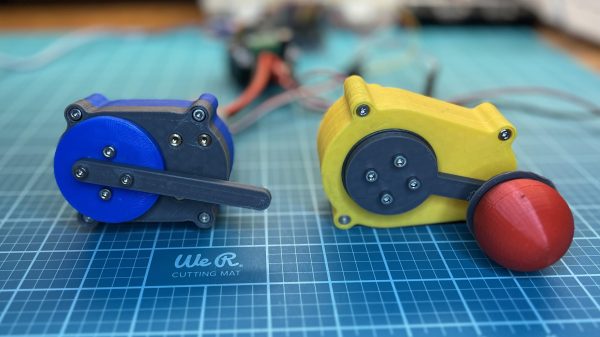
Hobby servos are nifty and useful for a wide range of projects. There’s nothing stopping you from building your own servos though, and you can even give them nifty features like 360-degree rotation In fact, that’s exactly what [Aaed Musa] did!

The servo relies on 3D printed gears in a 3D printed housing. The design makes prodigious use of threaded inserts to hold everything together nice and tight. A DC motor is charged with driving the assembly, as with any regular servo motor. However, in the place of a potentiometer, this design instead uses an AS5600 magnetic rotary position sensor to read the servo’s angle, via a magnet mounted in the servo’s gear. An Arduino is used to determine the servo’s current position versus the desired position, and it turns the motor accordingly with a BTS7960 motor driver.

The result is a sizeable and capable servo with an easily-customizable output, given it’s all 3D printed. If you’d rather just mod some servos instead, we’ve covered some great work in that area, too. Video after the break.

Continue reading “3D-Printed Servo Motor Has 360 Degrees Of Rotation”

An Atomic Pendulum Clock Accurate Enough For CERN

That big grandfather clock in the library might be an impressive piece of mechanical ingenuity, and an even better example of fine cabinetry, but we’d expect that the accuracy of a pendulum timepiece would be limited to a sizable fraction of a minute per day. Unless, of course, you work at CERN and built  “the most accurate pendulum clock on the planet.”

While we’re in no position to judge [Daniel Valuch]’s claim, we’re certainly inclined to believe him, mainly because the 1950s-era Czechoslovakian pendulum clock his project was based on, the Elektročas HH3, was built specifically as a master clock for labs, power plants, and broadcast use. The pendulum of this mid-century beauty is made of the alloy invar, selected for its exceptionally low coefficient of thermal expansion. This ensures the pendulum doesn’t change length with temperature, but it still only brings the clock into the 0.1 second/day range.

Clearly that’s not good enough for a clock at CERN, the European Laboratory for Nuclear Research, where [Daniel] works as an RF engineer. With access to a 10-MHz timebase from a cesium fountain atomic clock — no less a clock than the one that’s used to define the SI second, by the way — [Daniel] looked for ways to sync the clock up to it. Now, we know what you’re thinking — he must have used some kind of PLL to give an electromagnetic “kick” to the bob to trim the pendulum’s period. Good guess on the PLL, but the trimming method is a little cruder — [Daniel] uses a stepper motor attached to the clock’s frame to pay out or retract a length of fine chain into a cardboard dish attached to the pendulum’s rod. The change in mass changes the pendulum’s center of gravity, which changes its effective length, and allows the clock to be tuned a couple of seconds per day.

It seems like [Daniel] is claiming that his chain-corrected clock won’t drift more than a second from the cesium clock for 158 million years. Again, we’ll take his word for it, but it’s a wonderfully ad hoc approach to tuning the clock, and we appreciate its simplicity.