UCompute Junior Is An Easy Entry To The Embedded Platform

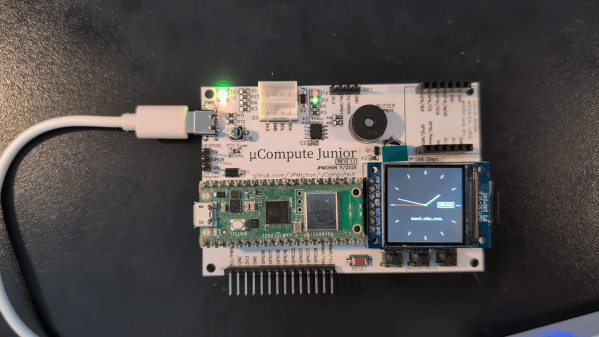
[JP Michon] has long been working on a bit of a modular microcontroller hardware platform, and it goes by the name of uCompute. The latest entry in this series is the uCompute Junior, which offers plenty of functionality in a compact form factor.

[JP Michon] calls this the “Bring Your Own Pico” version of the uCompute design, because it’s intended that you’ll grab your own microcontroller and drop it in to the Junior carrier board. For flexibility, it’s designed to work with the Raspberry Pi Pico, Pico W, Pico 2, and Pico 2W. This version is optimized for accessibility, being easier to hand solder than some of the earlier boards in the lineup.

As is common across the various uCompute boards [JP Michon] has built thus far, the main interface is a small LCD or OLED screen along with three tactile buttons for control; you can use an ST7789 or an SSD1306 display as you like. There’s an onboard micro SD card slot, useful for storage or data logging, as well as a CAT24 EEPROM chip on I2C. There’s also an onboard piezo buzzer for sound output.

As far as upgrades go, the add-on module socket supports a range of hardware. You can drop in an ESP12F for WiFi, an NRF24L01 or RFM95W LoRa radio, or a W5500 Ethernet module if so desired. There’s also a dedicated header for driving NeoPixels/WS2812B LEDs, too.

If you’re looking to tinker with the Pi Pico lineup and you want a neat board to drop them into, this might be right up your alley. Consider also taking a look at some of the other wonderful things the Pi Pico can do. Continue reading “UCompute Junior Is An Easy Entry To The Embedded Platform” →

This Week In Security: Federal Breaches, Leaky AI Routers, PhpAfterShell, Bluetooth Trailer Brakes

The CIA and the Office of the Director of National Intelligence have discovered a breach of an unclassified system used for open-source intelligence: the analysis of news reports, social media, and other public or commercially available data. According to Nextgov, and the New York Times who first reported it on Tuesday, the breach disrupted an unclassified network but didn’t touch classified systems, and the matter has “been resolved”. Nobody has officially said who was responsible, or whether any data was taken, though people familiar with the investigation say early indicators point to China, according to The Decoder‘s summary of the Times and CNN reporting. The Times also reported that the National Geospatial-Intelligence Agency was affected at the same time.

Unclassified doesn’t mean unimportant. As Huntress’ Ben Bernstein told Nextgov, “If you can see what analysts are searching for and what topics they’re tracking, you get a solid look at U.S. intelligence priorities and blind spots without ever touching a classified file.” Nextgov reports that ARTEX, the AI-driven attack framework the FBI warned about last week, is believed to have been used in the breach, and its sources say it was also used in a separate, low-impact intrusion into the Defense Department’s Cyber Defense Command.

Apparently, November 2026 is going to be “that kind of month”. The FBI is investigating a hack of the National Crime Information Center, the Agriculture Department told employees that hackers had accessed the system it uses to make payments to farmers, and the Treasury’s Financial Crimes Enforcement Network is investigating “unauthorized access to a limited subset of its systems,” and has taken some systems offline. At the state level, Colorado says an attack on its myColorado app, which has 2.1 million users and handles digital IDs and state services, likely exposed data on nearly 150,000 people, and the app is still offline heading into Thanksgiving.

Nothing points yet to the outages being a coordinated attack: This might just be the new normal of AI developed exploits, attack frameworks, and fragile patches. I’m not sure if that’s supposed to be reassuring. If you’re staring at a dead service and wondering whether it’s hackers, WIRED has a guide to telling whether an outage is a cyberattack. (Hint: usually not.)

Continue reading “This Week In Security: Federal Breaches, Leaky AI Routers, PhpAfterShell, Bluetooth Trailer Brakes” →

Classic Pokemon Goes Widescreen

There are a great many handheld gaming platforms on the market these days, many of which are specifically designed for emulating old console games. They can be a great way to play old Pokemon titles, except for the fact that the aspect ratio of the classic games seldom suits the modern widescreen displays these handhelds use. PokeDaisy aims to fix that.

PokeDaisy is designed for playing all the Pokemon games from the Game Boy, Game Boy Color, Game Boy Advance, and the Nintendo DS on on a wide array of modern devices — from your Windows or Linux computer and Android smartphone, all the way to the Steam Deck and homebrew-capable Nintendo 3DS. The trick is that it runs a companion tool that hooks into the game, that displays lots of useful data like your party, inventory, and the overworld map. There’s even a special tool for tracking your Nuzlocke run, if you’re so inclined. So far, so useful.

Where things get really cool, though, is in the Generation III games from the Game Boy Advance, along with original Game Boy titles. The EXPAND tool manages to scrape the overworld of the game and extend the 240 x 160 display to the edges of your screen. Instead of playing in a pillar-boxed 4:3 format, you enjoy the game in a layout that better suits modern devices.

Files are on GitHub for the curious. We’ve featured some other fun Pokemon hacks before, too.

Continue reading “Classic Pokemon Goes Widescreen” →

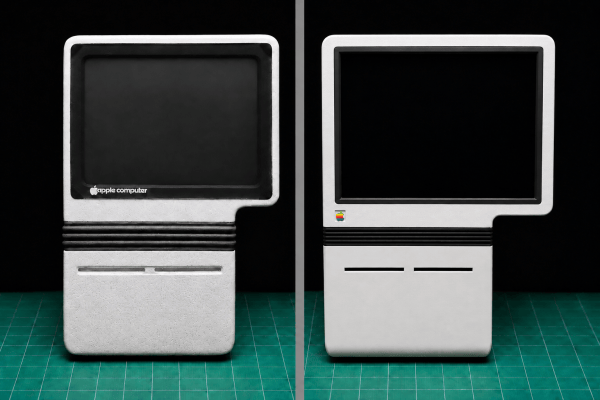
Two images of similar all-in-one computers side-by-side. They each are sitting on a green cutting mat with a pedestal with two black slits below a slightly wider screen mounted at the top. It is lined up on the left side with the pedestal, but the right edge of the screen is floating over space. The left image has a white apple logo and the text "Apple Computer" on the screen bezel while the device on the right has the rainbow Apple logo and no text.

The Happy Mac That Apple Never Made

The plethora of different machines available in the 80s are one of the things that makes retrocomputing fun, but sometimes we run across ideas that never quite made it to production that are also worth a look. [wottle] wanted to reexamine some early designs investigated by Apple with the Frog Design “Happy” Mac.

In 1982, Apple contracted Frog Design to develop a new design language for their products. The eight non-functional “Snow White” concepts ranged from mild to wild, but most never saw the light of day, despite influencing most Apple products in the late 80s. [wottle] chose the LisaEm Lisa emulator as the interface for the device to give it a period-correct OS.

The machine uses a Raspberry Pi 5 coupled to the LCD panel from an iPad 3 or 4, giving it a slimmer silhouette than the original concept as it would have been limited by the CRT technology of the time. Steel bar ballast in the base of the 3D printed enclosure keep the device stable. The current build is lacking built-in sound or an external power button, so there’s still some room for improvement.

If you are interested in the ill-fated Lisa, we’ve discussed it before, the open sourcing of its code, as well as seen it resurrected on an FPGA. We’ve also seen the Apple Jonathan concept that showed promise, but didn’t make it to production either.

A Modular 6502 Computer

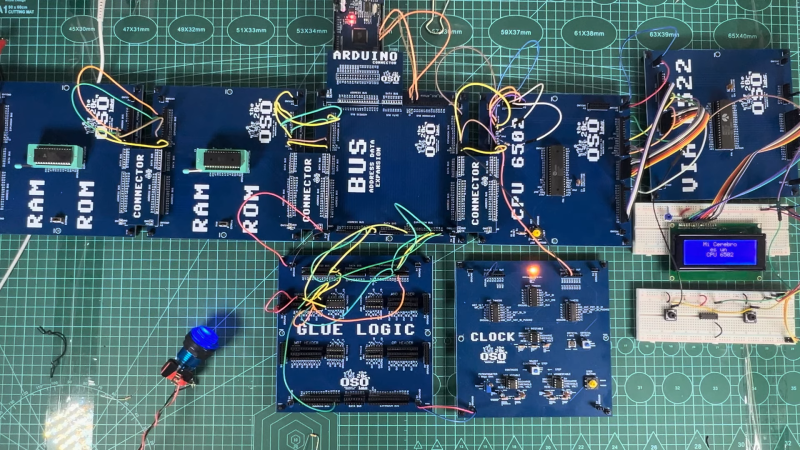
Back in the day, there were plenty of nice compact microcomputers out there that featured the 6502 CPU. There were also simpler computers that put the chip on a bare board and put you very closer to the bare metal. The 20c from [osolabs] is a bit more like that, but with a unique and appealing modular design.

At its heart, the 20c is a learning platform. The hardware is built out of interchangeable modules that each correspond to a key part of the computer’s architecture. There are swappable CPU modules for the 6502 or different variants like the 6510 and 8502, as well as ROM, RAM, and address and data bus modules. There are also modules for the clock, glue logic, and even I/O subsystems like the Commodore PIA, VIA, and CIA. Bits and pieces can be assembled and swapped in and out at will to build a different character of machine and learn about different hardware and the architecture as a whole.

If you’re wanting to get to grips with how computers work at the very low level, the 6502 and the 20c are a great place to start. Design files are on Github for the curious. You might want to take a look at a guide on 6502 assembly to get you started, too. If you’ve been cooking up similar homebrew computers in the lab, don’t hesitate to let us know on the tipsline. Video after the break.

Continue reading “A Modular 6502 Computer” →

When Decoupling Capacitors Go Wrong

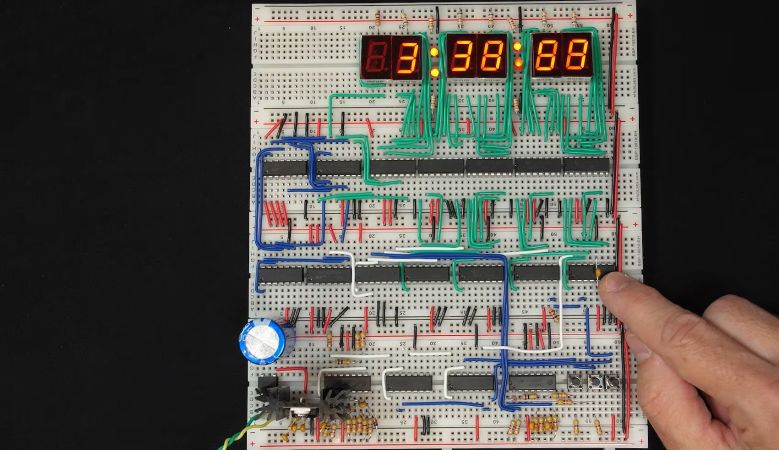
Popular wisdom holds that decoupling capacitors are good, and thus more decoupling capacitors is better. Unfortunately physics disagrees on that notion, as [Ben Eater] discusses in a recent video, following feedback from a viewer who found that upon adding said capacitors, their supply rail got unstable and began oscillating.

After reproducing the issue, [Ben] set to work trying to understand what was going on and why the oscillation was happening. Ultimately it was deduced that the large electrolytic capacitor on the output of the 7805 5V regulator was missing a straight ground path to said regulator. By having the ground thus take a circuitous loop through a large section of wiring and segments of the breadboard a lot of induction was introduced.

The effort is similar to a tank circuit, where an inductor-capacitor combination creates a resonance that can be really useful if it’s intentional. In this case it merely served to introduce a lot of noise on the supply lines which got amplified by the decoupling capacitors placed near the ICs.

In short, this is why you must always put  input and output capacitors as close as possible to your voltage regulators, with in this particular case one ground wire between the regulator and the electrolytic capacitor’s ground fixing the decoupling issue.

Continue reading “When Decoupling Capacitors Go Wrong” →

Diagnosing A Failed LG Fridge Ice Maker

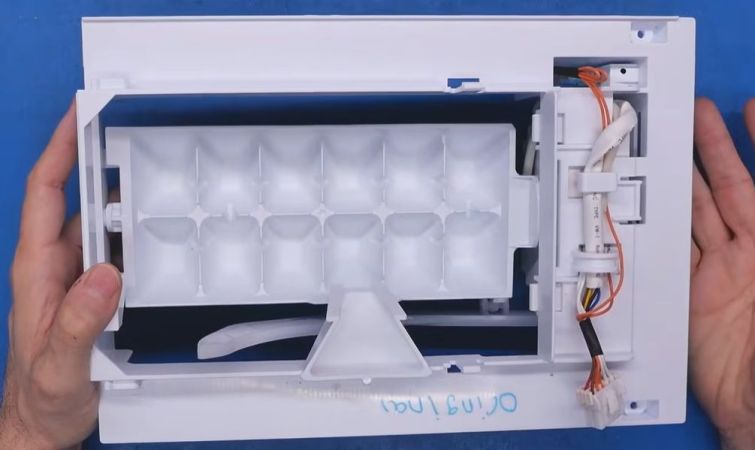
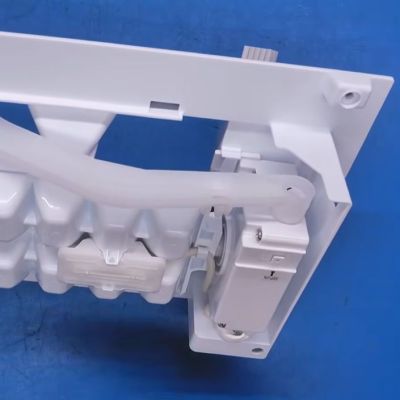
Although a useful feature for people who use ice cubes a lot, an automatic ice cube maker feature in a refrigerator can be a bit of a pain if they stop working properly. In the case of [Adrian]’s LG fridge its ice maker began to overfill the internal tray, causing cubes to freeze together and ultimately the entire mechanism to stop producing cubes. In his diagnostics video he goes over the way the mechanism works, how it interacts with the control board in the fridge and a lot of puzzlement over a new tray fixing the issue with no clear cause.

Bottom of the tray with the temperature sensor and feeler arm.

The most bemusing aspect of this mechanism is probably that the water filling mechanism is an open loop system that only has a timer, a temperature sensor and a feeler arm for the ice bucket. The timer’s duration is settable  using dip switches depending on the water pressure at the installation site. After swapping out the control board [Adrian] found that this made no difference to the problem of it working fine for a few cycles until it started overfilling the tray again.

In the comment section [Jeffrey Hullekes] seems to be on point with his theory that one or more ice cubes simply do not dislodge from the tray, which is not detected by the fill mechanism that thus happily keeps filling for the same number of seconds. After that the excess water then helps to worsen the problem until it’s all one frozen block of water.

With the mechanism having no way to detect fill level, stuck cubes or other issues, it would seem that the smoothness of the tray’s plastic is a load-bearing part of the whole system. Perhaps that spraying on some kind of release film will provide a fix here, as also suggested in the comments, but overall it’s an interesting cost-optimized mechanism that works well for a ‘just buy a replacement unit’ mindset.

Continue reading “Diagnosing A Failed LG Fridge Ice Maker” →