Hacked AC Window Unit Split In Half To Cool The Garage

It’s getting into the hot summer months for those of us in the Northern Hemisphere, and for many Hackaday readers, that means its time to get the old window air conditioner out of storage and lug it back into position. But what if you’re trying to cool a space that doesn’t have a convenient window? In that case, this clever conversion that [Infrared] came up with to keep his garage cool might be of interest.

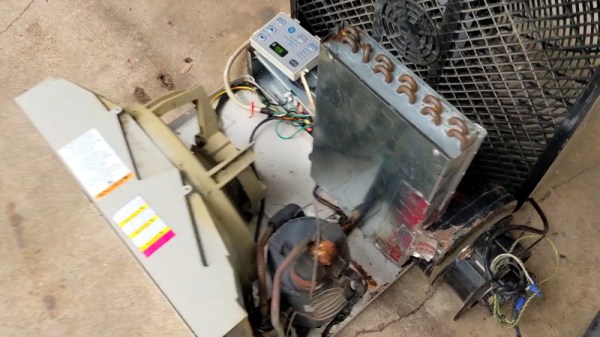
Basically, he’s taken the classic window AC and turned it into an impromptu ductless unit. By rotating the evaporator coils into a vertical position and lengthening the compressor wires, he was able to make the center of the AC thin enough that he could close his garage door over it. The back of the unit looks largely untouched, but the front side has a real Mad Max vibe going on; with sheet metal, exposed wiring, and a couple of fans thrown in for good measure. Fine for the garage or workspace, but probably not a great choice for the kid’s room.

[Infrared] says the hacked up AC can get his garage 18 degrees cooler than the outside air temperature in its current form, but he hopes the addition of some high CFM computer fans will not only improve performance, but let him make the new front panel look a bit neater. Though even in its current form, this is far from the most ridiculous DIY AC project we’ve seen in recent memory.

Continue reading “Hacked AC Window Unit Split In Half To Cool The Garage”

Fat Tire Bike Turned Hubless

Bicycle wheels have looked pretty much the same for over a century, and for very good reason: It works. [The Q] decided to ignore reason for a bit and focus on looks, so he built a fat tire bike without any hubs or spokes.

To make this work, he fabricated two sets of ring shaped “hubs” about the size of the rims, with a series of ball bearings around the circumference for the rims to roll around. The original forks were cut short and welded to a set of brackets that bolt to new hubs. This further complicates the back end as there’s nowhere to attach the sprocket cassette. The original rear hub, cassette and disc brake was moved to the inside of the frame. This drives the rear wheel using a second chain attached to a large ring sprocket mounted directly on the rim. The front brake was simply eliminated.

While this new design won’t be taking on existing bicycles, we doubt practicality was a priority in the build. It’s definitely a head turner, and we can’t help but see an opportunity to go even further and build a TRON bicycle.

Just recently, [The Q] turned another fat tire bike into an all-wheel-drive extreme off-roader. For another pedal-powered head turner, check out the strandbeest bicycle.

Active Ball Joint Uses Spherical Gear

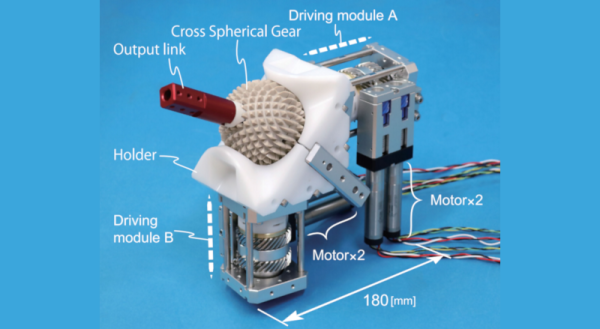
A common CAD operation is to take a 2D shape and extrude it into a 3D shape. But what happens if you take a gear and replicate it along a sphere and then rotate it and do it again? As you can see in the video below, you wind up with a porcupine-like ball that you can transfer power to at nearly any angle. There’s a paper describing this spherical gear as part of an active ball joint mechanism and even if you aren’t mechanically inclined, it is something to see.

The spherical gear — technically a cross spherical gear — is made from PEEK and doesn’t look like it would be that difficult to fabricate. There’s also a simpler version known as a monopole gear in the drive system that provides three degrees of freedom.

Continue reading “Active Ball Joint Uses Spherical Gear”

ISS Gets Roll-Out Solar Panels In Post-Shuttle Fix

Astronauts are currently installing the first of six new solar arrays on the International Space Station (ISS), in a bid to bolster the reduced power generation capability of the original panels which have now been in space for over twenty years. But without the Space Shuttle to haul them into orbit, developing direct replacements for the Stations iconic 34 meter (112 foot) solar “wings” simply wasn’t an option. So NASA has turned to next-generation solar arrays that roll out like a tape measure and are light and compact enough for the SpaceX Dragon to carry them into orbit.

Space Shuttle Atlantis carrying part of the ISS truss.

Considering how integral the Space Shuttle was to its assembly, it’s hardly a surprise that no major modules have been added to the ISS since the fleet of winged spacecraft was retired in 2011. The few small elements that have been installed, such as the new International Docking Adapters and the Nanoracks “Bishop” airlock, have had to fit into the rear unpressurized compartment of the Dragon capsule. While a considerable limitation, NASA had planned for this eventuality, with principle construction of the ISS always intended to conclude upon the retirement of the Shuttle.

But the International Space Station was never supposed to last as long as it has, and some components are starting to show their age. The original solar panels are now more than five years beyond their fifteen year service life, and while they’re still producing sufficient power to keep the Station running in its current configuration, their operational efficiency has dropped considerably with age. So in January NASA announced an ambitious timeline for performing upgrades the space agency believes are necessary to keep up with the ever-increasing energy demands of the orbiting laboratory.

Continue reading “ISS Gets Roll-Out Solar Panels In Post-Shuttle Fix”

Mechanically Multiplexed Flip-Dot

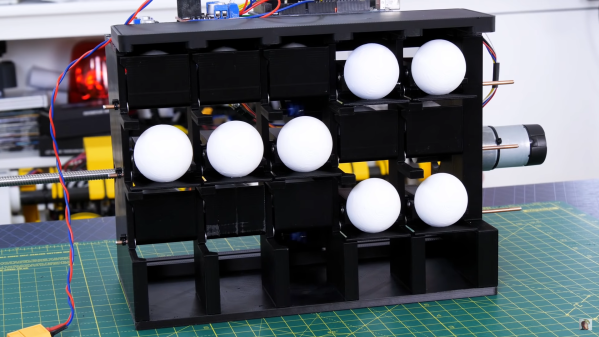
Flip dots displays are timeless classics, but driving the large ones can quickly turn into a major challenge. The electromagnets require a lot of current to operate, and the driver circuits can get quite expensive. [James Bruton] wanted to build his own, but followed a bit of a different route, building a mechanically multiplexed flip dot (ball?) display.

Each of the dots on [James]’ 5×3 proof of concept is a bistable mechanical mechanism that can either show or hide a ping pong ball sized half sphere. Instead of using electromagnets, the dots are flipped by a row of micro servos mounted on a moving carriage behind the display. The mechanism is derived from one of [James]’ previous projects, a mechanical multiplexer. Each dot mechanism has a hook at the back of the mechanism for a servo to push or pull to flip the dot. A major disadvantage of this design is the fact that the servo horn must match the state of the dot before moving through the hook, otherwise it can crash and break something, which also reduces the speed at which the carriage can move.

This build was just to get a feel for the concept, and [James] already has several ideas for changes and improvements. The hook design can certainly change, and a belt drive would really speed things up. We think this mechanical display is a very interesting design challenge, and we are interested to hear how our readers would tackle it? Let us know in the comments below.

Recently we covered a 3D printed flip dot display for the first time. It’s still small and [Larry Builds] is working out the kinks, but we would love to see it eventually match the mesmerising effect of Breakfast’s large installations.

You Can’t Put The Toothpaste Back In The Tube, But It Used To Be Easier

After five years of research, Colgate-Palmolive recently revealed Australia’s first recyclable toothpaste tube. Why is this exciting? They are eager to share the design with the rest of the toothpaste manufacturers and other tube-related industries in an effort to reduce the volume of plastic that ends up in landfills. It may not be as life-saving as seat belts or the Polio vaccine, but the move does bring Volvo and OG mega open-sourcer Jonas Salk to mind.

Today, toothpaste tubes are mostly plastic, but they contain a layer of aluminum that helps it stay flattened and/or rolled up. So far, multi-layer packaging like this isn’t accepted for recycling at most places, at least as far as Australia and the US are concerned. In the US, Tom’s of Maine was making their tubes entirely out of aluminum for better access to recycling, but they have since stopped due to customer backlash.

Although Colgate’s new tubes are still multi-layered, they are 100% HDPE, which makes them recyclable. The new tubes are made up of different thicknesses and grades of HDPE so they can be easily squeezed and rolled up.

Toothpaste Before Tubes

Has toothpaste always come in tubes? No it has not. It also didn’t start life as a paste. Toothpaste has been around since 5000 BC when the Egyptians made tooth powders from the ashes of ox hooves and mixed them with myrrh and a few abrasives like powdered eggshells and pumice. We’re not sure what they kept it in — maybe handmade pottery with a lid, or a satchel made from an animal’s pelt or stomach.

The ancient Chinese used ginseng, salt, and added herbal mints for flavoring. The Greeks and Romans tried crushed bones, oyster shells, tree bark, and charcoal, which happens to be back in vogue. There is evidence from the late 1700s showing that people once brushed with burnt breadcrumbs.

Continue reading “You Can’t Put The Toothpaste Back In The Tube, But It Used To Be Easier”

A Pi USB Webcam That Was Born To Boot Quick

In the age of business Zoom rooms, having a crisp webcam is key for introducing fellow executives to your pet cat. Unfortunately, quality webcams are out of stock and building your own is out of the question. Or is it? [Dave Hunt] thought otherwise and cooked up the idea of using the Raspberry Pi’s USB on-the-go mode to stream video camera data over USB. [Huan Trong] then took it one step further, reimagining the project as a bootable system image. The result is showmewebcam, a Raspberry Pi image that transforms your Pi with an attached HQ camera module into a quality usb camera that boots in under 5 seconds.

Some of the project offerings on showmewebcam are truly stunning. Not only does the setup boot quickly, the current version requires a mere 64MB micro SD card for operations. What’s more, the project exposes camera settings like brightness, contrast, etc. via UVC, a standard USB protocol such that they can be controlled via typical software applications.

What’s truly exciting about this project is to see it take shape as different people tackle the same concept whilst referencing the prior milestone. [Dave Hunt] landed early to the scene with a blog post that established that the Pi could indeed be used as a USB webcam. [Huang Truong] built on that starting point, maturing it into an uploadable system image with notes to follow. Now, with showmewebcam on Github, it has seen contributions from over a dozen folks. Its performance specs are gradually improving. And it has a detailed wiki complete with suggested lenses and user-contributed cases to make your first webcam building experience a success.

And that’s not to say that others aren’t tackling this project from their own perspective either! For an alternate encapsulated solution, have a look at [Jeff Geerling’s] take on Pi-based USB webcams.


Continue reading “A Pi USB Webcam That Was Born To Boot Quick”