Design Solutions For The Heat Crisis In Cities Around The World

It was 1999 when Smash Mouth dropped the smash hit All Star, stating “The ice we skate is getting pretty thin, the water’s getting warm so you might as well swim.” Since then, global temperatures have continued to rise, with no end in sight. Political will has been unable to make any grand changes, and the world remains on track to blow through the suggested hard limits set by scientists.

As a result, heatwaves have become more frequent, and of greater intensity, putting many vulnerable people at risk and causing thousands of deaths each year. This problem is worse in cities, where buildings and roads absorb more heat from the sun than natural landscapes do. This is referred to as the heat island effect, with cities often being several degrees warmer than surrounding natural areas. It’s significant enough that experts are worried some cities could become uninhabitable within decades. Obviously, that’s highly inconvenient for those currently living in said cities. How bad is the problem, and what can be done?

Continue reading “Design Solutions For The Heat Crisis In Cities Around The World”

Jet Powered Go Kart Built With RC Gear

Turbine cars never quite came to be, despite many experiments in the 20th century. Despite their high power output for their size, they’re just not well suited to land transport applications; even the M1A1 tank has been much maligned for its turbine power plant. That didn’t stop [Warped Perception] for throwing a jet on the back of a kart though, and it looks like a whole lot of fun. (Video, embedded below.)

The build starts with a garden variety gokart, with the piston engine and all associated running gear stripped off in haste. The RC-sized turbo jet is then mounted on an elegant aluminium bracket, neatly welded on to the back of the car. It’s hooked up with its electronic controller, with throttle controlled by an RC transmitter. It’s not ideal trying to steer one-handed with another on the stick, but these are the sacrifices made when parts don’t arrive in time.

Early testing revealed issues with air ingestion into the fuel line over bumps, but overall performance was impressive. Future plans involve a top speed run which we can’t wait to see. Of course, if it’s not outrageous enough for your taste, consider [Colin Furze’s] pulsejet build.

Continue reading “Jet Powered Go Kart Built With RC Gear”

The Raspberry Pi Pico As An SDR Receiver

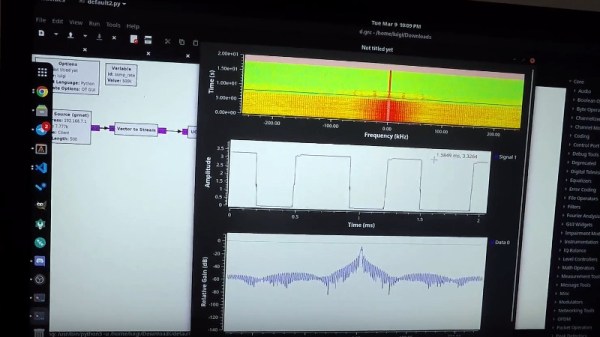
With the profusion of cheap RTL-SDR devices and the ever-reducing prices of more capable SDRs there might seem to be little place left for the low-bandwidth devices we’d have been happy with a decade or more ago, but there’s still plenty to be learned from something so simple. It’s something [Luigi Cruz] shows us with a simple SDR using the analogue-to-digital capabilities of the Raspberry Pi Pico, and since it works with GNU Radio we think it’s rather a neat project. CNX Software have the full story, and and quickly reveal that with its 500k samples per second bandwidth it’s not a machine that will set the SDR world on fire even when pushing Nyquist’s Law to the limit.

So with the exception of time signals and a few Long Wave broadcast stations if you live somewhere that still has them, you’ll need a fliter and receive converter to pull in anything of much use radio-wise with this SDR. But a baseband SDR with a couple of hundred kHz useful bandwidth and easy hackability through GNU Radio for the trifling cost of a Raspberry Pi Pico has to be worth a second look. You can see it in action in the video below the break, and if you’re at a loss for what to do with it take a look at Michael Ossmann and Kate Temkin’s 2019 Superconference talk.

Continue reading “The Raspberry Pi Pico As An SDR Receiver”

Raspberry Pi Pico ADC Characterized

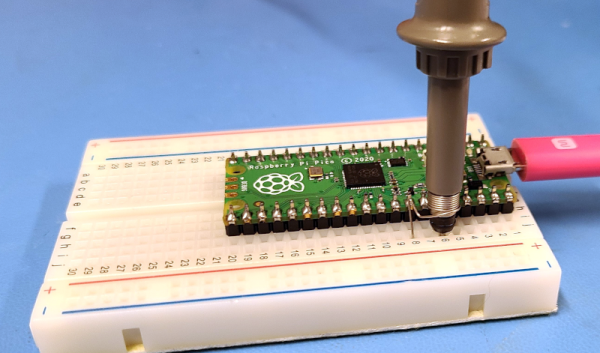
[Markomo] didn’t find much useful information about the Raspberry Pi PIco’s analog to digital converter, so he decided to do some tests to characterize it. Lucky for us, he documented the findings and shared them. The results are in a series of blog posts that cover power supply noise, input-referred noise, signal to noise ratio, and distortions.

There are some surprising results. For example, the Pico’s low noise regulator mode appears to produce more noise than having it set for normal operation. There also appears to be a large spike in nonlinearity around certain measurements.

Continue reading “Raspberry Pi Pico ADC Characterized”

PlayStation Unlocked With New Software Hack

The original PlayStation might be pushing 30 years old now, but that doesn’t mean hackers have given up on chipping away at it. A new exploit released by [Marcos Del Sol Vives] allows users to run copied games on all but the earliest hardware revisions of this classic console, and all you need to trigger it is a copy of Tony Hawk’s Pro Skater 2.

Aptly named tonyhax, this exploit uses a classic buffer overflow found in the “Create Skater” mode in Tony Hawk 2, 3, and 4. When the game sees a custom character saved on the memory card it will automatically load the name field to show it on the screen, but it turns out the developers didn’t think to check the length of the name before loading it. Thanks to this oversight, a long and carefully crafted name can be used to load an executable payload into the console’s memory.

The name contains the memory address of the payload.

That payload could be anything, such as a homebrew game, but in this case [Marcos] went all in and developed a simple tool that unlocks the console’s optical drive so it will play games burned to CD-Rs. Once the tonyhax exploit has been loaded, you simply swap the authentic Tony Hawk disc for whatever burned title you want to play. So far every game tested has worked, even those that span across multiple discs.

[Marcos] is providing not only the save files ready to load on your PlayStation memory card (either through a PC tool, or with the help of a hacked PS2), as well as the complete source code for tonyhax. This opens the door to the exploit being used to load other tools, emulators, and indie games, but as the PlayStation homebrew scene is relatively limited when compared to newer consoles, the demand might be limited.

Compared to the traditional physical modifications used to play copied games on the PlayStation, this new software approach is far more accessible. Expect to see memory cards with this exploit preinstalled hit your favorite import site in the very near future.

Continue reading “PlayStation Unlocked With New Software Hack”

Resilient AI Drone Packs It All In Under 250 Grams

When it was first announced that limits would be placed on recreational RC aircraft heavier than 250 grams, many assumed the new rules meant an end to home built quadcopters. But manufacturers rose to the challenge, and started developing incredibly small and lightweight versions of their hardware. Today, building and flying ultra-lightweight quadcopters with first person view (FPV) cameras has become a dedicated hobby onto itself.

But as impressive as those featherweight flyers might be, the CogniFly Project is really pushing what we thought was possible in this weight class. Designed as a platform for experimenting with artificially intelligent drones, this open source quadcopter is packing a Raspberry Pi Zero and Google’s AIY Vision Kit so it can perform computationally complex tasks such as image recognition while airborne. In case any of those experiments take an unexpected turn, it’s also been enclosed in a unique flexible frame that makes it exceptionally resilient to crash damage. As you can see in the video after the break, even after flying directly into a wall, the CogniFly can continue on its way as if nothing ever happened.

Continue reading “Resilient AI Drone Packs It All In Under 250 Grams”

Guitar Effects With No (Unwanted) Delay

MIDI has been a great tool for musicians and artists since its invention in the 1980s. It allows a standard way to interface musical instruments to computers for easy recording, editing, and production of music. It does have a few weaknesses though, namely that without some specialized equipment the latency of the signals through the various connected devices can easily get too high to be useful in live performances. It’s not an impossible problem to surmount with the right equipment, as illustrated by [Philip Karlsson Gisslow].

The low-latency MIDI interface that he created is built around a Raspberry Pi Pico. It runs a custom library created by [Philip] called MiGiC which specifically built as a MIDI to Guitar interface. The entire setup consists of a preamp to boost the guitar’s signal up to 3.3V where it is then fed to the Pi. This is where the MIDI sampling is done. From there it sends the information to a PC which is able to play the sound back quickly with no noticeable delay.

[Philip] also had to do a lot of extra work to port the software to the Pi which lacks a lot of the features of its original intended hardware on a Mac or Windows machine, and the results are impressive, especially at the end of the video where he uses the interface to play a drum machine via his guitar. And, while MIDI is certainly a powerful application for a guitarist, we have also seen the Pi put to other uses in this musical realm as well.

Continue reading “Guitar Effects With No (Unwanted) Delay”