Samsung is causing much angst among its SmartThings customers by shutting down support for its original SmartThings home automation hub as of the end of June. These are network-connected home automation routers providing Zigbee and Z-Wave connectivity to your sensors and actuators. It’s not entirely unreasonable for manufacturers to replace aging hardware with new models. But in this case the original hubs, otherwise fully functional and up to the task, have intentionally been bricked.
Users were offered a chance to upgrade to a newer version of the hub at a discount. But the hardware isn’t being made by Samsung anymore, after they redirected their SmartThings group to focus entirely on software. With this new dedication to software, you’d be forgiven for thinking the team implemented a seamless transition plan for its loyal user base — customers who supported and built up a thriving community since the young Colorado-based SmartThings company bootstrapped itself by a successful Kickstarter campaign in 2012. Instead, Samsung seems to leave many of those users in the lurch.
There is no upgrade path for switching to a new hub, meaning that the user has to manually reconnect each sensor in the house which often involves a cryptic sequence of button presses and flashing lights (the modern equivalent of setting the time on your VCR). Soon after you re-pair all your devices, you will discover that the level of software customization and tools that you’ve relied upon for home automation has, or is about to, disappear. They’ve replaced the original SmartThings app with a new in-house app, which by all accounts significantly dumbs down the features and isn’t being well-received by the community. Another very popular tool called Groovy IDE, which allowed users to add support for third-party devices and complex automation tasks, is about to be discontinued, as well.
Just a few weeks before Atlantis embarked on the final flight of the Space Shuttle program in 2011, a small Mexican company by the name of Squad quietly released Kerbal Space Program (KSP) onto an unsuspecting world. Until that point the company had only developed websites and multi-media installations. Kerbal wasn’t even an official company initiative, it started as a side project by one of their employees, Felipe Falanghe. The sandbox game allowed players to cobble together rockets from an inventory of modular components and attempt to put them into orbit around the planet Kerbin. It was immediately addictive.
There was no story to follow, or enemies to battle. The closest thing to a score counter was the altimeter that showed how far your craft was above the planet’s surface, and the only way to “win” was to put its little green occupant, the titular Kerbal, back on the ground in one piece. The game’s challenge came not from puzzles or scripted events, but from the game’s accurate (if slightly simplified) application of orbital mechanics and Newtonian dynamics. Building a rocket and getting it into orbit in KSP isn’t difficult because the developers baked some arbitrary limitations into their virtual world; the game is hard for the same reasons putting a rocket into orbit around the Earth is hard.
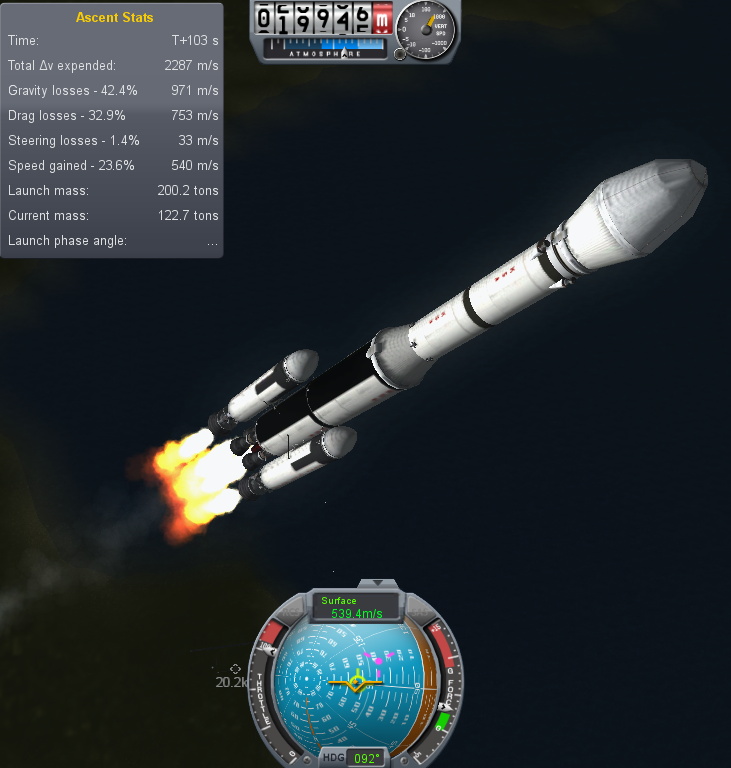
One of my early rockets, circa 2013.
Over the years official updates added new components for players to build with and planets to explore, and an incredible array of community developed add-ons and modifications expanded the scope of the game even further. KSP would go on to be played by millions, and seeing a valuable opportunity to connect with future engineers, both NASA and the ESA helped develop expansions for the game that allowed players to recreate their real-world vehicles and missions.
But now after a decade of continuous development, with ports to multiple operating systems and game consoles, Squad is bringing this chapter of the KSP adventure to a close. To celebrate the game’s 10th anniversary on June 24th, they released “On Final Approach”, the game’s last official update. Attention will now be focused on the game’s ambitious sequel, which will expand the basic formula with the addition of interstellar travel and planetary colonies, currently slated for release in 2022.
Of course, this isn’t the end. Millions of “classic” KSP players will still be slinging their Kerbals into Hohmann transfer orbits for years to come, and the talented community of mod developers will undoubtedly help keep the game fresh with unofficial updates. But the end of official support is a major turning point, and it seems a perfect time to reminisce on the impact this revolutionary game has had on the engineering and space communities.
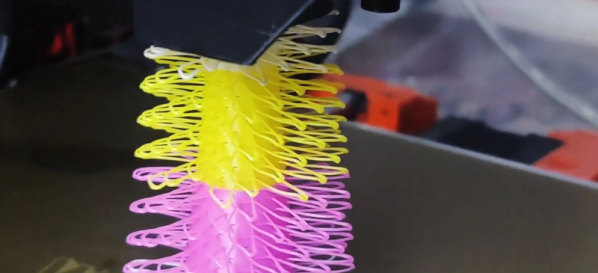
We all love 3D printing, but printing anything that has an overhang requires support, right? Maybe not. [Create Inc] has a video showing some 3D prints that seem to hang impossibly in the air — not bridges, but loops just floating in the air. You can see the effect in the video below.
The first part of the post covers gcode basics. Around the 5:30 mark, [Create] talks about his inspiration: FullControl Gcode Designer. You can do a lot with this tool and it inspired [Create’s] similar web-based version.
The point of these tools is to make it easier to create gcode directly instead of using a slicer. You can think of it as assembly language for 3D printing — you can do almost everything in the high-level language — 3D models — but if you want ultimate control you use assembly language, or, in this case, gcode.
The original tool uses Excel which didn’t visualize the output directly and could not provide proper error checking. The new tool solves those problems and is much easier to use.
[VK3YE] knows there are at least two things wrong with the cheap antennas you get with most SDR dongles. First, they are too short. You’d like to have enough to pull out a quarter wavelength on the longest frequency you want to operate. The second problem is there’s no real ground. He fixed both of these problems, as you can see in the video below.
The result might be called an ugly duckling rather than a rubber ducky. But it does seem to work. You could probably come up with something nicer to reseal the base, but the tape does work. A nice 3D printed housing would work, too, and might improve the appearance. We also thought about the goop you use on tool handles.
We actually have simply cut these antennas off and reused the cable and connector to hook up a better antenna. You might get more mileage out of that approach. On the other hand, the magnetic base and reasonably small form factor is pretty attractive.
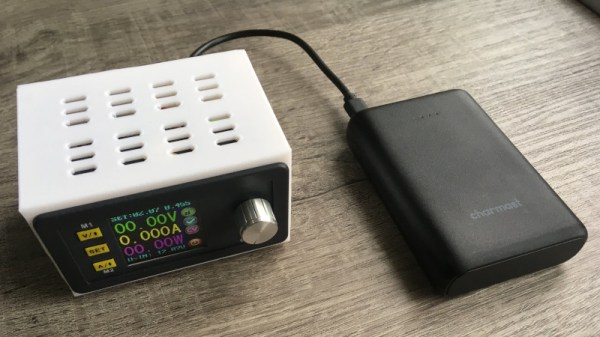
The build is a simple mashup, starting with a ZY12PDN USB Power Delivery board. This board talks to a USB-C supply that is compatible with the Power Delivery standard, and tells it to deliver a certain voltage and current output. This is then used to supply power to a pre-built power supply module that handles current limiting, variable voltage output, and all that fancy stuff. It even comes with a screen built-in! Simply slap the two together in a 3D printed case with a couple of banana plugs, and you’re almost done.
All you need then is a USB-C power supply – [Ricardo] uses a portable power bank which allows him to use the power supply on the go. It’s a great alternative to a traditional heavy bench supply, and more than enough for a lot of hobby uses.
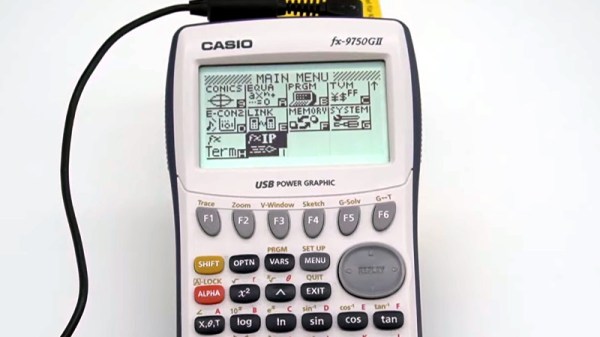
Over the years we’ve become used to seeing some impressive hacks of high-end calculator software and hardware, most often associated with the Z80-based models from Texas Instruments. But of course, TI are far from the only player in this arena. It’s nice for a change to see a Casio receiving some attention. The Casio fx series of graphical calculators can now communicate with the world, thanks to the work of [Manawyrm] in porting a TCP/IP stack to them.
As can be seen in the video below, lurking in the calculator’s menu system is an IRC client, there is also a terminal application and a webserver which you can even visit online (Please be aware that it’s only a calculator though, so an onslaught of Hackaday readers clicking the link may bring it down). The Casio doesn’t have a network interface of its own, so instead, it speaks SLIP over the serial port. In this endeavor, it uses a UART driver sourced from [TobleMiner].
It’s always good to see a neglected platform get some love, and also to note that this is an unusual outing for an SH4 CPU outside its most familiar home in the Sega Dreamcast. It’s a surprise then to read that the SH4 in a calculator of all products, is a custom version that lacks an FPU. This deficiency doesn’t mean it can’t be overclocked though, as this very old Hackaday article describes.
Tell the world that something is in short supply, and you can bet that people will start reacting to that news in the ways that make the most sense to them — remember the toilet paper shortage? It’s the same with the ongoing semiconductor pinch, except that since the item in short supply is (arguably) more valuable than toilet paper, the behavior and the risks people are willing to take around it are even more extreme. Sure, we’ve seen chip hoarding, and a marked rise in counterfeit chips. But we’d imagine that this is the first time we’ve seen chip smuggling quite like this. The smuggler was caught at the Hong Kong-Macao border with 256 Core i7 and i9 processors, valued at about $123,000, strapped to his legs and chest. It reminds us more of “Midnight Express”-style heroin smuggling, although we have to say we love the fact that this guy chose a power of 2 when strapping these babies on.
Speaking of big money, let’s say you’ve pulled off a few chip heists without getting caught, and have retired from the smuggling business. What is one to do with the ill-gotten gains? Apparently, there’s a big boom in artifacts from the early days of console gaming, so you might want to start spreading some money around there. But you’d better prepare to smuggle a lot of chips: last week, an unopened Legend of Zelda cartridge for the NES sold for $870,000 at auction. Not to be outdone, two days later someone actually paid $1.56 million for a Super Mario 64 cartridge, this time apparently still in the tamperproof container that displayed it on a shelf somewhere in 1996. Nostalgia can be an expensive drug.
And it’s not just video games that are commanding high prices these days. If you’ve got a spare quarter million or so, why not bid on this real Apollo Guidance Computer and DSKY? The AGC is a non-flown machine that was installed in LTA-8, the “lunar test article” version of the Landing Module (LM) that was used for vacuum testing. If the photos in the auction listing seem familiar, it’s with good reason: this is the same AGC that was restored to operating condition by Carl Claunch, Mike Stewart, Ken Shiriff, and Marc Verdiell. Sotheby’s estimates the value at $200,000 to $300,000; in a world of billionaire megalomaniacs with dreams of space empires, we wouldn’t be surprised if a working AGC went for much, much more than that.
Meanwhile, current day space exploration is going swimmingly. Just this week NASA got the Hubble Space Telescope back online, which is great news for astronomers. And on Mars, the Ingenuity helicopter just keeps on delivering during its “operations demonstration” mission. Originally just supposed to be a technology demonstration, Ingenuity has proven to be a useful companion to the Perseverance rover, scouting out locations of interest to explore or areas of hazard to avoid. On the helicopter’s recent ninth flight, it scouted a dune field for the team, providing photographs that showed the area would be too dangerous for the rover to cross. The rover’s on-board navigation system isn’t great at seeing sand dunes, so Ingenuity’s images are a real boon to mission planners, not to mention geologists and astrobiologists, who are seeing promising areas of the ancient lakebed to explore.
And finally, most of us know all too well how audio feedback works, and all the occasions to avoid it. But what about video feedback? What happens when you point a camera that a screen displaying the image from the camera? Fractals are what happens, or at least something that looks a lot like fractals. Code Parade has been playing with what he calls “analog fractals”, which are generated just by video feedback and not by computational means. While he’d prefer to do this old school with analog video equipment, it easy enough to replicate on a computer; he even has a web page that lets you arrange a series of virtual monitors on your screen. Point a webcam at the screen, and you’re off on a fractal journey that constantly changes and shifts. Give it a try.