DIY Ergonomic Game Pad Lends A Hand

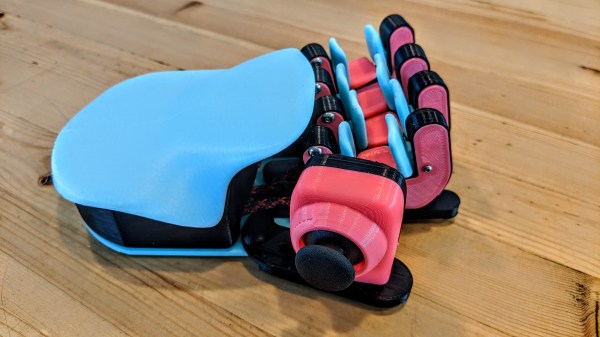
Does it seem like everyone you game against can do everything faster than you? Chances are good that they have some kind of dedicated game pad or macro pad with a bunch of custom shortcuts. If you can’t beat ’em, join ’em, but why buy one when you can build your own? [lordofthedum] did the smart thing when they built their own version of the Azeron game pad, which is an outrageously expensive but ergonomic and cool-looking macro pad that reminds us of the DataHand ergonomic keyboard.

Each finger hovers over a C-shaped group of three switches — one actuates by moving the finger forward, another by moving backward, and the third by pushing down like a regular button. The thumb gets a 4-way joystick. All of these inputs are wired up to an Arduino Pro Micro, which has sort of become the standard for DIY macro pads and keyboards. We think this looks fantastic, and really raises the bar for DIY macro pads.

Need a few more keys, but still want a thumb joystick? Check out the smooth and sweet Sherbet game pad.
Reforming 3D Prints With Salt And Heat

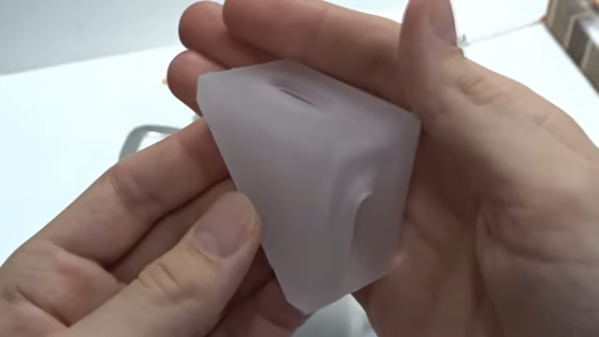
The biggest problem with fused deposition 3D prints is that while the layers should stick together, they aren’t the same as a solid piece of plastic you would get from, say, injection molding. You can anneal plastic using moderate heat, but it is likely to cause the part to deform or change size. [Free Spirit 1] has a solution for this. Using a powdered salt, the part is packed on the inside and out and put in an oven. The results in the video below look really impressive.

In addition to making the part look solid and — we assume — adding strength, the resulting prints are also water- and gas-tight which was the purpose of the effort. That alone would make the technique worthwhile.

The only thing we noticed is that the part has to have access to hold the salt. Anything not supported would be subject to deformation. However, the ground-up salt is so fine that it should be relatively easy to fill in most parts and, of course, print with 100% infill to avoid hollow internal areas.

[Free spirit 1] used a coffee grinder to get the salt powder, but apparently you can buy “flour salt.” We wondered if other powders might work well, too. Apparently, sand didn’t work out, perhaps because the salt dissolves out in water, so whatever you use, it should probably dissolve in something that won’t attack your plastic.

Annealing isn’t a new idea, and we’d love to see some objective tests on this new method.

Continue reading “Reforming 3D Prints With Salt And Heat”

In-vest-ing In Menopause

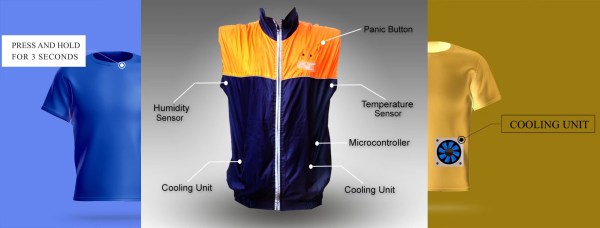
Most of us reach for an over-the-counter medicine if we have occasional pain, but menopause doesn’t act like that. Hot flashes don’t build like a headache, dizzy spells don’t wait for a good time, and panic attacks don’t announce themselves. Predicting and addressing sudden hormone shifts is the intent behind Menesto, a vest with sensors, cooling apparatus, and a companion app.

A thermometer and humidity detector monitor the skin for spikes in temperature and moisture to recognize when the wearer is having a hot flash. When an event is registered, a fan blows over a Peltier panel’s cool side and hopefully provides enough chilled air inside the vest. A Peltier panel is a thermoelectric heat engine that moves energy away from one ceramic plate to another, so one half gets cool while the other heats up. Power comes from rechargeable 18650 batteries and all the hardware talks to an ESP8266 on a NodeMCU running Arduino.

Continue reading “In-vest-ing In Menopause”

Community Testing Suggests Bias In Twitter’s Cropping Algorithm

With social media and online services are now huge parts of daily life to the point that our entire world is being shaped by algorithms. Arcane in their workings, they are responsible for the content we see and the adverts we’re shown. Just as importantly, they decide what is hidden from view as well.

Important: Much of this post discusses the performance of a live website algorithm. Some of the links in this post may not perform as reported if viewed at a later date. 

The initial Zoom problem that brought Twitter’s issues to light.

Recently, [Colin Madland] posted some screenshots of a Zoom meeting to Twitter, pointing out how Zoom’s background detection algorithm had improperly erased the head of a colleague with darker skin. In doing so, [Colin] noticed a strange effect — although the screenshot he submitted shows both of their faces, Twitter would always crop the image to show just his light-skinned face, no matter the image orientation. The Twitter community raced to explore the problem, and the fallout was swift.

Continue reading “Community Testing Suggests Bias In Twitter’s Cropping Algorithm”

How To Create Hermetically Sealed Electrical Connections

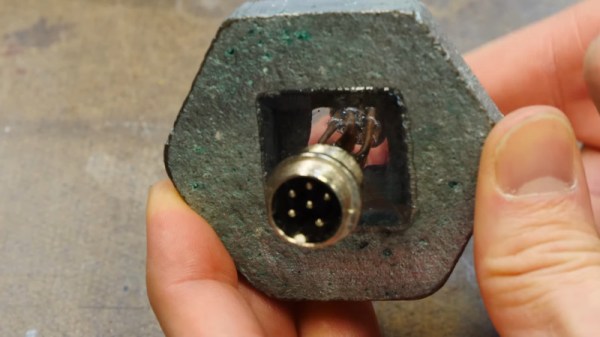
[Eric Strebel] is no stranger to pressure and vaccum tanks, regularly using them for all manner of resin casting jobs for his product design business. However, sometimes it becomes necessary to run equipment within a pressure tank, such as for rotomoulding or other similar jobs. In order to get power into a tank under pressure, [Eric] built a special plug with a hermetic seal to do the job. (Video, embedded below.)

The build starts with a large metal plug which screws into the pressure vessel, into which a square recess is machined. For the electrical passthrough, [Eric] selected GX-16 aviation connectors, in this case packing six conductors. The connectors are hooked up back-to-back through the hole in the metal tank plug, using bare copper wire. This is to avoid insulation on wires acting as a channel for gases to pass through. With the connectors wired up and an acrylic disc in place to stop overflow, the metal plug is filled with resin to create the hermetic seal.

Results are good, with the connectors functioning electrically and the resin acting as a perfect seal. There’s a small risk of short circuit with the exposed copper conductors, but [Eric] is exploring some easy solutions to avoid issues. We’ve seen his work before, too – like this great discussion on cardboard as a design tool. Video after the break.

Continue reading “How To Create Hermetically Sealed Electrical Connections”

Hard Disk Drives Have Made Precision Engineering Commonplace

Modern-day hard disk drives (HDDs) hold the interesting juxtaposition of being simultaneously the pinnacle of mass-produced, high-precision mechanical engineering, as well as the most scorned storage technology. Despite being called derogatory names such as ‘spinning rust’, most of these drives manage a lifetime of spinning ultra-smooth magnetic storage platters only nanometers removed from the recording and reading heads whose read arms are twitching around using actuators that manage to position the head precisely above the correct microscopic magnetic trace within milliseconds.

Despite decade after decade of more and more of these magnetic traces being crammed on a single square millimeter of these platters, and the simple read and write heads being replaced every few years by more and more complicated ones, hard drive reliability has gone up. The second quarter report from storage company Backblaze on their HDDs shows that the annual failure rate has gone significantly down compared to last year.

The question is whether this means that HDDs stand to become only more reliable over time, and how upcoming technologies like MAMR and HAMR may affect these metrics over the coming decades.

Continue reading “Hard Disk Drives Have Made Precision Engineering Commonplace”

Teleconferencing Like It’s 1988: Connecting Vintage Hardware To Zoom

Hang up your car phone and toss that fax machine in the garbage. Even back in the late 80s it was possible to do away with these primitive technologies in favor of video conferencing, even though this technology didn’t catch on en masse until recently. In fact, Mitsubishi released a piece of video conferencing equipment called the VisiTel that can be put to use today, provided you can do a bit of work to get it to play along nicely with modern technology.

[Alex] was lucky enough to have one of these on hand, as soon as it was powered up he was able to get to work deciphering the messaging protocol of the device. To do this he showed the camera certain pictures with known properties and measured the output waveforms coming from the device, which were AM modulated over an RJ9 connection which he had changed to a 3.5 mm headphone jack.

It communicates in a series of pictures instead of sending an actual video signal, so [Alex] had a lot of work to do to properly encode and decode the stream. He goes into incredible detail on his project page about this process and is worth a read for anyone interested in signal processing. Ultimately, [Alex] was able to patch this classic piece of technology into a Zoom call and the picture quality is excellent when viewed through the lens of $399 80s technology.

We have been seeing a lot of other hacks around video conferencing in the past six months as well, such as physical mute buttons and a mirror that improves eye contact through the webcam.